
P-STM: Bridging the Gap Between Location Privacy and Social Intelligence
P-STM: Privacy-protected social tie mining of individual trajectories
This paper introduces P-STM (Privacy-protected Social Tie Mining), a framework designed to infer social connections from individual spatiotemporal trajectories while ensuring Differential Privacy (DP). By leveraging a novel indicative dense region (IDR) mining approach and HMM-based calibration, it achieves SOTA utility in social tie discovery from sanitized, heterogeneous mobility data.
Executive Summary
TL;DR: P-STM is a dual-purpose framework that sanitizes spatiotemporal trajectories using Differential Privacy (DP) while maintaining enough utility to "mine" social ties (acquaintanceships) between users. It solves the problem of data heterogeneity and privacy leakage by calibrating raw movements against a set of "Indicative Dense Regions" (IDRs).
Background Positioning: This work represents a significant shift from "point-wise" noise injection to "model-based" calibration. It targets the tension between Business Intelligence (understanding social graphs) and User Privacy (hiding exact locations).
The Core Conflict: Heterogeneity vs. Privacy
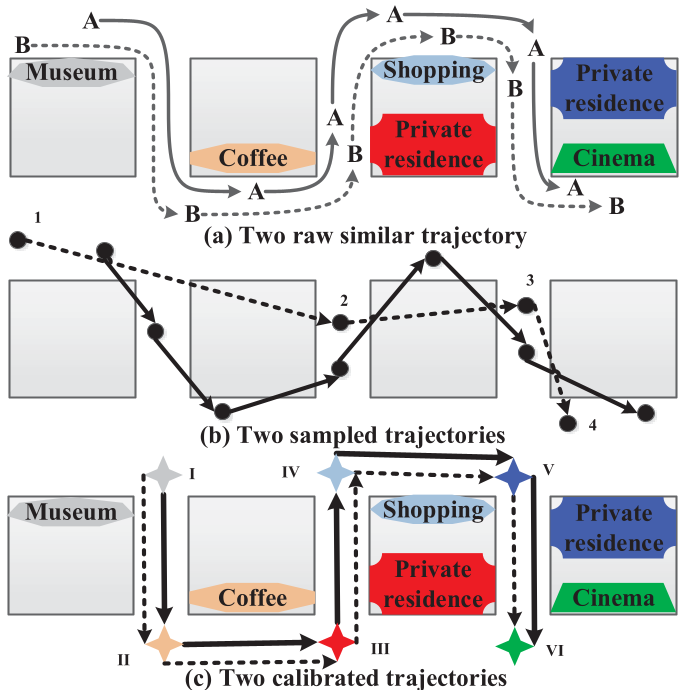
Mining social ties from trajectories relies on measuring movement similarity. However, two users following the exact same path might produce vastly different datasets if one device samples every 10 seconds and the other only at check-ins (Heterogeneity). Simply adding Laplace noise to these points to protect privacy usually makes the data so "jittery" that any social correlation is lost.
Methodology: The P-STM Architecture
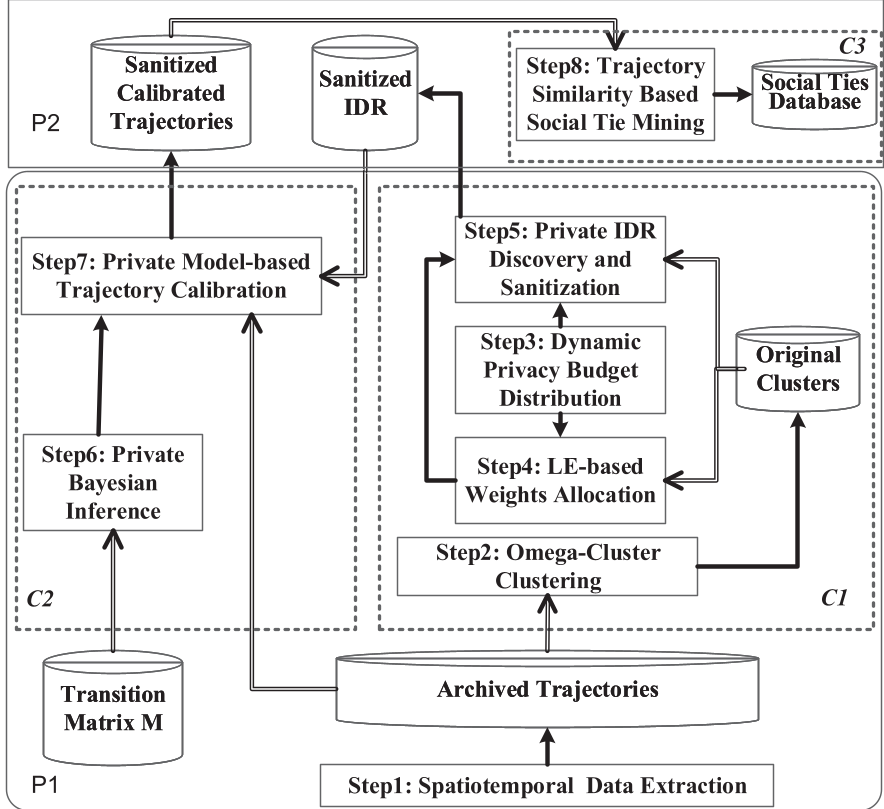
The authors break the solution into three logical phases:
1. LE-based IDR Mining (C-1)
Instead of treating every GPS coordinate as equal, the system identifies "Indicative Dense Regions" (IDRs)—areas where users actually spend time. They use Location Entropy (LE) to weight these regions.
- Innovation: To save the privacy budget, they only spend high noise-reduction effort on "worthwhile" regions (those likely to indicate social behavior), using an Adaptive Privacy Budget Distribution.
2. Private Model-based Calibration (C-2)
This is the "secret sauce." Instead of moving a point to a noisy point , P-STM views the trajectory as a sequence of hidden states.
- The HMM Approach: Using a transition matrix , the system calculates the most likely IDR a user was visiting, even if the raw data is sparse or noisy.
- Bayesian Inference: It uses the probability to align the messy raw data to a clean, sanitized set of landmarks.
3. Social Tie Discovery (C-3)
Once trajectories are "calibrated" to the same set of landmarks, calculating similarity becomes a robust task. They use segment-based IDR pair extraction, where similarity is a function of both physical distance and the "weight" (importance) of the region.
Experimental Validation
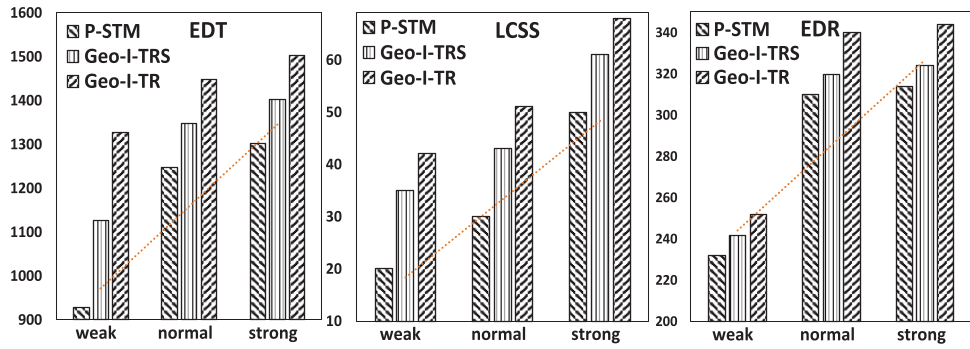
The authors tested P-STM on 6.7 million geo-tagged tweets from Melbourne. The results were compelling:
- Clustering Accuracy: Their "-Cluster" approach outperformed DBSCAN by 18-24% in F-measure, proving that DP-aware clustering is superior for social tasks.
- Utility Retention: Under "Strong" privacy settings (), P-STM maintained significantly higher LCSS (Longest Common Subsequence) scores than traditional spatial perturbation methods.
Critical Insight & Conclusion
Takeaway: The brilliance of P-STM lies in its realization that we don't need exact GPS points to find friends; we need the semantic intent of the movement. By snapping points to sanitized "landmarks" (IDRs), the framework filters out sampling noise and privacy noise simultaneously.
Limitations: The model assumes a pre-existing transition matrix . In highly dynamic urban environments where new "hotspots" appear weekly, the static IDR set might require frequent, privacy-draining updates.
Future Outlook: This methodology paves the way for "Privacy-by-Design" in LBSNs (Location-Based Social Networks), where raw data is never released, only its "calibrated" semantic representation.