
The Social Network Paradox: Why Your Privacy Depends on Your Friends' Investments
Making Privacy Protection Investment Decisions in Social Networks: An Interdependent Security Game Approach
The paper introduces an Interdependent Security Game approach to optimize privacy protection investments in Online Social Networks (OSNs). By leveraging a linear influence model and Nash equilibrium, it determines the optimal degree of privacy settings for users while accounting for positive externalities from neighbors, achieving a convergence error (MAE) as low as in experimental datasets.
TL;DR
Privacy in social networks isn't just about what you do; it’s about what your friends do. This paper proposes a game-theoretic framework to calculate the optimal privacy investment for users. By modeling social connections as an "Influence Matrix," the researchers show that users can avoid over-investing in security while still maintaining high protection, provided they account for the "free-riding" benefits gained from their neighbors' settings.
Background Positioning
In the landscape of cybersecurity research, this work sits at the intersection of Behavioral Economics and Network Science. While most tools assume privacy is a binary choice (on/off), this paper treats it as a continuous investment problem, positioning itself as a refinement of SOTA interdependent security (IDS) models by transitioning from discrete to continuous strategy spaces.
The Problem: The "Interdependence" Trap
Why is it so hard to get privacy right on platforms like WeChat or Facebook?
- Positive Externalities: When your friend sets their profile to "Private," it indirectly protects your shared interactions.
- Resource Waste: If you and your friends both spend maximum effort on the same granular privacy settings, you are likely over-investing (diminishing returns).
- The Information Gap: Most users are "limited rational"—they don't know the global network topology, making it impossible to calculate a perfect strategy in one go.
Methodology: The Core Mechanism
The approach follows a three-stage pipeline to bridge the gap between social connections and mathematical optimization.
1. The Influence Matrix ()
The authors define influence based on the Jaccard-like similarity of friend circles. If you and User B share many common friends, your privacy investments are highly coupled.
2. The Game Formulation
Each player (user) seeks to maximize a payoff function: Where is the benefit (convex function) and is the cost of setting up privacy (e.g., time/effort).
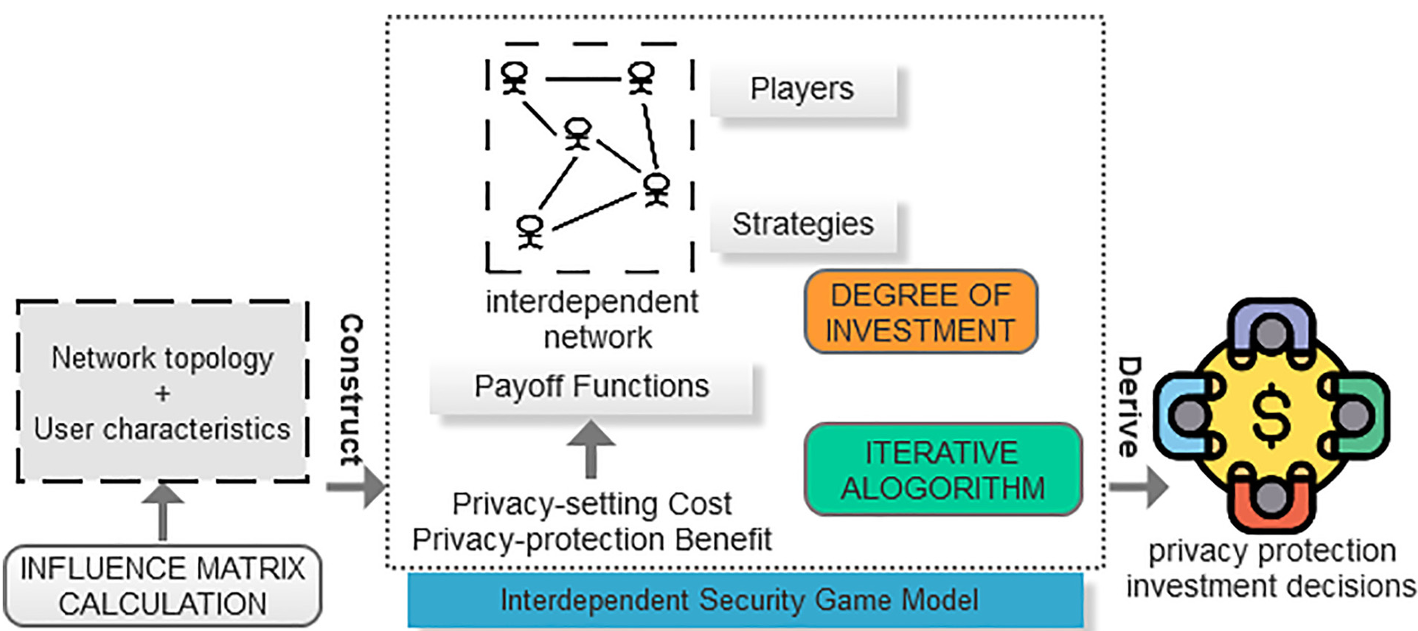 Figure 1: The framework showing the transition from network topology to Nash equilibrium.
3. Iterative Solving
Since real users can't solve complex matrix equations, the authors propose an Iterative Method. Users observe their payoff in "subgames" and adjust their strategies. The paper proves that as long as the influence matrix is "strictly diagonally dominant" (meaning you care about your own investment more than any single friend's), the system will always converge to a unique Nash Equilibrium.
Experiments & Results
The researchers tested their model on real-world data from the Stanford Large Network Dataset Collection (SNAP).
- Convergence: Across Ego-Facebook and Wiki-vote datasets, the algorithm converged rapidly.
- The "Degree" Insight: A fascinating result from the Ego-Facebook experiment (Fig 5) shows that as a user's "degree" (number of friends) increases, their required personal investment actually decreases and eventually plateaus.
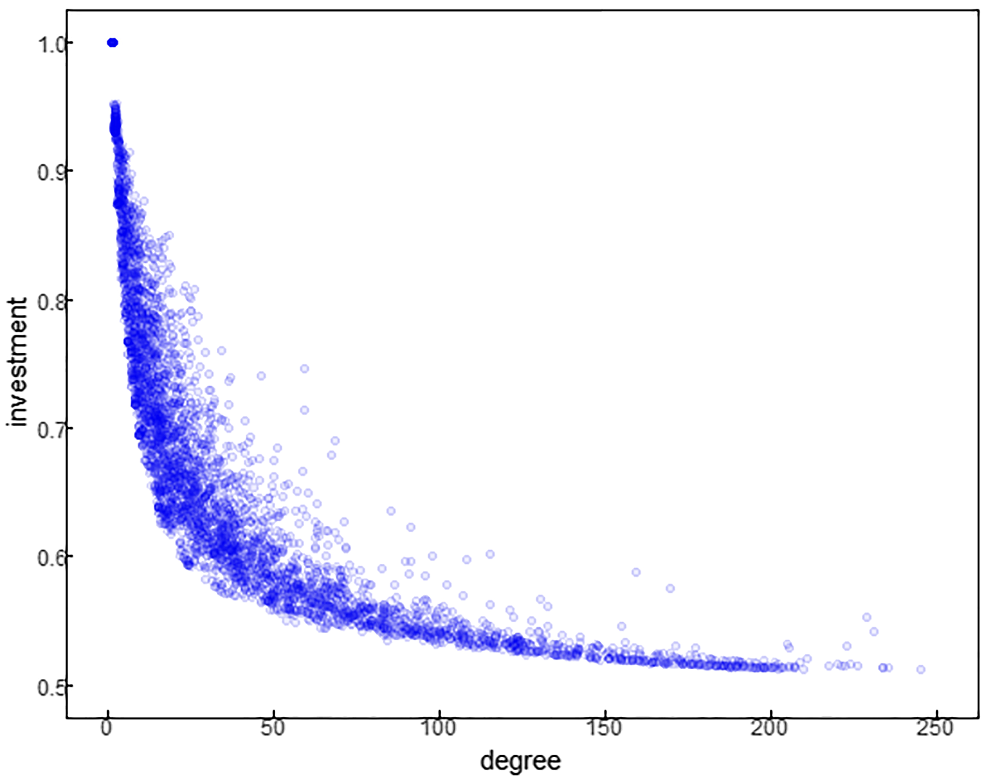 Figure 2: Optimal investment vs. Number of friends. Note the downward trend as neighbors provide more "free" protection.
Critical Analysis & Conclusion
Takeaway
This paper provides a rigorous mathematical foundation for collaborative privacy. It proves that in a closely connected group (like a lab or a family), the collective security is high even if individuals don't max out their settings—as long as their investments are strategically balanced.
Limitations
- Symmetry Assumption: The model assumes "positive externalities" only. In reality, some friends might be "malicious" or "leaky," creating negative externalities that this model doesn't yet account for.
- Complete Information: The theoretical proof assumes players know the benefit functions of others, though the iterative method partially mitigates this.
Future Outlook
The logical next move for this research is to apply it to Multi-Project Privacy. How do users allocate a limited "attention budget" across Facebook, Twitter, and LinkedIn simultaneously? This work sets the stage for smarter, automated privacy assistants that could one day manage these investments for us.