
Unmasking the Void: Why Randomizing Edges is Not Enough for Social Network Privacy
On link privacy in randomizing social networks
This paper investigates link privacy in social networks, specifically testing the effectiveness of edge-based randomization (adding/deleting edges). It introduces a framework to quantify how topological proximity measures (e.g., Common Neighbors, Katz) allow attackers to breach anonymity and achieves high prediction accuracy (Precision > 0.8) on sensitive links even in perturbed graphs.
TL;DR
Think deleting a few connections and adding some fake ones is enough to hide a sensitive relationship in a social network? Think again. This paper demonstrates that topological proximity acts as a structural signature that survives randomization. The authors prove that attackers can use simple similarity metrics to identify original links with over 80% precision, even in heavily perturbed graphs.
The "Anonymity" Illusion
Most social network anonymization techniques operate on a simple premise: if we remove names (node identifiers) or shuffle edges (randomization), the identities and relationships remain hidden.
However, the authors point out a critical flaw in prior work: structural correlation. In real-world networks, friends of friends are likely to be friends. This "homophily" or structural clustering remains visible even after moving edges around. If an attacker sees two nodes with many common neighbors in a randomized graph, they can guess with high confidence that a real link exists between them, regardless of the noise injected.
Methodology: Exploiting Structural Signatures
The paper shifts the focus from "how many edges were changed" to "what can an attacker infer from the remaining structure."
1. The Similarity Measures
The researchers utilize four core metrics to test their hypothesis:
- Common Neighbors (CN): The simplest count of shared friends.
- Adamic/Adar (Ad): Refines CN by giving more weight to shared neighbors who have fewer connections (rare connections are more informative).
- Katz Index: Sums paths of all lengths between nodes, exponentially damping longer paths.
- Commute Time (CT): Based on random walks; nodes that are "closer" in the graph have smaller commute times.
2. The Enhanced Posterior Belief
The core of the paper is a mathematical framework that calculates the probability of an edge existing in the original graph given the randomized evidence .

The authors use Maximum Likelihood Estimation (MLE) to estimate the proportion of true edges in its neighborhood of similarity values. This allows an attacker to rank every pair of nodes by their "likelihood of being a true link."
Experimental Proof: Precise De-anonymization
The authors tested their attack on several real-world datasets, including the Enron email network and political blogs.
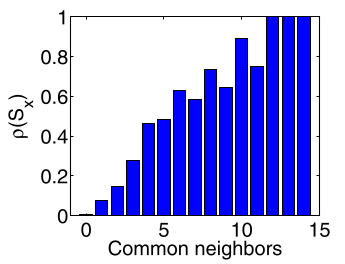 Figure 1: Showing how true edge probability correlates directly with similarity measures in original vs randomized data.
The results are striking. As shown in the precision-recall curves below, the "Enhanced Posterior Belief" (the red and colored lines) consistently stays above the baseline (the flat lines representing traditional methods).
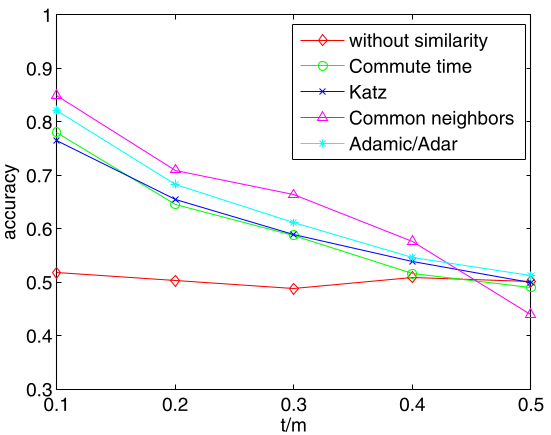 Figure 2: Precision across different datasets (Enron, Polbooks, etc.). Note that even with high perturbation (k=0.5m), top-tier predictions remain incredibly accurate.
Critical Analysis & Takeaways
The brilliance of this work lies in its objective look at link privacy as a probabilistic inference problem rather than a simple data-shuffling task.
- The SOTA Gap: Traditional randomization preserves "Global" properties (like spectrum) but fails to mask "Local" properties (neighborhood similarity).
- The Minimum Perturbation Theorem: The authors provide a formula (Result 4) to calculate exactly how many edges must be changed to guarantee a certain level of privacy. Crucially, they show that to truly protect a graph, the required (perturbation) might be so high that the graph loses its utility entirely.
- Limitation: The current model assumes the attacker knows the randomization parameters (). While this follows Kerckhoffs's principle (security should not rely on obscurity), it represents a worst-case scenario.
Conclusion
This paper serves as a warning for data owners: Structure is Identity. To protect social networks, we cannot merely add "noise"; we must fundamentally disrupt the topological signals that define our relationships. Future work must look toward techniques like Differential Privacy that provide rigorous mathematical bounds against such structural inference.