
Beyond the Rational Actor: Why We Sacrifice Privacy for a Discount
Privacy and Rationality in Individual Decision Making 26
This paper investigates the "privacy paradox" by analyzing how incomplete information, bounded rationality, and psychological deviations influence individual privacy decision-making. Through a theoretical critique and a survey of 119 individuals, it demonstrates that even privacy-concerned users frequently trade personal data for short-term benefits or fail to adopt protective technologies.
TL;DR
The "Privacy Paradox"—the gap between stating one cares about privacy and then giving away data for a free coffee—isn't just a sign of hypocrisy. This paper argues it is a result of bounded rationality and psychological biases. Even sophisticated users lack the information or cognitive energy to act optimally, often favoring immediate, certain rewards over distant, uncertain privacy risks.
Background: The Myth of the Rational Consumer
In classical economics, you are a "utility-maximizing Bayesian updater." You weigh the cost of sharing your email against the benefit of a discount and make a perfect choice. This paper, however, positions itself at the intersection of Behavioral Economics and Information Policy, arguing that this model is fundamentally broken when applied to the complex, opaque world of digital privacy.
The Three Barriers to Rational Privacy
The authors identify three core reasons why our privacy decisions fail:
- Incomplete Information: We don't know what we don't know. Information asymmetries mean companies know more about data usage than we do. Furthermore, we face "externalities"—when a friend shares their contact list, they share your data without your consent.
- Bounded Rationality: Even with all the facts, your brain is a limited processor. Individuals rely on simplified mental models. For example, many survey respondents believed that if a transaction is "secure" (encrypted), it is also "private" (not shared with third parties)—a dangerous conflation of distinct concepts.
- Psychological Deviations: Human biology is wired for the "now." Through hyperbolic discounting, we overvalue immediate gratification (a $1 discount) and drastically undervalue long-term costs (potential identity theft years later).
Methodology and Insights
The researchers surveyed a technologically savvy group at Carnegie Mellon University. By using k-means multivariate clustering, they identified four types of users: Privacy Fundamentalists, Online-Identity Concerned, Offline-Identity Concerned, and Privacy Unconcerned.
The Illusion of Anonymity
One of the most striking findings was the lack of awareness regarding data linkage.
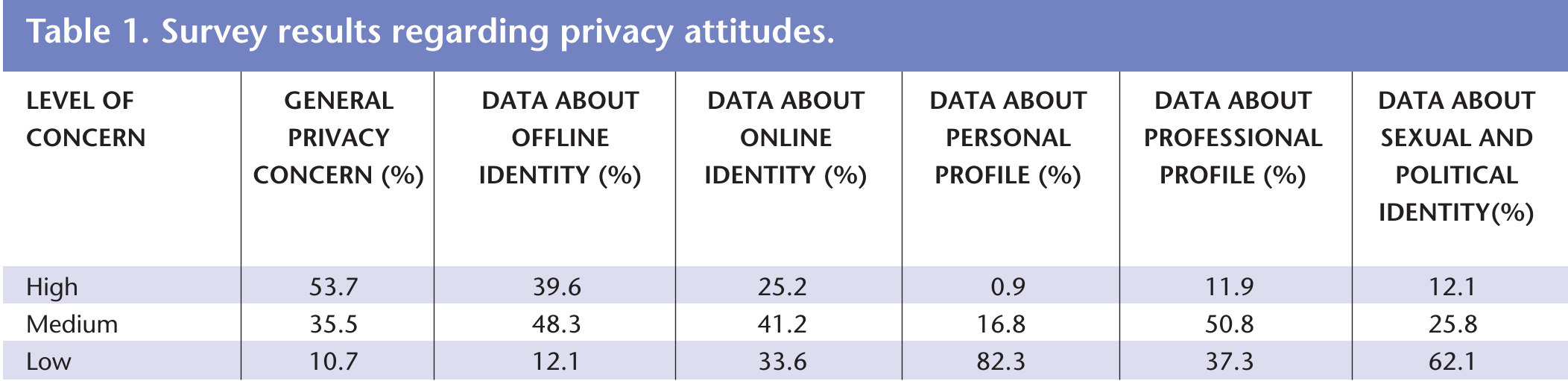 Table 1: Despite high general concern, users are significantly less worried about "personal profiles" until those profiles are linked to identifiers.
Furthermore, while Latanya Sweeney's research shows that 87% of Americans can be identified by just their zip code, birth date, and sex, over 68% of survey participants believed the probability of identification was under 50%. This "Optimism Bias" leads to a false sense of security.
The Beauty Contest: Testing Strategy
To prove that individuals struggle with complex strategic environments, the authors used the "Beauty Contest" game.
 The game requires players to guess 2/3 of an average number. A perfectly rational agent would choose 0, but only 10% of participants did. This demonstrates that in the "privacy game" against corporations, most individuals simply cannot think enough steps ahead to protect their interests.
Experiments & Results: The Pragmatism Gap
The results confirm a massive dichotomy:
- The Loyalty Card Trap: 87.5% of those "highly concerned" about sharing offline ID signed up for supermarket loyalty cards using their real names.
- The Technology Paradox: While 90% view privacy as "ownership," 62.5% of those who believe technology should protect privacy never use encryption.
- Time Inconsistency: 44% of respondents were found to be "time-inconsistent," explaining why they postpone the "immediate cost" of setting up privacy tools for the "immediate reward" of convenience.
Critical Analysis & Future Outlook
Takeaway
The core contribution of this work is the debunking of the "informed consent" model. Simply providing a longer privacy policy won't work because people are cognitively bound and psychologically biased.
Limitations
The study used a relatively small, highly educated sample (CMU students/affiliates). If this group—which is more tech-literate than average—fails to make rational choices, the implications for the general public are even more dire. However, the survey format relies on self-reporting, which can introduce its own biases.
Future Impact
This research suggests that Public Policy shouldn't just rely on "notice and choice." Instead, we need default protections and "Privacy by Design" that assume the user is tired, distracted, and prone to taking the path of least resistance.