
PSC Model: Why Your "Visibility" Matters as Much as Your "Sensitivity" in Social Media Privacy
Privacy Security Classification (PSC) Model for the Attributes of Social Network Users
This paper introduces the Privacy Security Classification (PSC) model, a novel framework designed to quantify and categorize the privacy risks of social network user attributes. By integrating attribute sensitivity with a multi-dimensional "visibility" metric, the model achieves a more granular risk assessment than traditional "one-size-fits-all" encryption methods.
TL;DR
The Privacy Security Classification (PSC) model represents a shift from static privacy protection to a dynamic, risk-aware framework. By quantifying not just what information is sensitive, but how "visible" it is across platforms like WeChat and Weibo, the model allows for a more efficient, graded approach to data security, preventing the waste of computational resources on non-critical data.
Background: The Failure of "One-Size-Fits-All"
As mobile internet usage skyrockets, the sheer volume of personal data—from phone numbers to "interests"—creates a massive resource challenge. Traditional security often treats all data with the same level of encryption. This "one-size-fits-all" approach is inefficient: it over-protects trivial data while potentially under-protecting high-risk clusters. The researchers argue that we need to rank information based on Privacy Risk, which is a function of its nature (Sensitivity) and its spread (Visibility).
Methodology: The Two Pillars of Risk
The core of the PSC model lies in a dual-metric approach, moving beyond simple binary "private vs. public" settings.
1. Attribute Sensitivity
Sensitivity reflects the inherent risk of an attribute. For example, a phone number is naturally more sensitive than a list of hobbies. The authors use a simplified version of Item Response Theory (IRT) to calculate a sensitivity value based on how many users choose to restrict a specific attribute at various levels.
2. Attribute Visibility
This is the paper’s most innovative contribution. Visibility isn't just about whether a profile is public; it’s a composite of four factors:
- Accessibility (): Who can see it (Friends vs. Public)?
- Extraction Difficulty (): Is the data structured (text) or unstructured (needing inference from a photo)?
- Reliability (): Does the same information appear across multiple platforms, confirming its accuracy?
- Privacy Attitude (): Does the user provide consistent or potentially "mendacious" (fake) data to confuse attackers?
 Note: The semi-suppressed Fuzzy C-Means clustering algorithm (shown above) is used to process these four dimensions into a final visibility score.
Experiments and Insights
The researchers tested the PSC model using real-world data from popular Chinese social networks (QQ, Weibo, WeChat).
Key Findings:
- High Sensitivity Attributes: Phone numbers (0.530), Current Town (0.434), and Address (0.423).
- Visibility Paradox: Some attributes like "Education" or "Job Details" have low inherent sensitivity but High Visibility because users frequently share them across multiple platforms to network, significantly raising their total privacy risk.
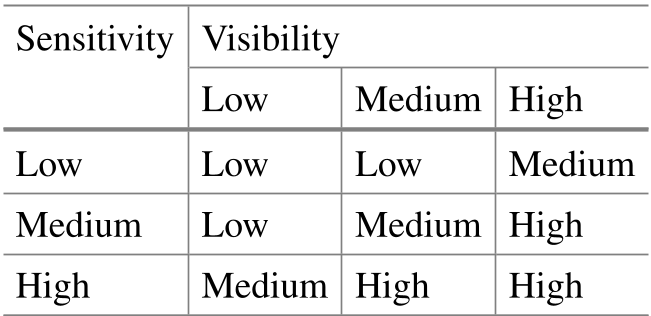 The table above illustrates the PSC logic: High-risk privacy is a state where either sensitivity or visibility is high, and the other is at least medium.
Critical Analysis & Conclusion
The PSC model provides a robust mathematical foundation for Graded Protection. By identifying which attributes are truly "High-Risk" (like Phone Number and Address) versus "Low-Risk" (like Interests), system architects can prioritize encryption resources where they matter most.
Takeaway: The real danger in social networks isn't just what you share once, but the "Reliability" and "Visibility" created when the same data points are linked across different platforms.
Limitations: The current study focuses primarily on text-based profile attributes. Future work will need to address the "consistency and rationality" of these classifications when applied to multi-modal content like AI-generated deepfakes or social graph connections.