
Behind the Screen: The Troubling Mismatch Between Privacy Perception and Reality in Social Networks
Privacy Settings in Online Social Networks -- Preferences, Perception, and Reality
This study investigates the discrepancy between Social Identity Management (SIdM) in physical versus digital environments by analyzing Facebook users' privacy settings. Using a novel Facebook-integrated questionnaire, the researchers identify a significant mismatch between perceived, preferred, and actual visibility settings for profile items and historical data.
TL;DR
Despite years of privacy discourse, a substantial gap remains between what you think people can see on your social media and what is actually public. This study by the University of Regensburg uses a unique Facebook-integrated tool to prove that users are frequently unaware of their "digital footprint" and lack the necessary controls to manage their social identities effectively over time.
The Friction of Digital Identity
In the "real world," privacy is intuitive. Conversations in a quiet cafe are naturally transient and bounded by the people physically present. However, Online Social Networks (OSNs) break these physical metaphors. Information on Facebook is persistent (it doesn't disappear), searchable, and often distributed to audiences the user never intended.
The researchers argue that Social Identity Management (SIdM)—the act of showing different versions of ourselves to different social circles—is fundamentally broken in digital spaces.
Methodology: A "Reality Check" Application
Unlike previous studies that asked general questions (e.g., "Are you concerned about privacy?"), this team built a Facebook app that pulled actual items from the users' walls and asked:
- Perception: "Who do you think can see this specific photo?"
- Preference: "Who should be able to see it?"
- Reality: The app checked the actual API data to see the true visibility setting.
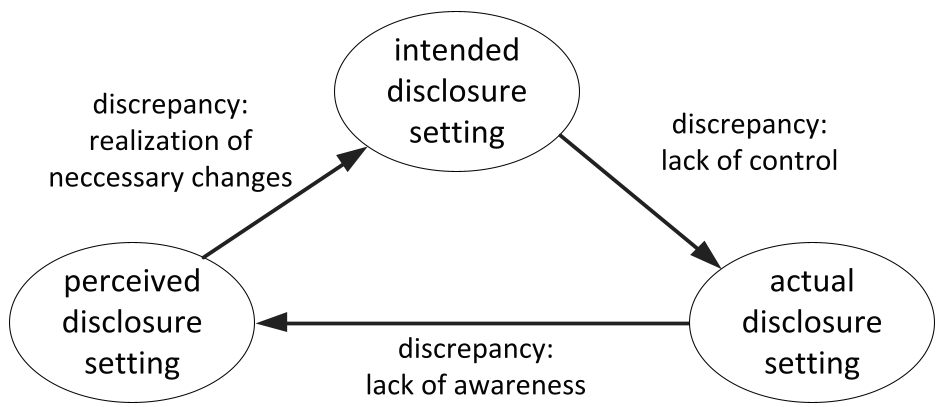 Figure 1: The framework used to decompose privacy failures into 'Lack of Awareness' and 'Lack of Control'.
Key Findings: The Awareness & Control Gap
1. The Default Trap
The study found that users overwhelmingly want more privacy than the platform defaults offer. Specifically, 85% of participants preferred default visibility settings that were more restrictive than Facebook’s "out-of-the-box" configurations. While users generally understood who could see their names, they were significantly confused about the visibility of more sensitive data like "Wall Posts" and "Likes."
2. The Danger of "Loose Acquaintances"
While users are quite accurate about what their "Close Friends" can see, their accuracy plummets when it comes to "Loose Acquaintances."
- False Negatives: Residents of the "outer circle" often have access to data the user thinks is hidden.
- Underestimation: nearly 45% of users underestimated how much of their content was visible to their broader network.
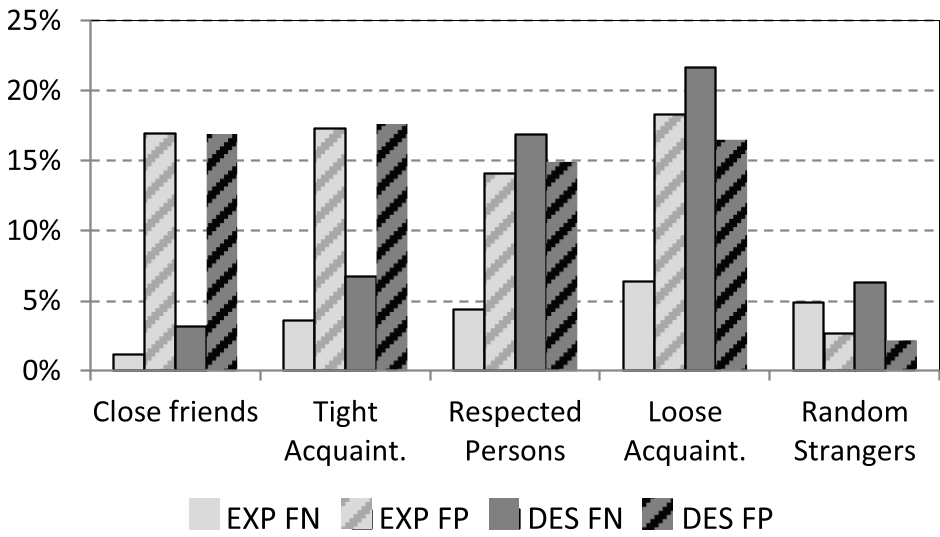 Figure 2: Statistical evidence showing that users struggle to accurately predict visibility as social tie strength decreases.
3. The "Ghost of Profiles Past"
Perhaps the most striking finding is the lack of awareness regarding historical data. When shown items from more than a year ago:
- 20% of users were surprised the items even existed or were still accessible.
- 37% of the items triggered a desire in the user to either delete them or severely restrict their visibility.
- This highlights the "transience gap"—modern OSNs force a permanence that contradicts the evolving nature of human personality.
Deep Insight: Is the "Privacy Paradox" Real?
The "Privacy Paradox" suggests that users say they care about privacy but act as if they don't. This paper offers a technical rebuttal: Users don't act recklessly; they act without adequate tools.
The mismatch isn't necessarily a lack of care; it's a Lack of Awareness (not knowing the setting) and a Lack of Control (the UI is too complex to fix the setting easily). If the "Actual" setting doesn't match the "Intended" setting, it's a failure of the platform's SIdM tools, not necessarily a personal failure of the user.
Conclusion and Future Outlook
The study concludes that OSN service providers have little incentive to improve default settings, leaving the burden on the user. The authors propose several paths forward:
- Context-Aware Sharing: Moving away from complex "privacy tables" toward interfaces that mimic social contexts (e.g., "Work" vs. "Family" spaces).
- Automated Assistants: Tools that help users audit their old posts and flag potentially sensitive information that has "lingered" too long.
- Education: Bridging the gap through better user awareness of how mediation changes the rules of social interaction.
As we move toward a more AI-integrated social web, the ability to manage our "Digital Identity Facets" will only become more critical. This paper serves as a quantitative reminder that our perceived digital safety is often just an illusion.