
The Cost of Connection: How "Lookahead" Destroys Link Privacy in Social Networks
Link privacy in social networks
This paper investigates link privacy in social networks, specifically how an attacker can reconstruct the global social graph by subverting (bribing) a small number of user accounts. The authors formalize the concept of "Lookahead" in social network interfaces and demonstrate that for common Lookahead values, a "Highest-Degree" bribing strategy can expose a significant fraction of the network's links with minimal effort.
Executive Summary
TL;DR: Social networks face a structural vulnerability where an attacker can reconstruct the entire global network by compromising a tiny fraction of user accounts. This paper proves that the "Lookahead"—how many levels of "friends of friends" you can see—is the critical factor. If a network allows you to see edges just 3 hops away, a few dozen subverted accounts are enough to map out hundreds of thousands of users.
Academic Positioning: This work shifts the focus from "Anonymized Data Release" to "Active Interface Exploitation." It provides a rigorous theoretical and experimental framework to evaluate the inherent privacy-utility trade-off in social network APIs like LinkedIn or Facebook.
The Core Intuition: The "Lookahead" Danger
Most social networks operate on a "Need-to-Know" basis. You can see your friends (Lookahead 0), and perhaps the friends of your friends (Lookahead 1). On platforms like LinkedIn, this visibility is a feature, helping users discover "Second-degree" connections.
However, the authors identify a fatal flaw: Local visibility is a global liability. If an attacker can "bribe" or subvert a select group of users, they can stitch together these local "ego-graphs" into a master map. The efficacy of this attack depends on the network's Lookahead (L):
- L=0: You see only your direct edges.
- L=1: You see edges incident to your friends (LinkedIn's model).
- L=f: All edges incident to nodes within distance are visible.
Methodology: Strategic Bribing
The researchers compared four strategies for selecting which accounts to "bribe" (subvert):
- Highest-Degree: Target the "Influencers" or "Hubs" with the most connections.
- Greedy: Choose the next user who reveals the most previously unknown edges.
- Crawler: A "blind" version of Greedy that only explores based on what it currently sees.
- Random: Purely stochastic selection.
Model Architecture and Strategy Comparison
The paper leverages a Power Law Graph model, which reflects real-world social dynamics where a few nodes have massive connectivity.
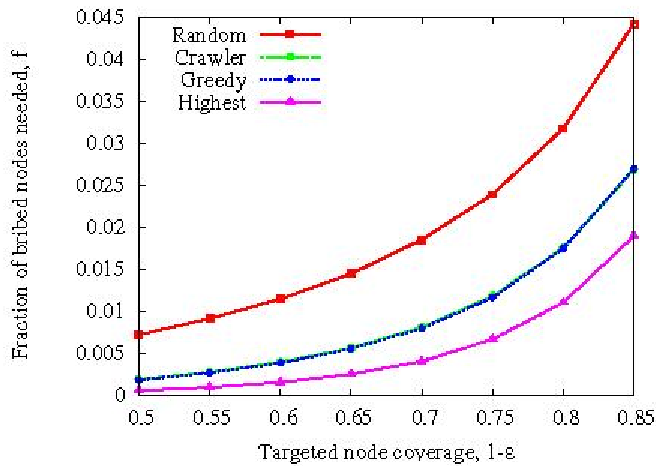 Fig. 1: In a Lookahead 2 scenario, the Highest-Degree strategy (top line) significantly outperforms Random selection, showing that targeting hubs is the most efficient way to "unmask" the network.
Experimental Results: The Exponential Collapse of Privacy
The most striking finding is how quickly privacy collapses as Lookahead increases. Using a dataset of 572,949 LiveJournal users, the authors demonstrated a terrifying scaling law.
- At Lookahead 1: The attack is difficult; you need to subvert a linear fraction of the population.
- At Lookahead 2: Higher sophistication makes the attack feasible.
- At Lookahead 3: The network is effectively public.
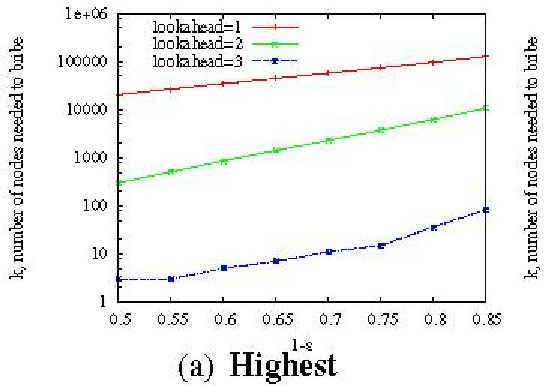 Fig. 2: The y-axis (number of nodes to bribe) is on a log scale. Notice the linear drop, representing an exponential increase in attacker efficiency as Lookahead increases from 1 to 3.
To put this in perspective: to cover 80% of the LiveJournal graph, an attacker needs 6,308 accounts at Lookahead 2. This drops to just 36 accounts at Lookahead 3. In a world of botnets and phishing, compromising 36 accounts is a trivial task.
Theoretical Insights
The authors back their experiments with heavy-duty graph theory. They prove that in power-law graphs (where the number of neighbors follows ):
- For , an attacker using the Highest-Degree strategy only needs to bribe roughly the square of the nodes compared to a Random strategy to get the same results.
- This "Hub-dominance" is what makes social networks so fragile; the very people who make the network valuable (the influencers) are the greatest structural weaknesses for privacy.
Critical Analysis & Conclusion
Takeaways
This paper serves as a stark warning to platform architects: Convenience is the enemy of privacy. Providing "Lookahead 2" or higher functions (like "See how you are connected to user X") provides attackers with the surgical tools needed to map the entire social landscape.
Limitations
- Static Assumptions: The model assumes the graph doesn't change during the attack.
- Uniform Bribing Cost: In reality, subverting a "High-Degree" user (e.g., a celebrity) might be much harder or more expensive than subverting a random user.
- Detection: Real networks have rate-limiting and anomaly detection that might flag a single account "looking" at thousands of edges.
Future Outlook
As we move toward decentralized social networks (Web3) where graph data might be even more exposed on-chain, the "Lookahead" principles established here will be crucial for designing next-generation privacy protocols. Designers should focus on Lookahead-limiting and Differential Privacy for degree queries to prevent "Highest-Degree" targeting.