
Social Identity Management: Bridging the Gap Between Perception and Reality in SNS Privacy
Privacy in Social Networks: Existing Challenges and Proposals for Solutions
The paper presents a comprehensive research framework for Social Network Site (SNS) privacy, introducing a conceptualization that bifurcates the issue into "Awareness" and "Control." It details several SOTA-inspired tools—including the Access Policy Grid and Friend Inspector—which address user discrepancies in privacy settings through visualization and gamification.
TL;DR
Social Network Sites (SNSs) have fundamentally changed how we communicate, but they've also created a massive mismatch between how we think we are sharing data and who can actually see it. This paper argues that privacy shouldn't just be a technical "on/off" switch. Instead, it introduces Social Identity Management—a framework that uses visual role mining, trust-based access control, and gamified education to align our digital visibility with our real-world social boundaries.
The Problem: The "Privacy Perception" Gap
Research shows that we are living in a state of "Privacy Illusion." In an empirical study of Facebook users, the authors found that a staggering 64% of participants wanted more restrictive settings than they actually had.
Why is this happening?
- Complexity: Privacy settings are modeled after technical Access Control Lists (ACLs), which are unintuitive for non-technical users.
- The "Flat List" Fallacy: SNSs treat your boss, your mother, and your high school acquaintance as the same entity: a "Friend."
- Lack of Awareness: Users consistently underestimate the default visibility of their items, leading to "Social Role" collisions (e.g., your boss seeing a party photo meant for close friends).
Methodology: Awareness and Control
The authors propose a dual-layered approach to fix the SNS privacy crisis.
1. Improving Awareness through Visualization
To help users grasp their "digital footprint," the authors developed the Access Policy Grid (APG). Instead of buried menus, the APG uses a matrix-based visualization combined with a role-mining algorithm.
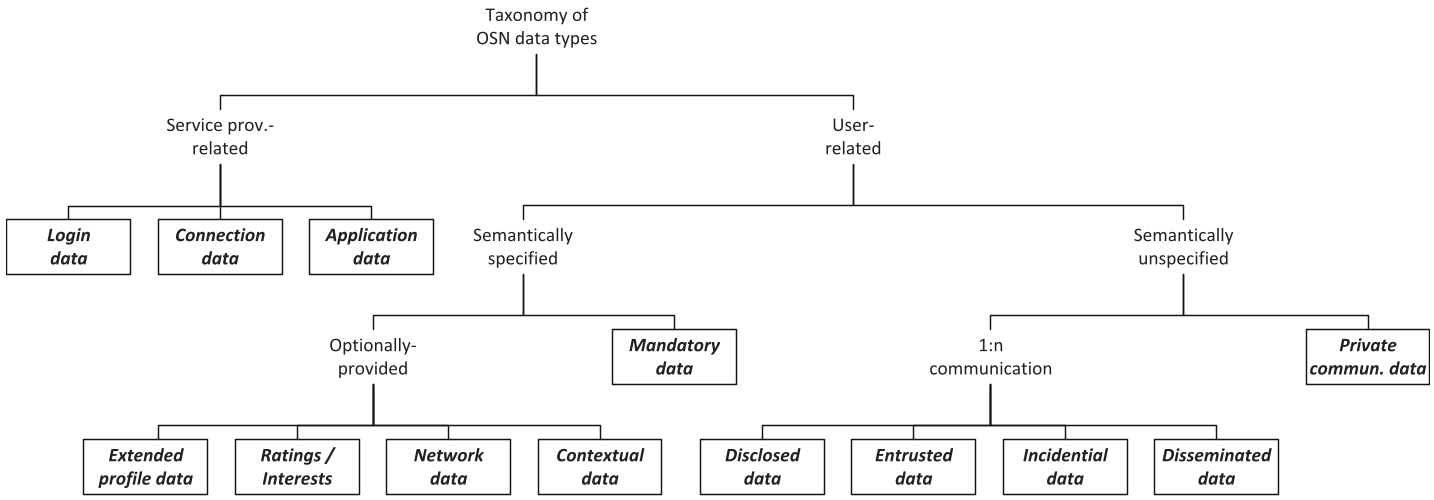
By clustering contacts with similar access rights, the system can visually highlight "Outliers"—contacts who have access they shouldn't have, or missing privileges that break a social role.
2. Improving Control through Context-Aware Models
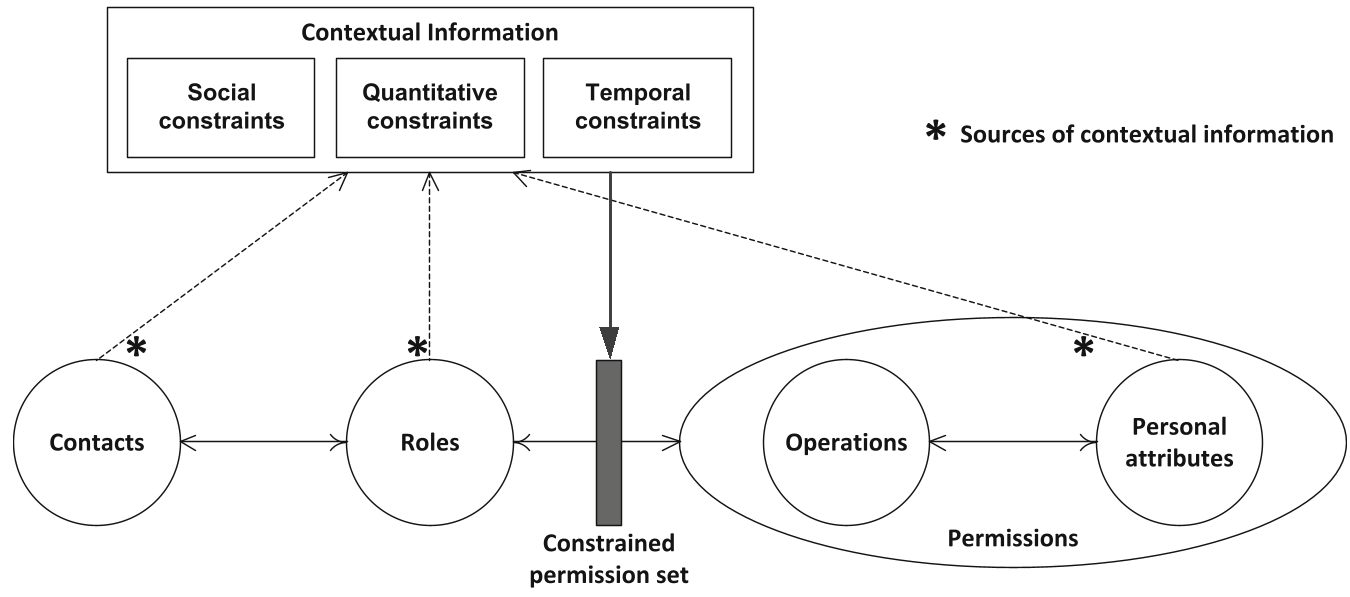
The authors move beyond the static "Role-Based Access Control" (RBAC) to a Context-Aware Model. This introduces the "Trust" variable. Instead of just "Is person X a friend?", the system asks: "Does the trust level of person X meet the threshold for this specific photo at this specific time?"
Experiments and Results
The study highlights how current systems fail:
- Mismatch in Visibility: 17.9% of visibility perceptions were flat-out wrong.
- Audience Segregation: The authors successfully demonstrated a clustering algorithm that discovers "Social Spheres" automatically by analyzing mutual friend relationships. This allows the system to suggest, "Hey, these 20 people look like your coworkers; should we put them in a 'Work' group?"
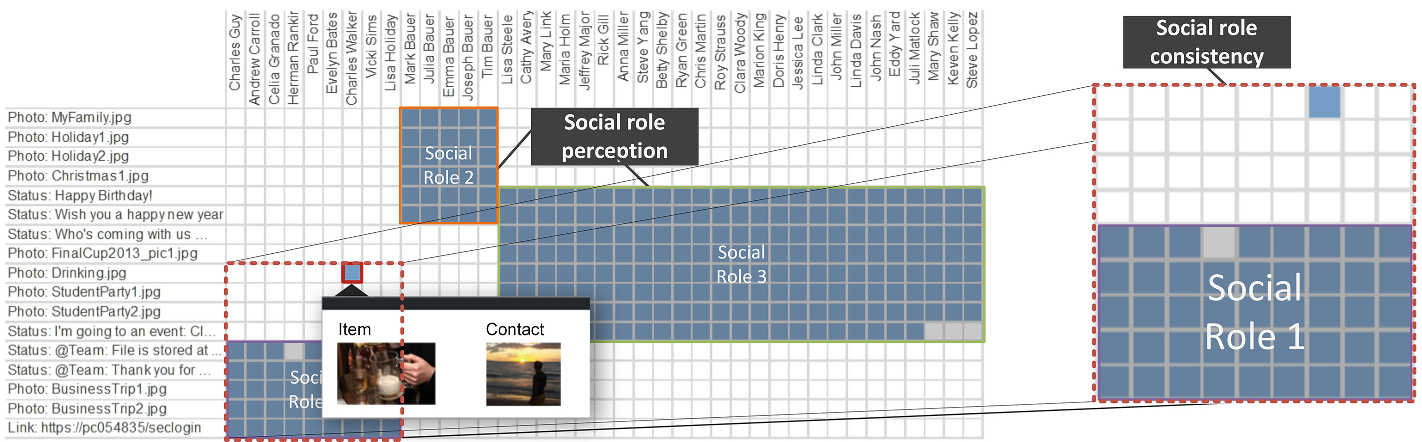 In the figure above, the APG identifies an inconsistency where 'Charles Walker' is the only member of a social role who can see a specific photo, signaling a potential privacy leak.
Critical Insight & Conclusion
The core takeaway is that Privacy is a Social Problem, not a technical one. We cannot expect users to manage complex permission matrices manually. The future of SNS privacy lies in Assisted Identity Management:
- Automation: Using clustering to group contacts into real-world social spheres.
- Gamification: Using tools like "Friend Inspector" to teach privacy habits through experience rather than manuals.
- Abstraction: Moving the user's focus from "who has access" to "what social role am I projecting here?"
While the paper focuses heavily on Facebook (the giant of the era), the principles of Provider-Independent Identity Management are more relevant than ever in our age of fragmented platforms (Twitter, Threads, LinkedIn, Mastodon). The real challenge remains: will SNS providers ever want to make data more private when their business models rely on exposure?