
Privacy-Triggered Communications: Balancing Social Connectivity with Location Anonymity
Privacy-triggered communications in pervasive social networks
The paper introduces "Privacy-Triggered Communications," a framework for Pervasive Social Networks (PSNs) that dynamically regulates peer-to-peer data sharing based on real-time context. It utilizes a middleware "privacy-wrapper" that triggers message broadcasting only when user-defined or system-calculated anonymity thresholds (such as k-anonymity) are met.
TL;DR
In the era of Always-On mobile connectivity, Pervasive Social Networks (PSNs) allow us to share information directly with nearby peers. However, this convenience leaks location and identity data to any eavesdropper with a radio. This paper introduces a Privacy-Wrapper—a middleware that acts as a "firewall for context." It ensures your device only speaks when you are "hidden in the crowd," using sophisticated Markov Decision Processes (MDP) to balance your need to communicate with your need for anonymity.
Problem & Motivation: The Danger of "Static" Privacy
Most current privacy tools are binary: they are either ON or OFF. However, human privacy needs are context-dependent. You might be comfortable sharing your music taste at a public concert but highly protective of your movements near a clinic or a political protest.
Traditional methods like pseudonym changes (swapping MAC addresses) fail because an adversary can still track you by observing the timing and location of your messages—a process known as "linking." The researchers recognized that for PSNs to succeed, privacy must be dynamic and triggered by the environment.
Methodology: The Privacy-Wrapper
The authors propose a middleware architecture that sits between social applications (like chat or file sharing) and the wireless hardware.
1. The Measurement Loop
The system continuously calculates a privacy score using k-anonymity.
- Logic: If there are other users around you within a "confusion distance," an eavesdropper cannot certain which one is sending the packet.
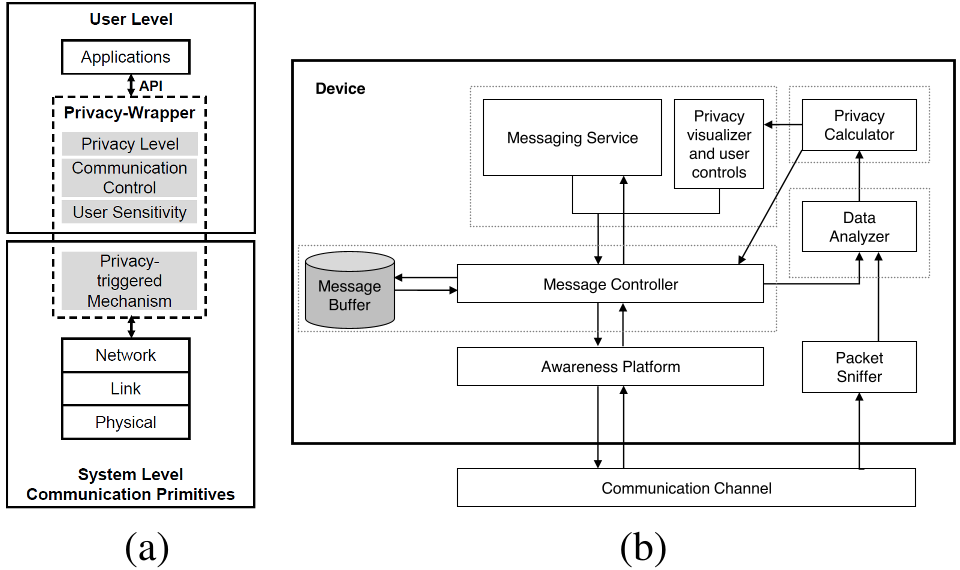 Figure 1: (a) The conceptual view of the privacy-wrapper; (b) The specific software architecture implemented on Nokia N810 devices.
2. Decision Mechanisms: Threshold vs. Probabilistic
- Threshold-based: A simple "If/Then" logic. "Do not send this message unless I have at least 6 neighbors." If the condition isn't met, the message sits in a buffer.
- MDP-based (Probabilistic): This is the "brain" of the system. Since privacy changes stochastically as people move, the authors frame the decision of when to send as a Markov Decision Process.
Using the Bellman Equation, the device calculates an optimal policy : This formula essentially evaluates the "Reward" (utility of the message) against the "Risk" (loss of anonymity), looking ahead to future states to decide if it's better to wait for a more crowded area.
Experiments & Results: The Price of Privacy
The team simulated 100 users in a 1km x 1km urban environment. Their findings confirm a classic trade-off in distributed systems: Privacy vs. Quality of Service (QoS).
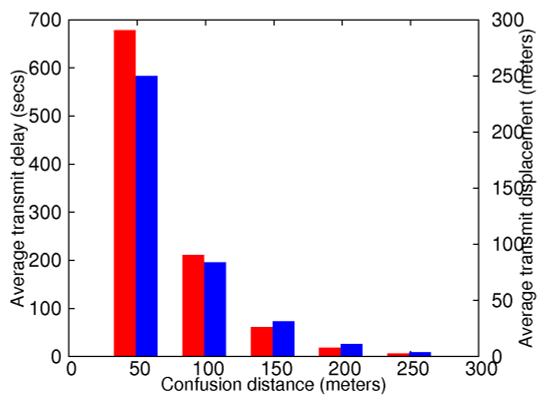 Figure 2: Simulation results showing (a) Application UI on Nokia N810 and (b) The correlation between neighbor density and communication delay.
Key Findings:
- Manageable Latency: In a typical urban setting, achieving a safe anonymity level resulted in an average delay of 3 minutes. For non-urgent social updates, this is highly acceptable.
- The POI Effect: Points of Interest (POIs) act as natural "mix zones." Communication becomes "bursty" as devices wait to reach crowded areas before dumping their message buffers.
- Side Effects: This burstiness can lead to local network congestion, showing that privacy-preserving behavior actually changes network traffic patterns.
Critical Insight & Future Outlook
The most profound takeaway is the authors' "Password Strength" analogy. By providing users with a Privacy Visualizer, they shift the burden from complex encryption to intuitive "contextual awareness."
However, the system has limitations:
- Buffer Bloat: If a user stays in a low-density area (e.g., a quiet park), their messages may never be sent, leading to "starvation."
- Adversarial Crowds: If the "" neighbors are actually a "sybil attack" (fake identities controlled by the attacker), the privacy calculation fails.
Moving forward, integrating this with State Space Models (SSM) or more advanced Reinforcement Learning could allow the "Privacy-Wrapper" to learn a user's specific habits, further refining the balance between being social and staying invisible.
Conclusion
Privacy-Triggered Communications prove that anonymity in the mobile age isn't about hiding forever—it's about choosing the right moment to speak. By leveraging local density as a shield, we can enjoy pervasive networking without sacrificing our movements to the digital void.