
Unmasking the Social Link: Privacy Vulnerability in MSN Routing
Privacy Vulnerability Analysis on Routing in Mobile Social Networks
This paper introduces a Privacy Attack Tree model specifically designed to analyze vulnerabilities in social-aware routing algorithms within Mobile Social Networks (MSNs). By systematically mapping potential attack vectors, the authors quantify the risk of privacy disclosure regarding node identity, location, and social relationships.
TL;DR
Mobile Social Networks (MSNs) rely on our social "fingerprints" to route data efficiently. However, this paper reveals a significant trade-off: those same social properties act as a roadmap for attackers. By proposing a formal Privacy Attack Tree, the authors quantify how easily an adversary can de-anonymize nodes and map relationships, providing a mathematical framework to evaluate MSN security.
The Hidden Cost of Social-Aware Routing
In the realm of Delay Tolerant Networks (DTNs), traditional routing often fails due to intermittent connectivity. The solution? Social-aware algorithms. By understanding that human movement is not random but governed by social ties, protocols like Bubble Rap and SimBet use "friendship" and "community" metrics to decide where a packet should go next.
The problem is that these metrics are inherently private. If a node is chosen as a relay because it is a "social hub," its role in the network effectively broadcasts its importance and identity. Prior work focused almost exclusively on delivery ratios and latency, ignoring the fact that routing behavior is a massive side-channel for privacy leaks.
Methodology: The Privacy Attack Tree
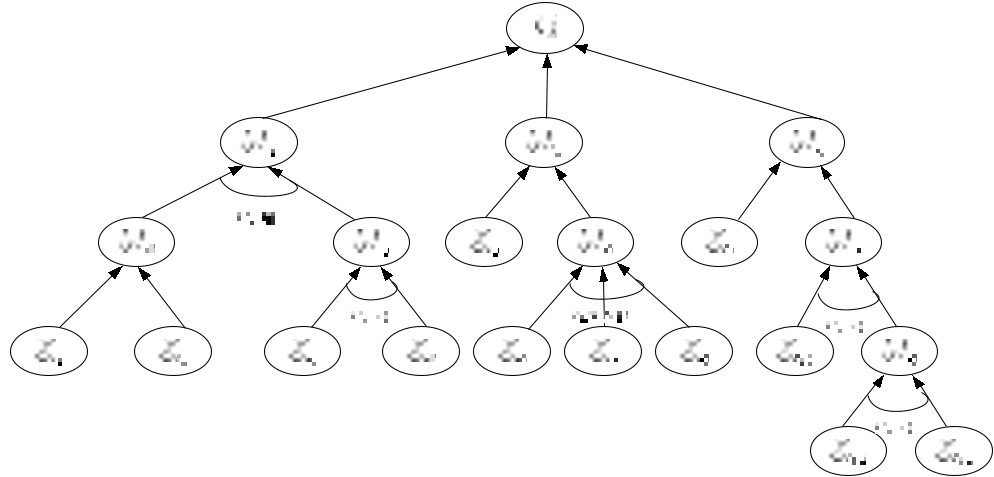
The authors treat privacy disclosure not as a single event, but as a hierarchical goal. They define a Privacy Attack Tree , where:
- G (Root): The ultimate goal (e.g., total privacy disclosure).
- M (Intermediate Nodes): Sub-goals like "Node identity disclosure" or "Social relationship mapping."
- X (Leaf Nodes): Concrete attack actions such as eavesdropping or background knowledge matching.
Quantifying the Threat
Not all attacks are created equal. The paper introduces a utility function to calculate the Occurrence Probability () of an attack: This formula balances Attack Cost (), Technical Difficulty (), and Success Probability ().
Experiments and Critical Findings
By applying this model to typical social routing scenarios, the authors identified several "Attack Sequences." The results are eye-opening:
- Direct Monitoring is King: Sequence 1 (Monitoring social behavior, ) has the highest occurrence probability (0.2917). This suggests that simply observing who a node interacts with frequently is the most cost-effective path for an attacker.
- The Background Knowledge Trap: Intercepting node identities () combined with background knowledge () is a highly potent combination for re-identification.
- Low-Tech Vulnerabilities: Complex attacks (like Sequence 5, involving global hotspots and specialized messages) have much lower probabilities (0.0059), meaning the biggest threats today are "low-tech" eavesdropping methods.

Critical Insight: Why This Matters
The core takeaway is that efficiency is the enemy of privacy in MSNs. The more "accurate" a routing decision is (by picking the perfect social relay), the more information that decision leaks about the network's social topology.
Limitations and The Road Ahead
While the model is robust, it relies on an "expert scoring method" for the initial leaf node attributes, which can be subjective. Additionally, the current model assumes a relatively static social structure.
Future research must focus on Differential Privacy in Routing, where "noise" is added to social metrics to protect individual identities without crippling the network's ability to deliver messages. This paper serves as the necessary diagnostic tool before we can prescribe the cure.
Conclusion
As we move toward a world of ubiquitous mobile computing, our devices carry more than just data—they carry our social identities. This research provides a vital framework for understanding how vulnerable those identities are in the very networks designed to keep us connected.