
The Privacy Wizard: Bridging the Gap Between Complex Policies and User Effort
15039_Privacy wizards for social networking sites.
The paper introduces a "Privacy Wizard" for social networking sites that uses Active Learning to automatically configure fine-grained privacy settings. By leveraging community structure as a primary feature, the wizard achieves high accuracy (90%+) with minimal user effort (labeling ~25 friends).
TL;DR
Specifying who can see your "Date of Birth" or "Photos" on social media shouldn't be a chore. This paper proposes a Privacy Wizard that uses Active Learning and the Community Structure of your social graph to predict your privacy preferences. With as few as 25 manual labels, the system can configure a user's entire network with over 90% accuracy.
The Problem: The High Cost of Manual Control
Most social networks offer fine-grained privacy controls, yet few users utilize them. Why? Because the interface cost is too high. If you have 200 friends, manually sorting each into "Work," "Family," or "Acquaintances" is a barrier to security. Previous studies have shown that users experience a "Privacy Paradox"—they care about privacy but are overwhelmed by the settings required to protect it.
Methodology: Let Machine Learning Do the Heavy Lifting
The authors propose a framework that treats privacy configuration as a Classification Problem. Instead of the user labeling everyone, the wizard picks the "most uncertain" friends—those that the model is least sure about—and asks the user for a simple "Allow" or "Deny."
1. Intuition: Communities are Key
The breakthrough insight is that privacy preferences aren't random; they follow social boundaries. If you trust one person in your "High School Friends" group, you likely trust the others in that same cluster.
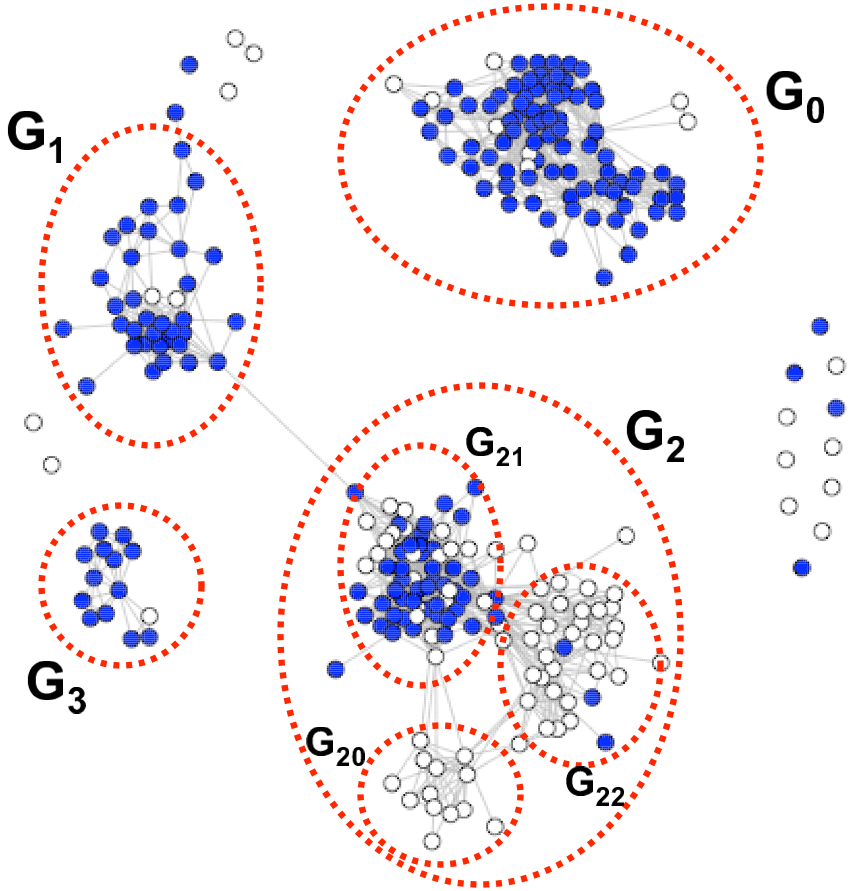 Figure 1: Notice how the "Allow" (shaded) and "Deny" (white) nodes naturally cluster within communities G20 and G22.
2. Active Learning via Uncertainty Sampling
The wizard doesn't pick friends at random. It uses Uncertainty Sampling to find friends at the decision boundary of the classifier. This ensures that every click the user makes provides the maximum amount of "information" to the model, allowing the classifier to converge much faster than random selection.
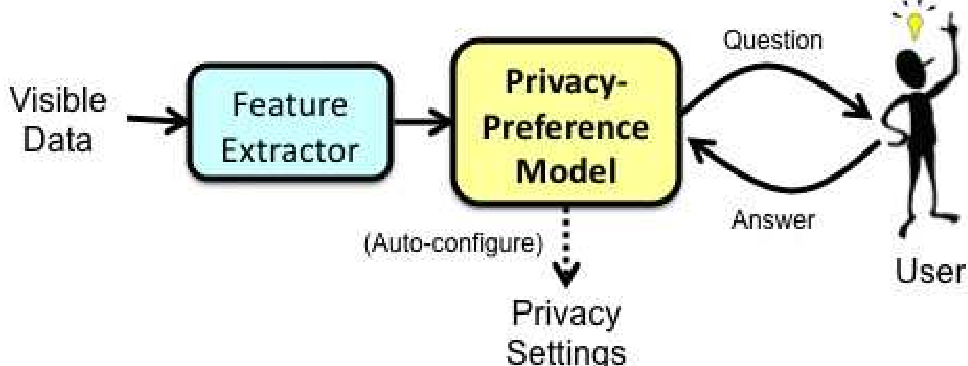 Figure 2: The workflow involves feature extraction (communities), user input labels, and a preference model (Decision Tree/Naive Bayes).
Experiments: Performance and Feature Importance
The study evaluated 45 real Facebook users. The results were categorized into static (one-time setup) and dynamic (adding new friends) scenarios.
- Total Accuracy: By labeling only 25 friends, the accuracy reached ~90%.
- Feature Efficacy: Community-based features were significantly more predictive than profile data like "Gender," "Political Views," or "Online Activities."
- Visualization: For power users, the system can generate a Decision Tree visualization, showing the logic behind the "Allow" or "Deny" decisions.
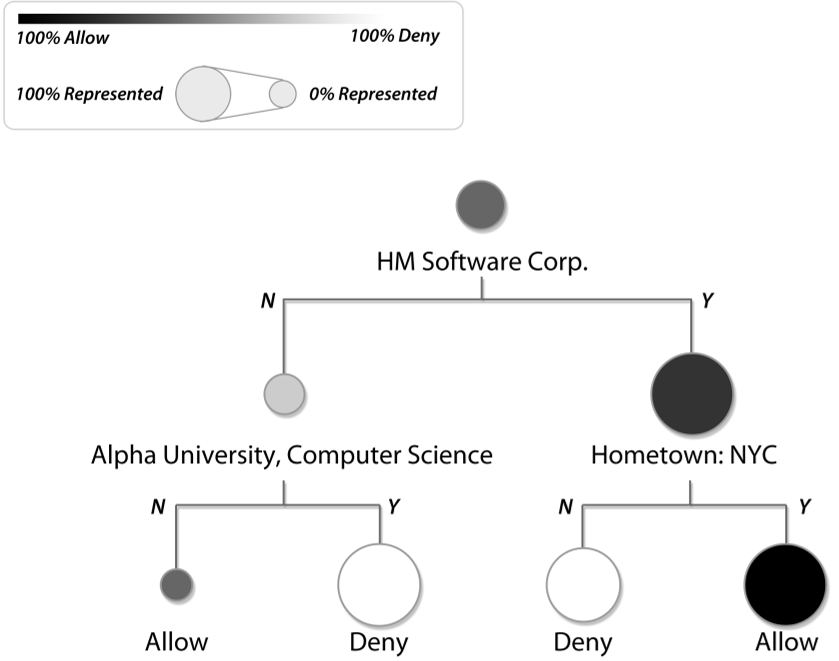 Figure 3: A human-readable model allowing users to audit why certain groups are granted access.
Final Insights & Limitations
This work demonstrates that social topology is the fundamental signal for privacy. Unlike profile attributes that may be missing or faked, your connections to others (communities) define your trust boundaries.
However, the work has its limitations. It assumes that "Allow" and "Deny" are sufficient, whereas some users might want "Limited Access." Additionally, as social networks evolve, the "context" of a community might change, requiring the model to be updated. Regardless, this paper serves as a blueprint for how platforms can use AI to empower users rather than confuse them.