
Beyond Random Noise: Leveraging Social Media for Private and Personalized Web Search
Providing useful and private Web search by means of social network profiling
The paper proposes a novel single-party privacy-preserving web search scheme that distorts user profiles by submitting synthetic "fake" queries. It introduces the use of social network data (specifically Twitter) to build accurate local user profiles, shifting away from traditional methods that rely on potentially noisy past search history.
TL;DR
Researchers have developed a more "intelligent" way to hide your search habits from Google or Bing. Instead of just spamming random words to confuse search engines, this system uses your Twitter (X) profile to create a realistic "mask" of interests. By blending your real queries into a stream of fake but semantically relevant queries based on your social persona, the system protects your sensitive "micro-interests" while ensuring the search engine still understands your general preferences.
Background: The Price of Personalization
Every time you search for a medical symptom or a niche financial product, your Web Search Engine (WSE) adds a brick to your digital wall—a profile that is incredibly valuable for ads but dangerous for privacy. Previous work attempted to solve this by injecting fake queries (noise). However, if the noise is too random, personalization breaks; if it's based on past searches, it often inherits the "noise" of circumstantial or accidental queries.
The Core Insight: Social Media as the "Ground Truth"
The authors argue that our social media posts (like Tweets) are a more consistent reflection of our true interests than our search queries. Search queries are often erratic, while social media interactions represent our deliberate "macro-interests."
Methodology: How the "Shrouding" Works
The system operates in a three-stage loop:
- Local Profiling: It analyzes your Tweets to build a Local Profile (LP) using Natural Language Processing (NLP) and the Open Directory Project (ODP).
- Public Profile Monitoring: It maintains a local copy of what the WSE likely thinks your profile looks like (the Public Profile or PP).
- Dynamic Distortion: Whenever you search for something, the system calculates which category in your Public Profile is "under-represented" compared to your true Social Profile. It then generates fake queries to fill that gap.
(Note: Refer to Section II-B of the paper for the specific algorithm of selecting categories based on the difference Δ between LP and PP).
Experimental Results: Quality over Quantity
The researchers tested their method against a "Naive Random" approach. They used real-world data: query logs from the infamous AOL leak and active Twitter profiles like @johnmaeda (Design/Arts) and @ReutersScience (Science).
The findings were striking:
- Efficiency: The proposed method with only one fake query () was more effective at aligning the profiles than the random method using eight fake queries ().
- Mathematical Precision: Using a distance metric , the study showed that the system rapidly converges the WSE's view of the user toward their actual general interests, effectively burying specific private queries (micro-interests) in a sea of plausible, macro-interest-aligned queries.
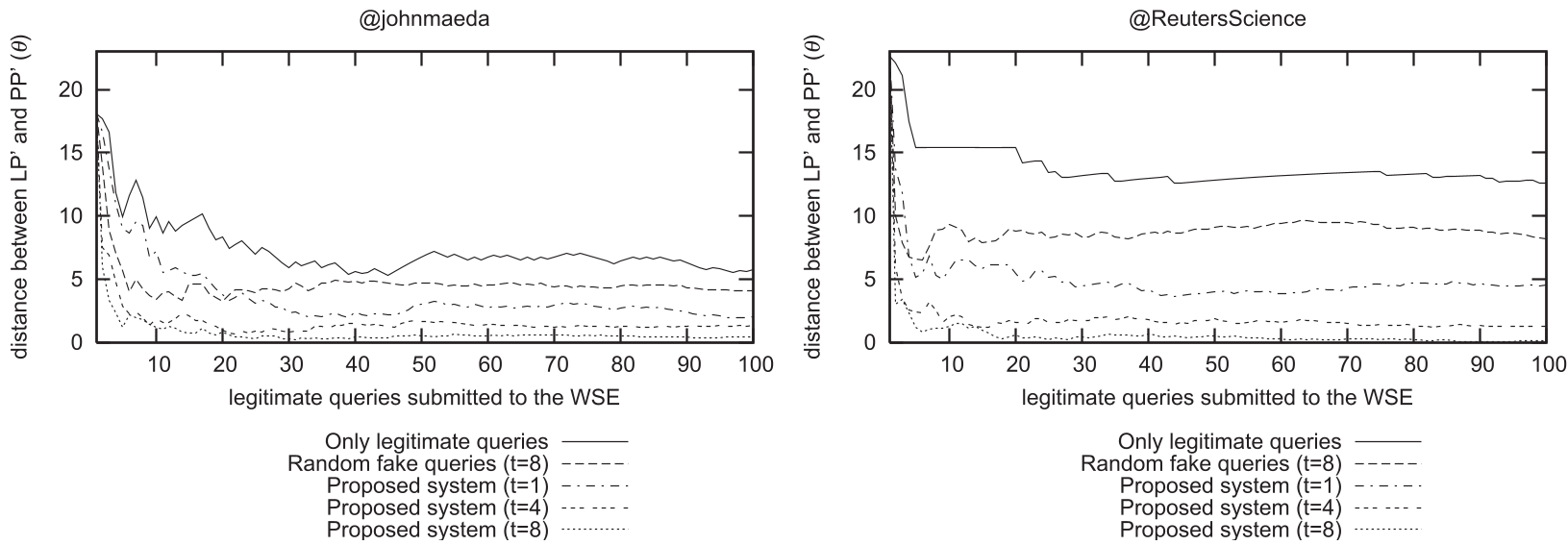 Fig 1: The proposed method (solid lines) consistently maintains a lower distance to the true user profile compared to random noise (dotted lines).
Critical Analysis & Conclusion
Takeaway
The genius of this approach lies in its semantic authenticity. By using social media to ground the "fake" queries, the noise becomes indistinguishable from the signal to an outside observer. This provides a rare "win-win": the user gets to keep personalized search features (because the WSE correctly identifies their major interests) while gaining a high degree of privacy for their specific, sensitive searches.
Limitations
- Platform Dependency: The system relies on the user having an active, public social media presence.
- Evolution of Content: In the era of 2024+ AI, simple Noun-Phrase extraction might be less effective than embedding-based semantic analysis.
- WSE Countermeasures: Modern WSEs might use behavioral analytics (hover time, click-through rate) to distinguish between a human-generated query and an automated "fake" query.
Future Outlook
As we move toward "Small Language Models" that can run locally on our devices, we could see this kind of social-context-aware privacy layer becoming a standard feature in browsers, ensuring that our data serves us, not just the advertisers.