
UWS Model: Predicting E-commerce Purchases via Emerging Local and Social Interests
A Probabilistic Model for Predicting E-commerce Purchases from Emerging Local and Social Interests
The paper proposes a probabilistic UWS model (User, Website, Social) to predict e-commerce purchases by treating them as "emerging processes." It integrates local behavior (ad clicks) and global social media trends (Twitter word surges) into a Bayesian framework to achieve state-of-the-art predictive precision.
TL;DR
Predicting when a user will hit the "Buy" button is the holy grail of e-commerce marketing. This paper moves beyond static profiles, treating purchase intent as an emerging process. By combining a user's sudden surge in ad clicks (Local Interest) with trending topics on Twitter (Social Interest), the authors' UWS Model achieves a 21% precision boost over standard baselines.
Background: Why "What You Click" Isn't Enough
Most recommendation systems look at what you like. However, purchase prediction needs to know when you are ready to buy. Previous models often missed the "cross-domain" signal—the fact that a user might click ads on various news sites or blogs before returning to a store. Furthermore, they ignored the "social zeitgeist"—for example, how a summer heatwave discussed on Twitter drives a surge in electronics or beverage sales.
The Core Insight: Purchase as an "Emergent Phenomenon"
The authors argue that a purchase is the result of multiple sequential interactions. They define two types of "Surges":
- Local Interest Surge: A sudden spike in a specific user's ad-clicking activity compared to their baseline.
- Social Interest Surge: A significant increase in specific keyword frequencies on Twitter (e.g., "Holiday," "Sunscreen," "Gourmet").
Methodology: The UWS Probabilistic Framework
The paper introduces the UWS Model, which utilizes a Bayesian approach to calculate the probability of a purchase () based on three pillars:
- User (): The inherent probability that a specific user's interest leads to a sale.
- Website (): The influence of the domain where the ad was displayed.
- Social (): The global "push" from social media trends.
The Bayesian Magic
Each parameter is modeled using a Beta distribution (prior) and updated via Bernoulli trials (likelihood) to find the posterior probability. The final prediction is a weighted combination of these factors:

The authors also include a critical Purchase History (h) factor. If a user just bought a product, a surge in clicks might just be "comparison shopping" rather than a new intent to buy. Using as a filter significantly reduces False Positives.
Experimental Showdown
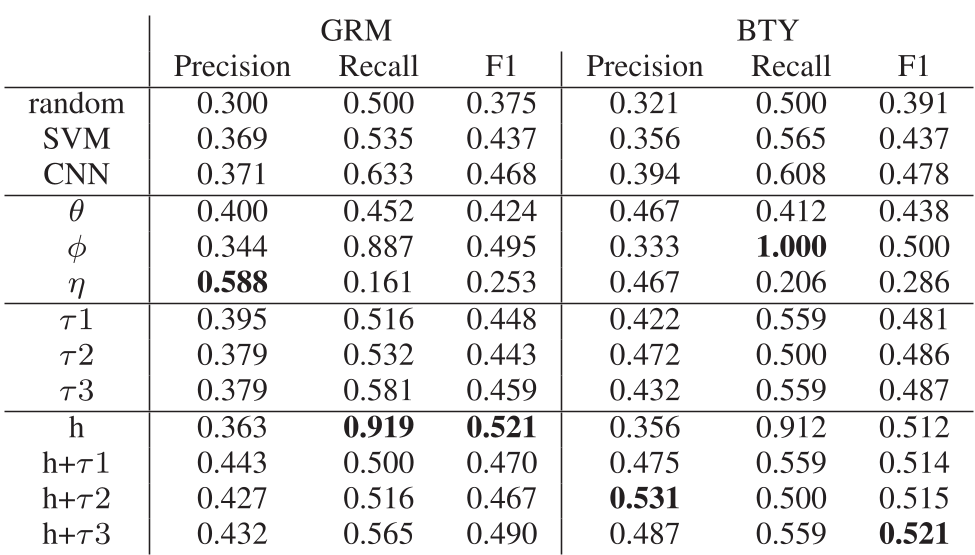
The model was tested on real-world Japanese e-commerce data (Gourmet and Beauty categories) and 450k+ Tweets.
Key Findings:
- Social Media Matters: For beauty products, the Social factor () was a stronger predictor than for gourmet products.
- Precision Leap: The combination of history and intent () achieved the highest scores.
- Vs. AI Baselines: Traditional Machine Learning (SVM) and Deep Learning (CNN) fell short because they struggled to interpret the temporal "surge" logic as effectively as the probabilistic UWS model.
Critical Insight & Future Outlook
The UWS model proves that context is king. By treating clicking behavior not as a static feature but as a dynamic "emergence," we can catch the window of opportunity before it closes.
Limitations: The model currently requires users to have a purchase history (to avoid the "cold start" problem). Future Work: The next frontier is applying this to item-specific predictions—not just "will they buy something?" but "will they buy this specific camera?".
Final Takeaway
For retailers and ad-tech platforms, the message is clear: stop looking at clicks in a vacuum. Start looking for the surge and sync it with the social pulse.