
Social Consistency: Reimagining Distributed Systems Through the Lens of Human Relationships
Probabilistic Sequential Consistency in Social Networks
The paper introduces "Social Consistency," a client-centric consistency model designed for social networks facing flash crowds. It utilizes a split-merge algorithm to partition users into socially-connected clusters that maintain Sequential Consistency (SC) internally, while allowing eventual consistency between clusters to handle overloads.
TL;DR
Distributed systems often treat all users and data access patterns as uniform, leading to massive performance bottlenecks during "hot-spot" events (like a celebrity post). "Social Consistency" proposes a paradigm shift: Instead of global Sequential Consistency (SC), we should maintain SC within social clusters and settle for eventual consistency between them. This approach, implemented in a system called GLEE, boosts throughput by 2.4x and improves user experience quality by 37%.
Background: The Price of Popularity
In the world of distributed databases (like Cassandra or Dynamo), the CAP theorem is a constant shadow. To keep a system available during a traffic surge, we often give up strong consistency. However, for a user, seeing a comment on a post before the post itself is frustrating.
Existing solutions like consistent hashing fail when a single key (a trending tweet or Facebook post) becomes a hot-spot because that key cannot be partitioned further across traditional nodes. The authors argue that the missing ingredient is the social graph.
The Insight: Sequential Consistency as a Social Bound
The authors observe that users care most about the causal order of posts and comments from their friends. By partitioning users into clusters based on social ties, we can provide a "best-effort" SC.
- Intra-cluster: Users see a perfectly consistent view.
- Inter-cluster: Users see updates eventually.
The technical heart of this work is the use of a weighted social graph that combines static weights (friendships) and dynamic weights (frequency of interaction) to decide how to split the user base when a server is overloaded.
Methodology: The Math of Violations
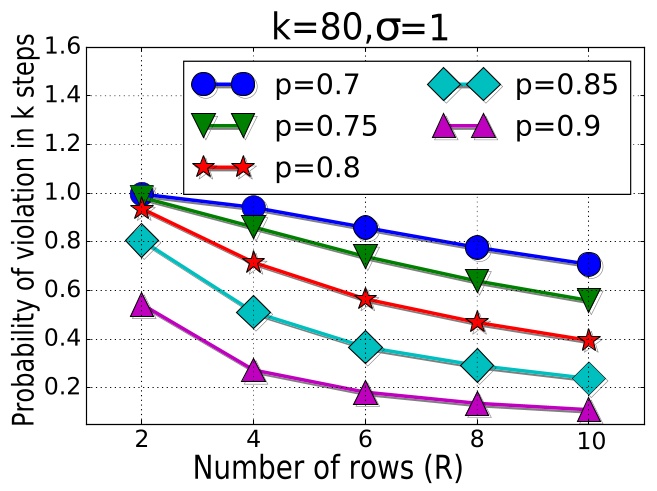
How do we know when a system "feels" inconsistent? The authors model SC violations as a random walk in a 2D Cartesian space, where the y-axis represents the cluster and the x-axis represents the sequence of events.
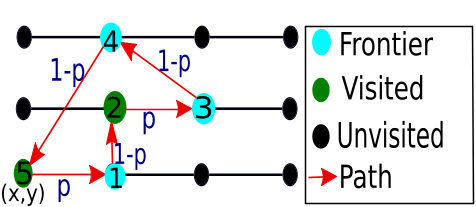
A violation occurs when a "happens-before" relationship is broken—modeled as reaching a coordinate in the walk that predates the current "frontier" of a cluster. By using Monte Carlo simulations, the system can predict the probability of a user seeing "stale" data and adjust the number of clusters () to keep this probability within acceptable bounds.
The Split-Merge Algorithm
When a Data Server detects an overload (e.g., a post goes viral), it triggers a Split:
- The Social Graph is partitioned using a min-cut algorithm (Gpmetis).
- A new clone of the data is created on another server.
- The user set is divided so that social "hot-links" stay within the same cluster as much as possible.
Experiments: GLEE vs. Cassandra
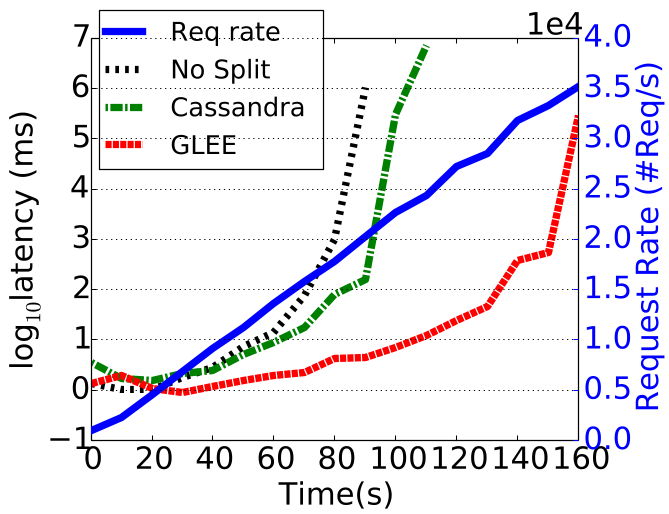
The authors evaluated GLEE (Good quaLity Experience and pErformance) against vanilla Cassandra. Unlike Cassandra, which struggled to balance the load for a single hot object, GLEE's social partitioning allowed it to horizontalize the load effectively.
Performance Metrics
- Throughput: GLEE handled 1.6x more workload with a single split and 2.4x more with three splits compared to Cassandra.
- Latency: As request rates spiked, GLEE stabilized within seconds by splitting, while Cassandra's latency remained high until the traffic naturally subsided.
Quality of Experience (QoE)
The paper introduces a "Quality" metric: the ratio of friends' comments received to total friends' comments. GLEE maintained a significantly higher quality index (1.37x) than systems that partitioned users randomly.
Critical Insight & Conclusion
The genius of Social Consistency lies in its Inductive Bias. It acknowledges that data in a social network isn't accessed randomly; it's accessed through the filter of human relationships. By aligning the technical architecture (partitioning) with the social architecture (graph clusters), GLEE provides a pragmatic solution to the CAP theorem's limitations.
Takeaway: Future distributed systems should not be "socially blind." By incorporating application-level semantics like friendship and interaction frequency into the consistency protocol, we can achieve SOTA performance without leaving the user in a state of "eventual" confusion.