
Beyond Boolean Matrices: Detecting Social Events via Probabilistic Snapshots
Probabilistic Snapshot Based Evolutionary Social Network Events Detection
This paper introduces a probabilistic snapshot model for evolutionary social networks to detect significant network events. By transforming discrete interaction counts into a probabilistic space and employing a Probabilistic Factor Model (PFM), the authors successfully track structural variations in scale-free networks like the Enron email dataset.
TL;DR
Social networks are messy and unbalanced. This paper moves away from traditional "fixed" snapshots, proposing a Probabilistic Snapshot Model. By converting interaction data into probabilities and using a latent factor model, it creates a robust "Evolution Index" capable of pinpointing major organizational shifts—like the infamous Enron scandal—through communication patterns.
The "Matthew Effect" Problem
In real-world social networks (like Weibo or Google+), influence follows a power law: a handful of users have millions of followers, while most have almost none. This is known as the Matthew effect.
When researchers try to detect "events" in these networks using standard snapshots, they run into two walls:
- Extreme Sparsity: Most nodes don't interact, leaving the association matrix mostly empty.
- Optimization Bloat: Using raw interaction counts as weights makes the mathematical search space for "node characteristics" (latent vectors) too large and inefficient to solve.
Methodology: The Probabilistic Shift
The core innovation lies in treating the social network not as a certain fact, but as a series of Probabilistic Snapshots.
1. The Probabilistic Factor Model
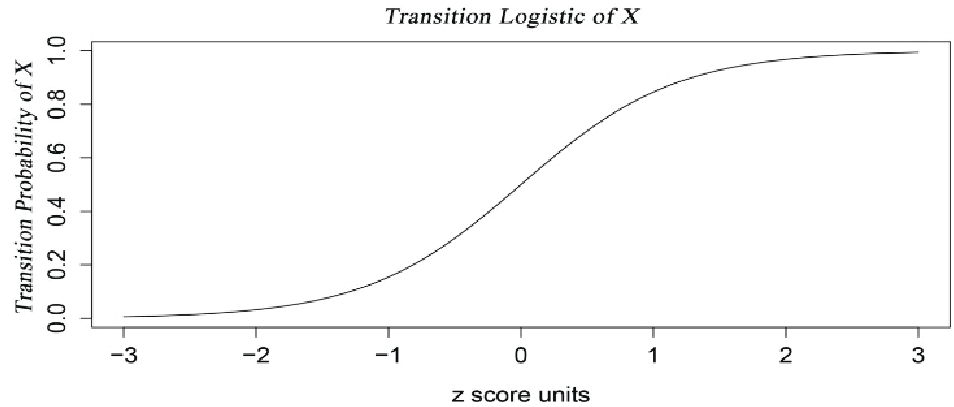
Instead of saying "A emailed B five times," the model asks: "What is the probability that a significant association exists between A and B?" The authors utilize a Logistic Function (Sigmoid curve) to map interaction counts into a probability space.
2. Reconstructing the Network
By assuming latent vectors for each node follow a Gaussian distribution, the authors use Probabilistic Matrix Factorization. They minimize an objective function that accounts for observed interactions while penalizing complexity (using regularization).
The gradient descent update looks like this:
Experiments: Tracking the Enron Collapse
The authors tested their Prob-Event-Detect algorithm on the famous Enron email dataset. By calculating the Evolution Index—a measure of change between reconstructed matrices over time—the system successfully identified critical windows of the corporate crisis.
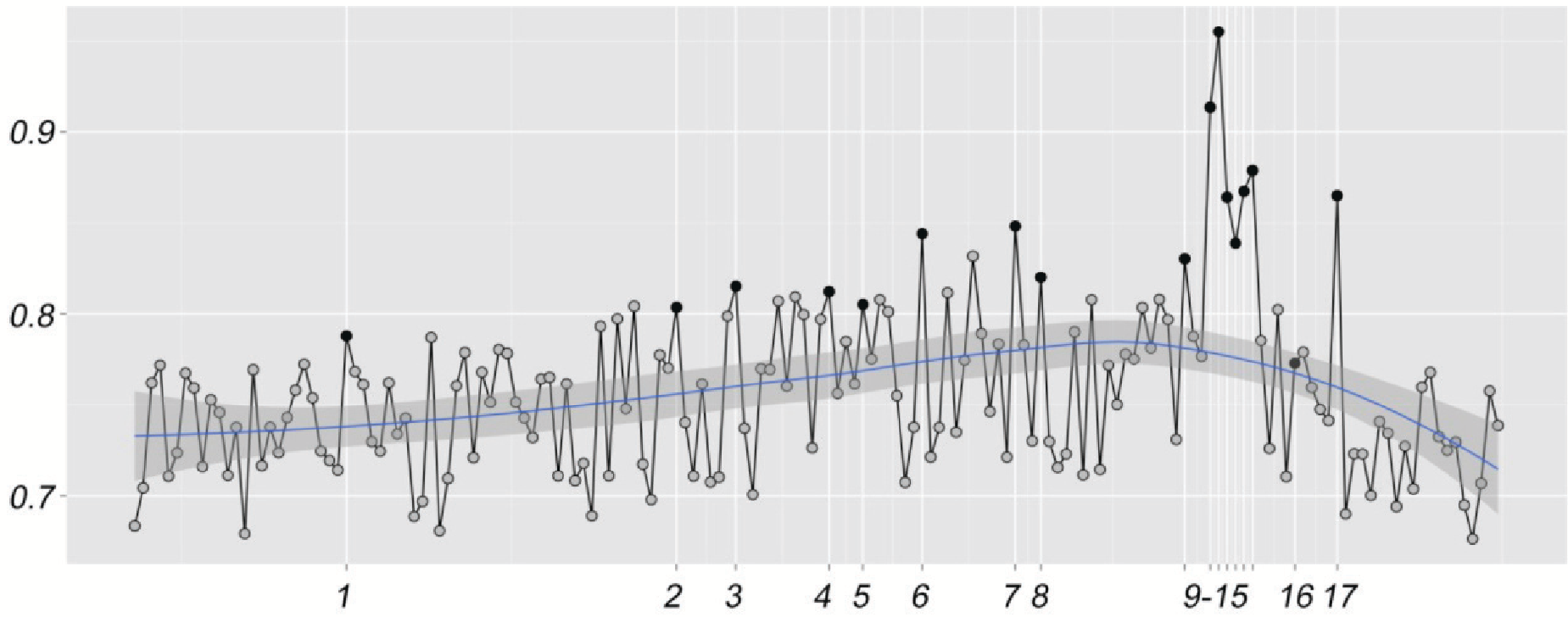
- Stabilization: Following the initial setup of the mail system, the index showed slow, steady fluctuations.
- Crisis Detection: Between moments 9 and 15 (late 2001), the index spiked dramatically, coinciding with the exposure of fraud scandals and the subsequent bankruptcy.
- Cool-down: Post-bankruptcy, the association strength plummeted as the organization dissolved.
Critical Insight & Summary
This work stands out because it recognizes that association strength is a latent variable that shouldn't be read directly from raw data. By applying a probabilistic "buffer," the model becomes resilient to the noise and scale imbalances typical of human interaction.
Key Takeaways:
- Scalability: The algorithm runs in linear time , making it viable for "big data" social flows.
- Practical Utility: It effectively translates abstract communication shifts into a quantifiable index that mirrors real-world organizational health.
- Future Potential: This probabilistic approach could be extended to community detection (Prob-Cluster-Detect) to see how groups form and dissolve under pressure.