
Probabilistic Sound: Adapting Pronunciation for Spontaneous TTS
Probabilistic Speaker Pronunciation Adaptation for Spontaneous Speech Synthesis Using Linguistic Features
The paper introduces a speaker-specific pronunciation adaptation method for spontaneous Text-to-Speech (TTS) synthesis. It utilizes Conditional Random Fields (CRFs) to predict realized phoneme sequences from canonical ones, exclusively leveraging a refined set of linguistic features.
TL;DR
Standard Text-to-Speech (TTS) often sounds "too perfect" to be human. This paper tackles the "robotic" nature of TTS by proposing a probabilistic pronunciation adaptation method using Conditional Random Fields (CRFs). By focusing solely on linguistic features (like word frequency and syllable stress), the model learns how specific speakers "slur" or drop sounds in conversational English, reducing phoneme errors by 23%.
Context & Positioning
In the landscape of Speech Synthesis, most models excel at "reading style" (clear, formal). However, spontaneous speech—the kind we use in daily life—is messy. It is full of deletions ("going to" → "gonna") and substitutions. While prior work often used acoustic cues (like pitch or energy) to explain these shifts, this paper takes a more challenging and practical route for TTS: using only text-based linguistic features.
The Core Challenge: The Non-Deterministic Speaker
Why is this hard? Because humans aren't consistent. A speaker might pronounce the word "concentrated" perfectly in one sentence and swallow half the syllables in the next. The authors demonstrate that in the Buckeye conversational corpus, 30% of phonemes and 57% of words differ from their dictionary (canonical) standards.
Methodology: CRFs and Linguistic Insight
The researchers chose Conditional Random Fields (CRFs) because they are exceptionally good at sequential labeling and allow for the easy integration of diverse feature sets.
1. Feature Selection (The "Election" Strategy)
Instead of throwing all data at the model, they used a "voting" mechanism among 20 speakers to find which features actually mattered.
- The Winners: Canonical phoneme identity, current word, syllable lexical stress, and part-of-speech (POS) tags.
- The Losers: Global word occurrence counts and deep utterance positions.
2. Contextual Windows
The authors found that a phoneme's "neighbors" are critical. By using a window of W=±2 (considering two phonemes before and after the target), the model significantly improved its ability to predict deletions and substitutions.
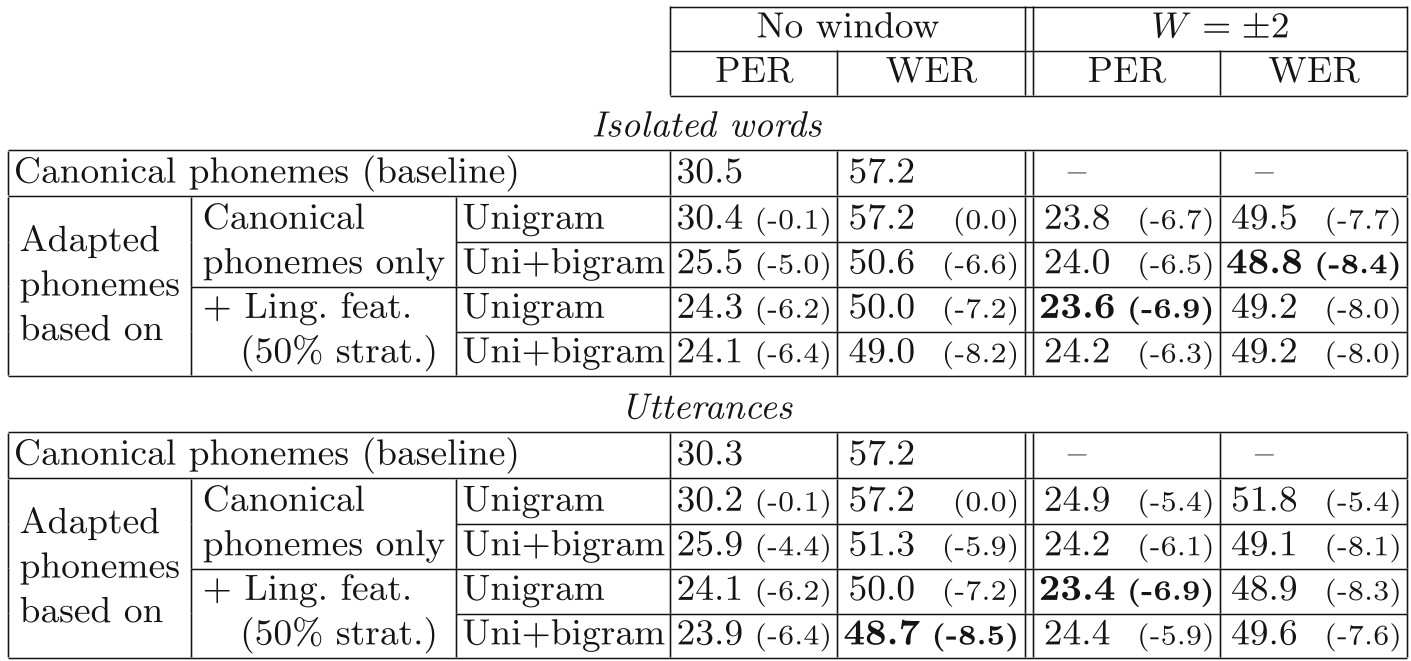 Table: Comparison of PER and WER across different window sizes and feature strategies.
Experimental Breakthroughs
The "Uni+Bigram" configuration (looking at pairs of predicted labels) proved tricky. While it theoretically captures more context, it suffered from data sparsity—there wasn't enough conversational data for every possible phoneme pair. Consequently, the best results came from a Unigram CRF combined with Linguistic Features and a Phoneme Window.
Quantitative Success:
- Phoneme Error Rate (PER): Dropped from 30.3% (Baseline) to 23.4%.
- Word Error Rate (WER): Dropped from 57.2% to 48.9%.
The "Oracle" Insight
One of the most profound findings in the paper is the N-best analysis. If the model provides its top 2 guesses instead of just 1, the error rate plummets to 16.4%. This suggests that the model "knows" the right pronunciation, but current TTS pipelines are too rigid to pick the second-best option even when it's more stylistically appropriate.
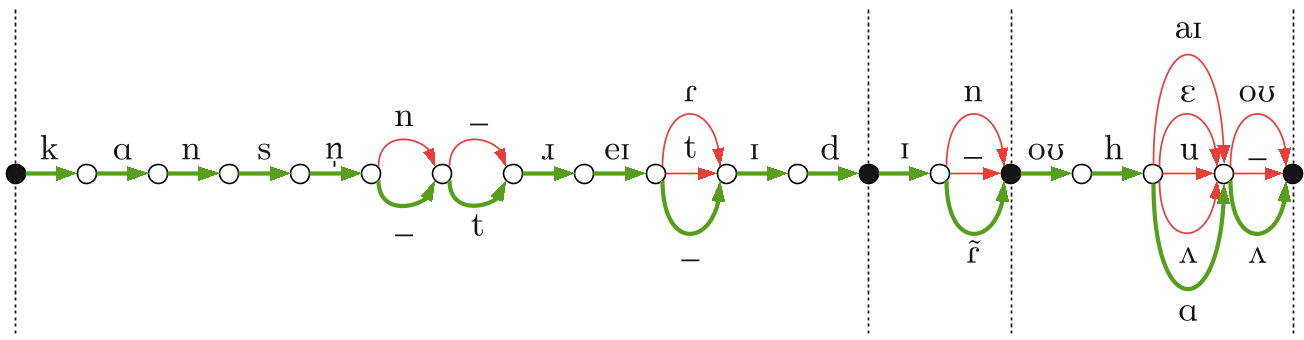 Figure: A confusion network for the phrase "concentrated in Ohio," showing how multiple paths represent valid spontaneous variations.
Critical Analysis & Conclusion
The strength of this work lies in its parsimony. By proving that linguistic features (extractable from plain text) can drive pronunciation adaptation, the authors provide a clear roadmap for enriching TTS front-ends.
Limitations:
- The model is speaker-dependent (it needs specific data for each voice).
- The study stays in the "symbolic domain"—it predicts phonemes but hasn't yet synthesized the audio to see if ears agree with the math.
The Takeaway: To make AI sound human, we must embrace the "uncertainty" of speech. Moving from deterministic look-up tables to probabilistic confusion networks is the key to crossing the "Uncanny Valley" of speech synthesis.