
PMATCH: Scaling Probabilistic Subgraph Matching to Billion-Edge Social Networks
Probabilistic Subgraph Matching on Huge Social Networks
This paper introduces Probabilistic Subgraph (PS) queries and the corresponding PMATCH algorithm for efficient pattern matching on massive social networks. It allows users to define "approximate" matches using weighted query components and linear probability functions, successfully scaling to graphs with over a billion edges.
TL;DR
Searching for complex patterns in massive social networks is hard because users are rarely 100% sure what they are looking for. This paper presents PMATCH, an algorithm designed for Probabilistic Subgraph (PS) queries. It allows users to weigh different parts of a query by importance and returns results that meet a probability threshold. Most importantly, it scales to networks with over 1 billion edges, outperforming standard baselines by nearly an order of magnitude.
Problem & Motivation: The Rigidity of Exact Matching
Most graph databases (like RDF or Neo4j) are built for exact subgraph isomorphism—finding an absolute 1:1 match for every node and edge. However, the real world is messy:
- Heterogeneity: Labels in social networks (e.g., "friend", "attended", "likes") are often inconsistent.
- User Uncertainty: A user might say, "I'm looking for a book recommended by a friend; I think it's a drama, but I'm not sure."
Existing "approximate" matching solutions often rely on fixed edit distances or ad-hoc similarity scores that don't allow users to define what "importance" means for their specific search. Furthermore, they fall apart when faced with the sheer scale of modern social data.
Methodology: PS-Queries and the PMATCH Innovation
The authors define a PS-query as a set of edge "boxes" (). is the "must-have" core, while others are optional with different weights ().
The Core Insight: Pruning via Probability
The central innovation is the PMATCH algorithm. Instead of finding all possible subgraphs and then ranking them (which is computationally suicidal), PMATCH integrates the probability calculation directly into the search process.
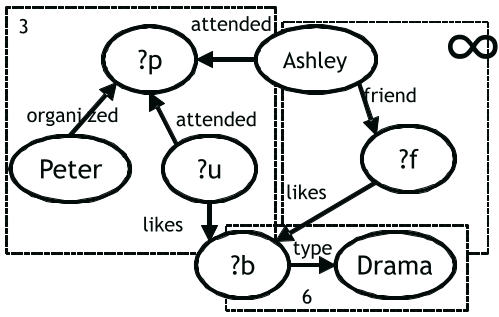 Fig 1: A query where the user is certain about the core (left box) but uncertain about the drama genre or the specific party event.
Key Technical Pillars:
- Iterative Substitution: It maintains "Candidate Sets" () for each query vertex and narrows them down through a recursive process.
- Greedy Pruning: On line 4 of the algorithm, it checks: "Even if all remaining parts of this query match perfectly, can I still reach the probability threshold ?" If not, it prunes the entire branch.
- hselect Function: This is a cost-benefit heuristic that picks which vertex to resolve next. It balances the "Progress" (how much weight the vertex adds) vs. the "Cost" (how many candidates are in the database).
Experiments & Results: Billion-Edge Performance
The authors tested PMATCH on two gargantuan datasets:
- Social Networks: 778 Million edges (Orkut, Flickr, etc.)
- Delicious: 1.122 Billion edges
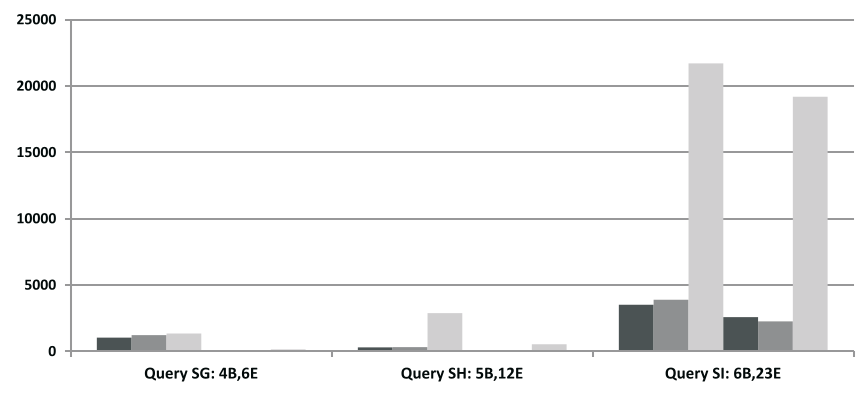 Fig 2: PMATCH significantly outperforms the SN-2 (Semi-Naive) baseline across different queries (SA-SI).
Key Findings:
- Speedup: PMATCH was 5.2x to 7.6x faster than the semi-naive baseline (which uses the DOGMA algorithm).
- Versatility: Even with a "Cold Cache" (reading straight from disk), it maintained a 3x-5x lead, proving that its pruning logic significantly reduces disk I/O—the primary bottleneck in massive graph processing.
- Scalability: While standard Neo4j exact matching often timed out (taking 3000x longer), PMATCH handled billion-edge joins in manageable timeframes.
Critical Analysis & Conclusion
PMATCH transitions the problem of "Approximate Matching" from a fuzzy similarity problem to a rigorous probabilistic inference problem. By allowing the user to specify a Generalized Linear Probability Function, the system converts a qualitative "feeling" of similarity into a quantitative pruning tool.
Limitations: The current approach relies on "anchored" queries (queries with at least one constant vertex). For purely variable-based unanchored queries, the initial candidate sets would be too large, likely causing performance degradation.
Future Outlook: As Knowledge Graphs and Social Networks continue to grow, the ability to query with uncertainty will become a standard feature, not a luxury. PMATCH provides the theoretical and algorithmic foundation for this expansion.