
PTRM: How 7M Parameters Outreason Frontier LLM Ensembles via Stochastic Exploration
Probabilistic Tiny Recursive Model
The paper introduces Probabilistic Tiny Recursive Model (PTRM), a task-agnostic framework that scales test-time compute for Tiny Recursive Models (TRM). By injecting Gaussian noise into the latent state during recursion to create parallel stochastic trajectories and selecting the best answer via the model's internal Q-head, PTRM achieves state-of-the-art results on Sudoku-Extreme (98.75%) and outperforms frontier LLM ensembles on reasoning puzzles with 0.0001x the cost.
TL;DR
Researchers have introduced Probabilistic Tiny Recursive Model (PTRM), a simple yet powerful inference-time modification for specialized reasoning models. By injecting noise into the latent "thought process" and using an internal verifier to pick the best outcome, this 7-million-parameter model achieves 91.2% accuracy on complex logic puzzles—crushing a perfect-verifier ensemble of the world's strongest LLMs (55.1%) at 1/10,000th of the cost.
Background: The Deterministic Trap
Tiny Recursive Models (TRM) have recently emerged as a highly efficient alternative to Large Language Models (LLMs) for constraint-satisfaction tasks (like Sudoku or ARC-AGI). Unlike LLMs that predict tokens autoregressively, TRMs iteratively refine a "latent state" (a vector representation of the solution).
However, TRMs are historically deterministic. If the model enters a "bad basin"—a region of its internal logic that leads to a wrong answer—it stays there. It has no mechanism to "rethink" or try a different path. This is a massive waste of potential; often, the model knows how to solve the puzzle, but its first guess gets stuck.
Methodology: Shaking the Latent Space
The authors propose PTRM, which introduces two critical components to the inference process:
- Stochastic Exploration (Width Scaling): Instead of one deterministic path, PTRM runs parallel paths. At every step, it injects a small amount of Gaussian noise () into the latent state. This "shakes" the model out of bad basins and allows it to discover alternative trajectories.
- Zero-Shot Verification: Every TRM has a "Q-head"—a small sub-network trained to predict if its current answer is correct (used for early stopping). PTRM repurposes this Q-head at test-time to score all trajectories and pick the winner.
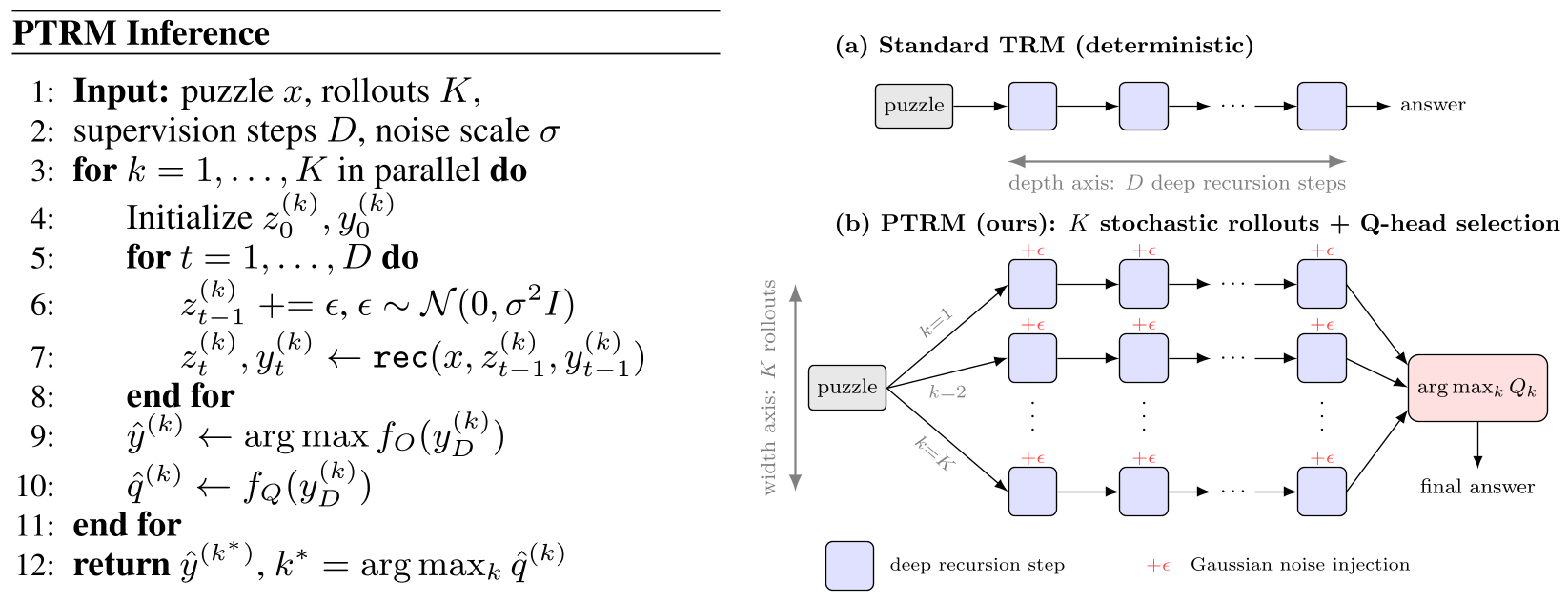 Figure 1: Standard TRM vs. PTRM. The noise creates the diversity needed to find the "good basin".
Why it Works: The Physics of "Good Basins"
The paper provides a fascinating visualization using Principal Component Analysis (PCA) to map the model's "mental state." They categorize trajectories into:
- Quick Success: Direct path to the correct solution.
- Delayed Success: An initial struggle in a bad basin followed by a sharp "escape" to the truth.
- Failure: Getting trapped in a loop or a bad region indefinitely.
By adding noise, PTRM turns "Failures" into "Delayed Successes." Even if only 8% of the noisy trajectories find the escape hatch, the Q-head is accurate enough to identify that rare 8% and discard the failures.
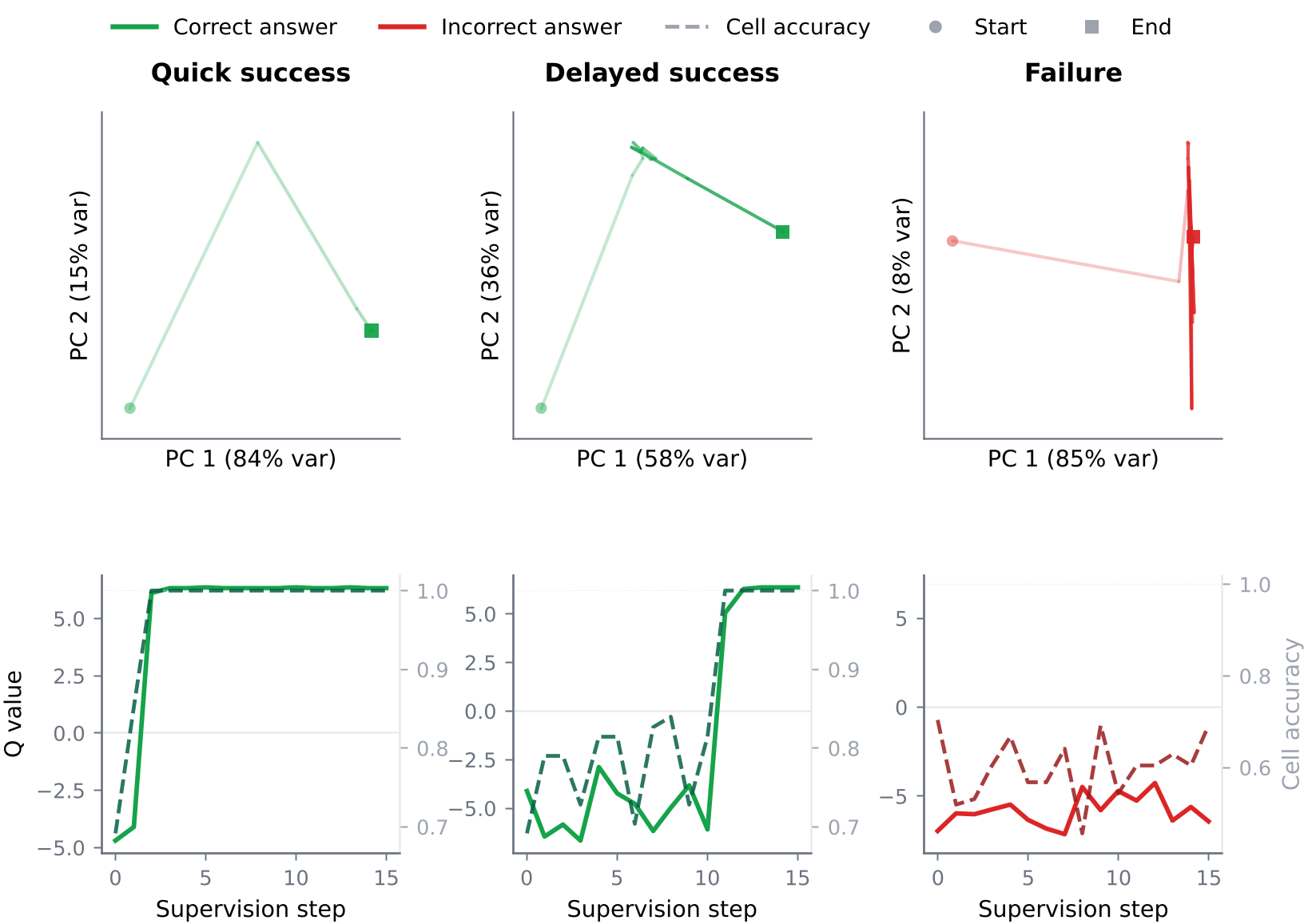 Figure 2: Visualizing the "mental" paths. Note how the Q-value (solid line) spikes only when the model finds the correct solution basin.
Experimental Showdown: Small vs. Giant
The results on the Pencil Puzzle Bench (PPBench) are staggering. When compared against frontier models including GPT-5 and Claude-Opus (using high-reasoning/agentic settings):
- Accuracy: PTRM reached 91.2%, while an ensemble of the 7 strongest LLMs (assuming a perfect verifier for the LLMs) only reached 55.1%.
- Cost: PTRM costs 38.51 for the same result.
- SOTA Achievement: On the grueling Sudoku-Extreme dataset, PTRM hit 98.75%, a new world record.
 Table 1: PTRM vs Baselines. Most of the gain comes from 'Width' (parallel trajectories) rather than 'Depth' (more steps).
Critical Insights & Limitations
- The Verifier Bottleneck: PTRM is only as good as its Q-head. In tasks like Maze-Hard, while the noise found the correct solution (High
pass@K), the Q-head struggled to identify it, leading to a gap in performance. - Generalization: This approach is currently specialized for puzzles with verifiable grid-based structures. Extending this to open-domain natural language reasoning remains a future challenge.
- Efficient Scaling: PTRM proves that for reasoning, parallelism (Width) is often more compute-efficient than sequential thinking (Depth).
Conclusion
PTRM is a masterclass in "System 2" thinking for small models. It proves that we don't always need billion-parameter LLMs for hard reasoning. Sometimes, we just need a small, focused model that is allowed to "explore" and a reliable way to check its own work.