
Collective Intelligence: Solving Distributed Optimization through Probability Collectives
Probability Collectives for decentralized, distributed optimization: A Collective Intelligence Approach
This paper presents a decentralized optimization framework based on 'Probability Collectives' (PC) within the Collective Intelligence (COIN) theory. It models complex systems as a group of self-interested agents that independently update their probability distributions to reach a Nash Equilibrium, effectively minimizing global objectives like the volume of a segmented beam.
TL;DR
This paper explores Collective Intelligence (COIN) through the lens of Probability Collectives (PC) to solve decentralized optimization problems. By treating system components as self-interested agents that optimize their own probability distributions rather than specific actions, the framework achieves a Nash Equilibrium that minimizes the global objective. Tested on a beam design problem, the method proves robust against uncertainty and highly scalable.
The Shift from Centralized to Collective Control
As modern engineering systems—like satellite constellations or smart grids—become increasingly complex, the "Centralized Brain" approach becomes a bottleneck. The core challenge is Coordination: how do you ensure that 1,000 agents, each looking out for themselves, don't create chaos but instead contribute to a global goal?
The authors suggest that we shouldn't ask "What move should I make?" but rather "What is the probability of this move being successful?" This subtle shift from deterministic action to probabilistic distribution is the heart of Probability Collectives.
Methodology: The Physics of Optimization
The PC theory is a fascinating hybrid of Game Theory, Statistical Physics, and Information Theory.
1. The Maximum Entropy (MaxEnt) Principle
Borrowing from E.T. Jaynes' work, the approach starts with maximum uncertainty (uniform distribution). As the agents "learn" from the environment, the distribution becomes "peaky" around optimal actions.
- Entropy (): Represents our uncertainty.
- Boltzmann Temperature (): Acts as a smoothing parameter. High encourages exploration; as is "annealed" (lowered), the agents settle on the best strategy.
2. The Feedback Loop
Agents don't know the exact actions of others; they "guess" based on the joint probability space. They receive a World Utility (reward) and update their local probability for a strategy using a gradient-based rule:
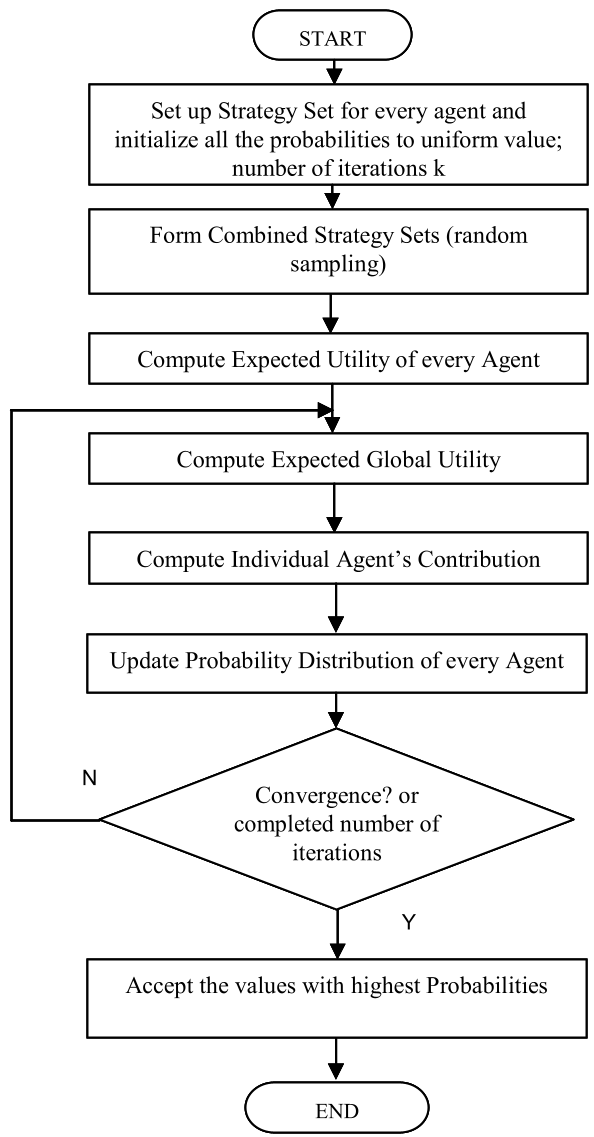
Case Study: The Segmented Beam
To prove the theory, the authors designed a segmented beam where each segment is an agent trying to minimize its own volume.
- Agents: 5 segments.
- Strategy Set: 42 different cross-sectional areas for each segment.
- Global Goal: Minimize Total Volume .
Experimental Results
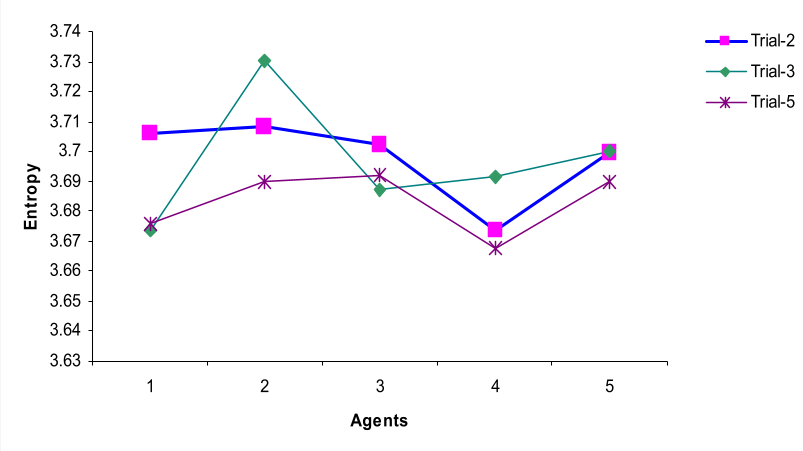
The results clearly show that the agents successfully learned the optimization landscape. In Trial 2, the "Favorable Strategy" (Highest Probability) resulted in a total volume of 1.8699e7 mm³, while the "Least Likely Strategy" remained at 3.9966e7 mm³.
Critical Insight: Why PC Wins Over GA/SA?
Unlike Genetic Algorithms (GA) or Simulated Annealing (SA), which operate in the discrete space of "moves," PC operates in the Euclidean space of probability vectors. This allows for:
- Gradient-based Efficiency: We can use calculus on probabilities even if the underlying variables are discrete.
- Sensitivity Analysis: A "peaky" distribution automatically tells engineers which variables are most critical to the system's performance.
- Inherent Robustness: Because it's probabilistic, it handles noisy data and poorly modeled environments better than deterministic solvers.
Conclusion and Future Horizons
The study successfully demonstrates that COIN and PC can solve structural optimization without a central controller. While the current implementation is unconstrained, the future of this work lies in Multi-UAV Path Planning and Traveling Salesman Problems (TSP), where agents must navigate complex constraints in real-time. This framework paves the way for truly autonomous, self-organizing engineering systems.