
Procedural Friction: How Interaction Rules Shape Consensus in Social Networks
Procedural Influence on Consensus Formation in Social Networks
This paper investigates Procedural Influence in networked consensus formation, introducing three interaction rules—Agenda Influences, Straw Polling, and Multi-stage Formation—into a multidimensional social influence model. Utilizing an Agent-Based Simulation (ABS), the author demonstrates how these rules regulate the flow of social influence, significantly impacting consensus efficiency and final collective outcomes.
TL;DR
In social networks, agreement isn't just a product of who you know, but how you are allowed to talk to them. This paper bridges group psychology and network science to show that interaction procedures—like setting an agenda or taking non-binding polls—act as "procedural influence" that can delay consensus and fundamentally shift the final collective opinion.
Background: Beyond the Network Topology
For decades, network science has focused on topology: "If I change the links in a graph, how does information spread?" However, humans rarely interact in a vacuum. We use procedures: agendas for meetings, straw polls to gauge the room, and departmental sub-groups to reach local agreements.
The author, Kathrin Eismann, argues that these rules are not neutral. They regulate the flow of social influence, creating a hidden layer of "procedural influence" that current mathematical models of opinion dynamics often ignore.
The Logic of Constraint: The Multidimensional Model
To capture this, the study uses a multidimensional social influence model. Unlike simple models where people agree on one topic, this model acknowledges that beliefs are interdependent. For example, your view on "Climate Policy" is logically linked to your view on "Taxation."
The core updating formula is:
Where:
- W is the social network (who listens to whom).
- C is the internal logic (how beliefs constrain each other).
- A is "Openness" (how much you care about others' opinions vs. your own).
Modeling Three Key Procedures
The paper introduces three specific "interventions" into this flow:
- Agenda Influences: Forcing topics to be discussed one by one rather than all at once.
- Straw Polling: Taking a "non-binding" vote that lets everyone see the current majority, creating normative pressure.
- Multi-stage Consensus: Requiring teams to agree internally before the whole organization meets.
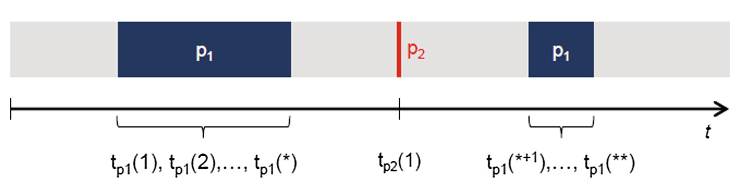 Figure 1: Conceptualizing procedures as specific intervention points in the temporal flow of influence.
Experimental Insights from ABS
Using an Agent-Based Simulation (ABS) with 100 agents, Eismann conducted a sensitivity analysis to see how these rules changed the "3 Pillars of Consensus": Mean Belief, Internal Agreement (Std. Dev.), and Efficiency (Iterations).
1. The Cost of Order (Agenda Effects)
Applying an agenda is the most "expensive" rule. Because agents can only focus on one issue at a time, the system takes significantly longer to reach a stable state. Interestingly, the order of the agenda didn't change the final answer, but it slowed down the process by a factor reflected in a high PRCC (0.809).
2. The Power of the Early Poll (Straw Polling)
Straw polls are dangerous if you want an "organic" consensus. The simulation found that polling shifts the final mean belief. Crucially, the timing matters: a poll taken late in the discussion has less impact than one taken early, which can "tip the scales" for undecided agents and create a path-dependent outcome.
3. Sub-group Silos (Two-Stage Effects)
Multi-stage formation (sub-groups first) leads to higher alignment within clusters but can actually skew the overall group's final position. It encourages "local majorities" to harden their stances before they ever face the global majority.
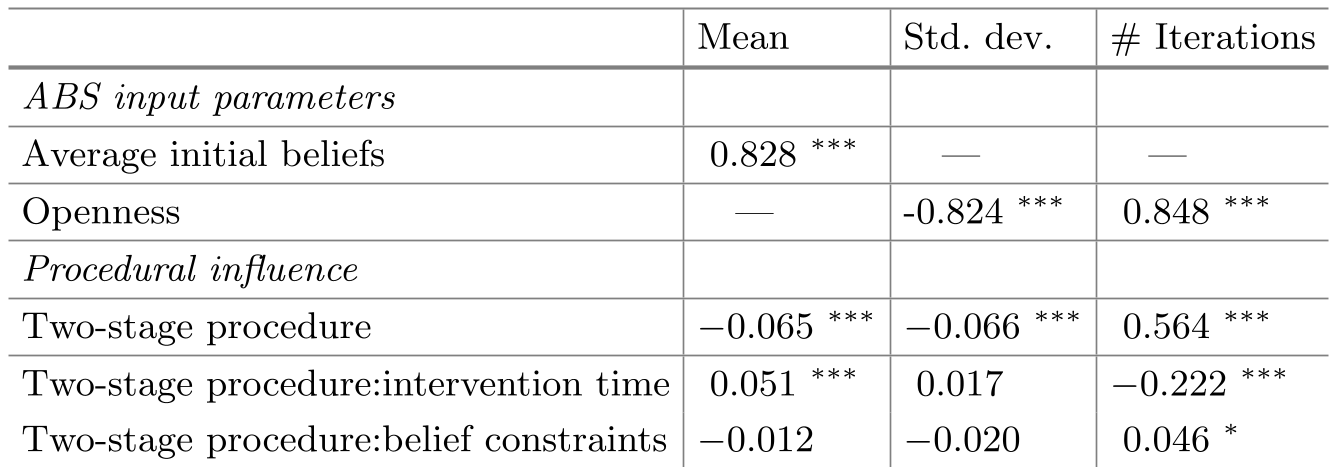 Key Results: Note the strong positive correlation between procedures and the # of Iterations (Efficiency loss).
Critical Analysis & Conclusion
The value of this research lies in its demystification of "neutral" rules.
Takeaways for Modern Research:
- Efficiency vs. Accuracy: Procedures are often implemented to make meetings "fairer" or "organized," but they almost always come at the cost of speed.
- Strategic Timing: If you are a moderator, applying a procedure early is a powerful tool for steering the outcome; applying it late is mostly a waste of time as beliefs have already "crystallized."
Limitations:
The model assumes agents are relatively honest and non-strategic. In real-world political or corporate networks, actors might use these procedures manipulatively (e.g., purposeful agenda setting to bury a topic). Future work should explore "adversarial" procedural influence.
Final Thought: In an era of digital governance and social media algorithms, we must ask: Are the "procedures" of our platforms—like how a thread is sorted or when a poll is displayed—silently determining our consensus before we've even finished the debate?