
Can a Product Have a Facebook? Reimagining Product Avatars through Social Media
Can a Product Have a Facebook? A New Perspective on Product Avatars in Product Lifecycle Management
The paper proposes a novel "Product Avatar" concept for Product Lifecycle Management (PLM) by leveraging the social network infrastructure of Facebook. It explores using Facebook's "Timeline" and "Profile" features to manage individual item-level product data in the context of the Internet of Things (IoT).
TL;DR
This research investigates whether the infrastructure of social networks—specifically Facebook's Timeline and Profile—can serve as a robust Product Avatar for Intelligent Products. By treating an individual physical product (like a boat) as a "socially intelligent" user, the paper demonstrates a way to track lifecycle information from manufacturing to end-of-life using familiar social metaphors.
Background: The Convergence of IoT and Social Web
In the era of the Internet of Things (IoT), products are no longer passive objects; they are becoming "intelligent," capable of decision-making and interaction. However, managing the data for millions of individual items throughout their lifecycle (Item-level PLM) remains a massive technical hurdle.
The authors argue that instead of building complex, proprietary PLM software from scratch, we should look at how Social Networks manage human "lifecycle" information. Facebook’s Timeline, introduced as a personal archive, is functionally identical to what a product needs: a searchable, data-driven history of events.
The Core Vision: From Fan Pages to Item Profiles
The paper identifies a critical distinction:
- Fan Pages (The Old Way): Currently, products like the iPhone have a Facebook page. This is for marketing. It represents the type of product, not your specific device.
- Product Profiles (The New Way): Each physical unit gets its own private profile. This profile becomes the Product Avatar—a digital counterpart that lives in the cloud and communicates with its owner, manufacturer, and service technicians.
Mapping Social Functions to Industrial Reality
The brilliance of this approach lies in the mapping of human social features to Product Lifecycle Management (PLM) tasks:
| Facebook Function | Industrial Interpretation |
|---|---|
| Timeline | A complete event log (Production, Repairs, Ownership changes). |
| Friends | Stakeholder management (Owner, Service Technician, Manufacturer). |
| Relationship Status | Physical assembly (e.g., "In a relationship with Engine Model X"). |
| Check-in | Location tracking and Supply Chain Management. |
| Education | Documentation of manufacturing history and process parameters. |
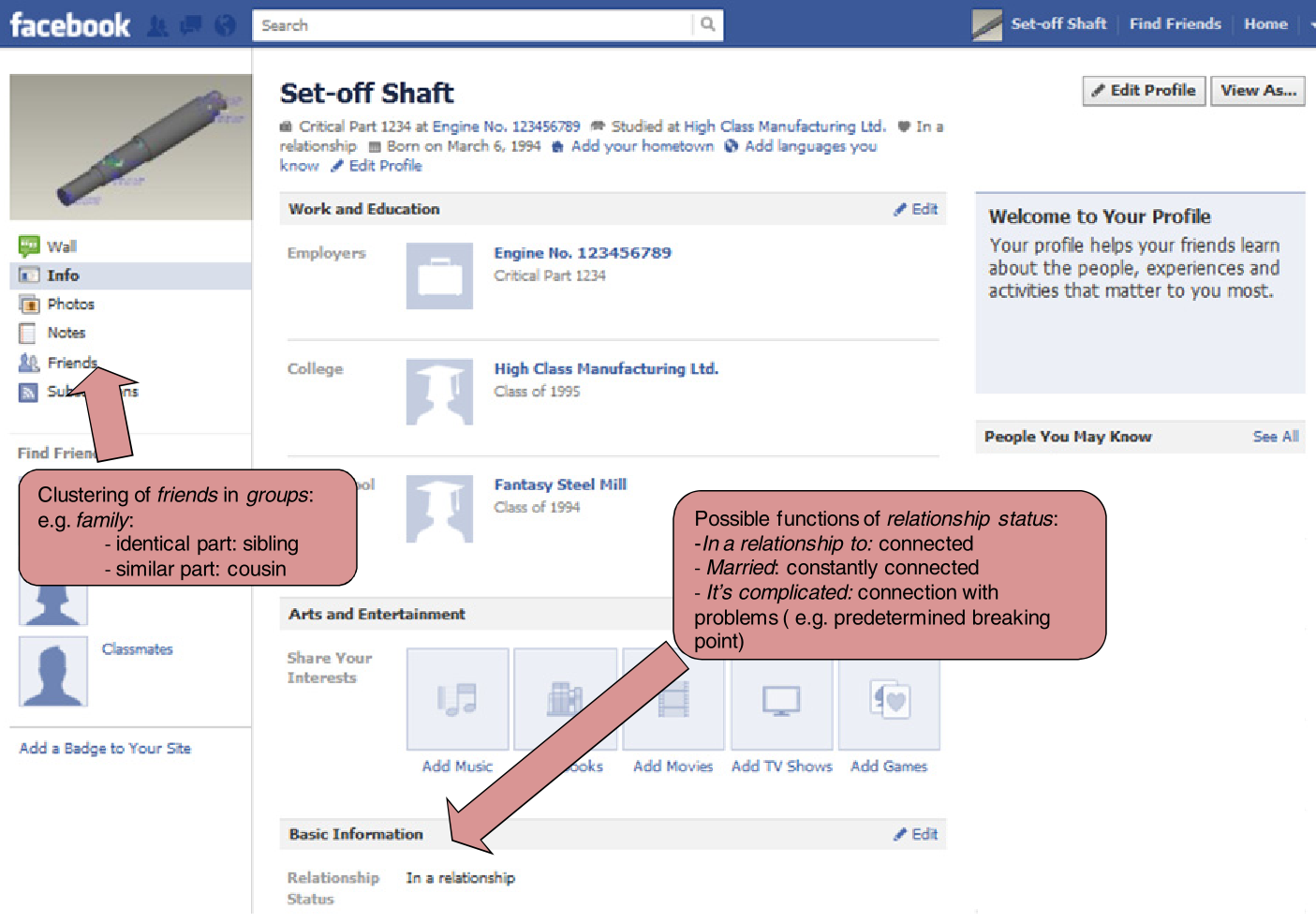 Figure: A conceptual Facebook profile for a specific product item.
Case Study: The Life of a Leisure Boat
The authors applied this framework to a leisure boat—a product with high customization and a long lifespan. Boating customers demand easy upkeep and real-time information.
In the Middle of Life (MOL) phase, the boat's "Timeline" would record every "Check-in" at a marina and every "Status Update" regarding engine health. If the engine needs oil, it could "tag" its "Friend" (the service technician) in a post, ensuring high quality of service through a transparent, mobile-accessible history.
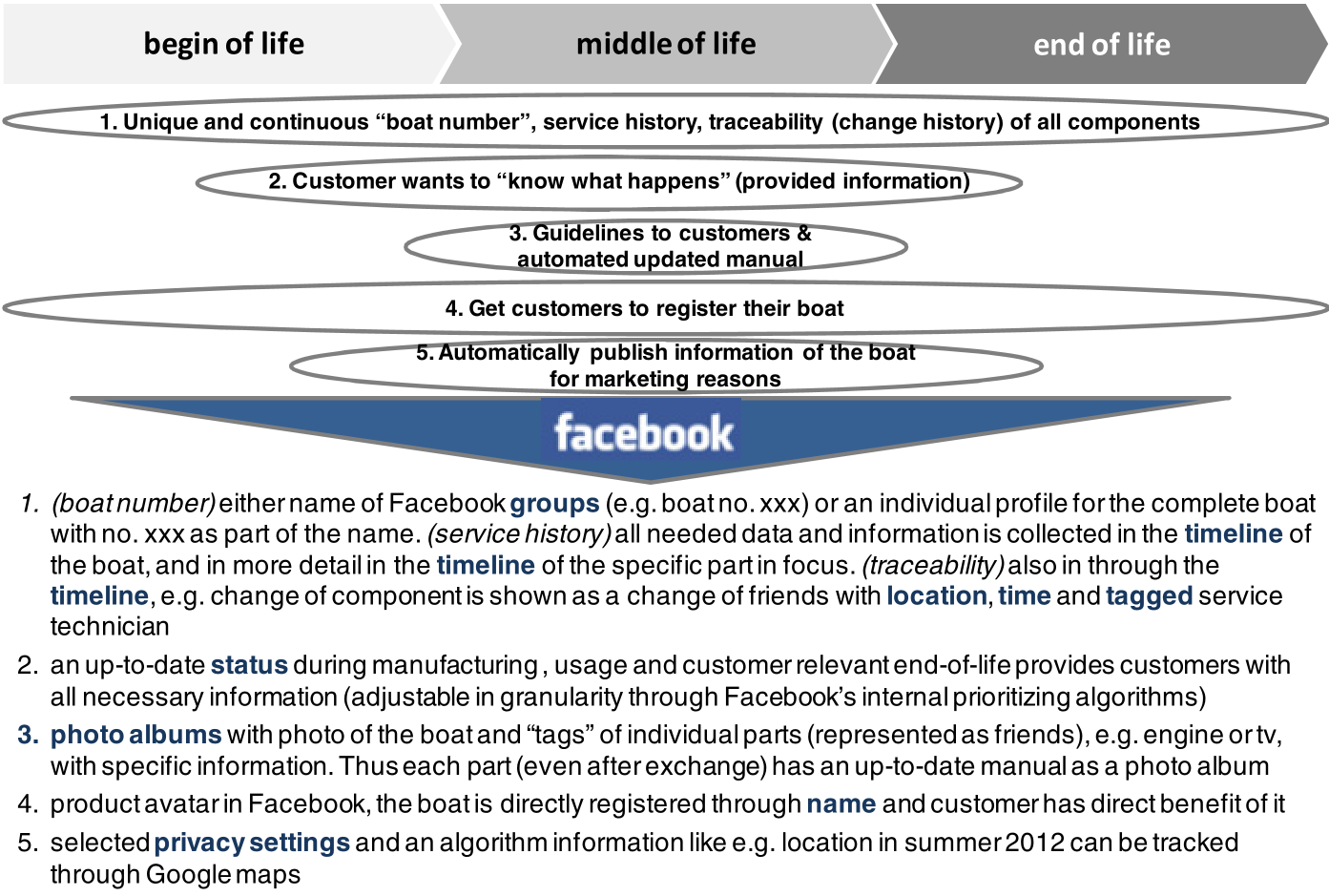 Figure: Mapping boat lifecycle phases to specific Facebook functionalities.
Professional Insight: Why This Works
The "Secret Sauce" of this method is the Inductive Bias of social media. Humans are already trained to use these interfaces. By using a "Like" button to approve a quality review or a "Group" to organize spare parts, the barrier to entry for complex data management vanishes.
Key Advantages Over Proprietary PLM:
- Accessibility: Naturally mobile-first and cloud-native.
- Scalability: Built to handle billions of users and trillions of posts.
- Interoperability: Standard APIs allow different products (friends) to share data easily.
Critical Analysis & Conclusion
While the concept is revolutionary, it faces significant Limitations:
- Data Privacy: Industrial secrets and ownership data on a third-party platform like Facebook present a massive security risk.
- Data Ownership: Who owns the "Profile" if the product is sold? The paper suggests "Employer" tags for legal status, but the legal framework is still nascent.
The Takeaway: This paper is a visionary early-mover in the "Social IoT" space. It suggests that the future of the Digital Twin might not look like a complex CAD model, but like a social media feed—a stream of events that tells the story of an object’s life.