
Detecting Social Recommender Sabotage: An Outlier Analysis Approach
Detection of profile injection attacks in social recommender systems using outlier analysis
This paper introduces an unsupervised detection framework for profile injection attacks (Push and Nuke) in social recommender systems. By combining user-item rating behavior with social network topology, the authors utilize k-means clustering to differentiate between authentic users and malicious accounts.
TL;DR
Recommender systems are under siege by "shilling attacks," where fake profiles manipulate ratings to promote or demote products. This paper proposes a novel detection framework that looks beyond simple ratings, incorporating social connection patterns. By applying k-means clustering to attributes like rating deviation and connection similarity, the system identifies malicious outliers with high precision.
The Core Challenge: The "Shilling" Problem
Collaborative filtering thrives on user input, but this openness is its Achilles' heel. Attackers inject biased profiles—Push attacks to inflate a product's popularity or Nuke attacks to tank it.
The real difficulty lies in obfuscation. Intelligent attackers don't just rate one item; they rate "filler items" to look like normal users. Prior work focused almost exclusively on the user-item matrix, but this paper argues that the social graph—who you "trust" or connect with—contains the smoking gun of a profile injection.
Methodology: The Three Pillars of Detection
The authors define three feature sets that quantify the "weirdness" of an attacker's profile:
- Deviation from Predicted Rating: Using Matrix Factorization, the system predicts what a user should have rated an item. High deviation suggests the user is acting on a bias rather than genuine preference.
- Multidimensional Similarity:
- Rating Similarity: Uses Vector Space Similarity (VSS) to see if a user's taste aligns with their neighbors.
- Connection Similarity: Measures the Jaccard-like overlap of mutual friends. Attackers often have random, low-overlap connections.
- Abnormal Behavior: This captures "Extreme Rating" (only giving 1s or 5s) and "Different Rating" (how much a user disagrees with the global average for specific items).
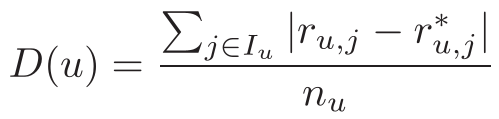 Note: Equation 1 shows the calculation for user deviation (), which serves as a primary input for the clustering stage.
Experimental Insights
The researchers tested their framework on the Epinions dataset, injecting synthetic intelligent attacks.
Key Findings:
- The Filler Size Paradox: Interestingly, the more "filler" items an attacker uses to hide, the easier they are to detect. Why? Because it becomes statistically impossible for an attacker to mimic the system-wide consistency across a large number of items.
- The Social Trap (Add-back Probability): The most dangerous scenario is when authentic users "add back" attackers (accepting their follow/trust requests). This social acceptance helps attackers "blend in," significantly lowering detection recall.
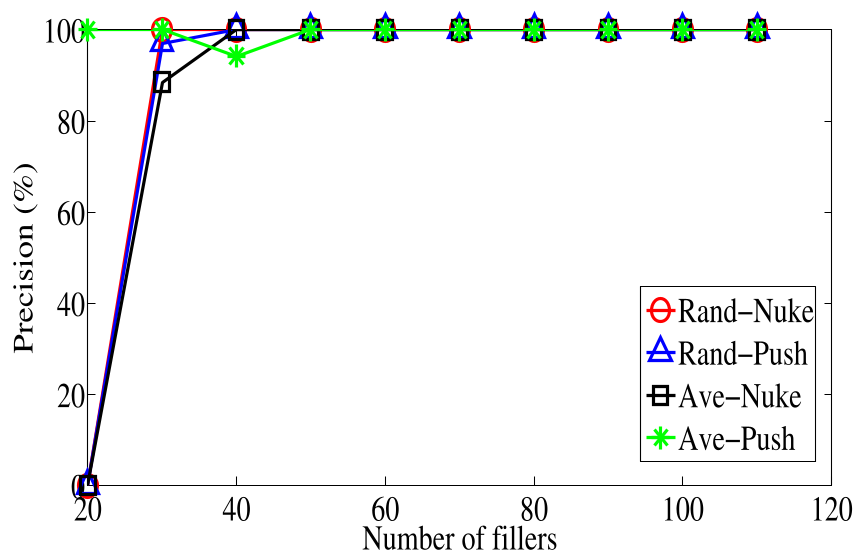 Fig 3: As attackers interact with more filler items, their profiles become distinct outliers, leading to near 100% precision in detection.
Critical Analysis & Conclusion
The strength of this work lies in its unsupervised nature. Unlike supervised classifiers that require labeled "attack" data, k-means outlier analysis adapts to new attack patterns.
Takeaway: If you are building a social recommender, don't just monitor the ratings—monitor the relationship-to-rating consistency. If a user's friends all love a product but the user (with zero mutual friends) hates it, you've likely found a Nuke attacker.
Limitations: The reliance on k-means assumes that the number of clusters (k=2) is known and that attackers will always form a distinct cluster. In a massive, noisy real-world system, attackers might require more sophisticated density-based clustering (like DBSCAN) to be properly isolated.