
Footprints in the Digital Sand: Profile Matching via Geo-Tags and Timestamps
Profile Matching Across Online Social Networks Based on Geo-Tags
The paper proposes a novel profile matching method across multiple Online Social Networks (OSNs) using system-generated geo-tags and timestamps. By moving beyond easily falsified user-provided text, the researchers aim to achieve high-accuracy identity linking through spatio-temporal usage patterns.
TL;DR
Matching a single user's identity across Facebook, Twitter, and Flickr is difficult because users often lie about their names or friends. This paper argues that while you can fake your bio, you can't easily fake your physical habits. By analyzing system-generated geo-tags and timestamps, the researchers propose an algorithm to link accounts with high reliability using the unique spatio-temporal "fingerprints" of our daily lives.
Positioning: This work moves profile matching from the realm of "User-Provided Content" (soft data) to "System-Generated Metadata" (hard data), significantly raising the bar for privacy and de-anonymization research.
The Core Problem: The Unreliability of User Data
Previous SOTA methods for profile matching generally fall into three categories:
- Attribute Matching: Comparing usernames and bios (Easily faked/typos).
- Network Architecture: Comparing friend lists (Fails if a user keeps "Work" and "Private" circles separate).
- Stylometry: Analyzing writing styles (Requires long, consistent texts).
The authors argue that all these rely on data where there is no ground truth. If a user wants to remain anonymous or distinct, they simply change their behavior. However, timestamps are generated by the server, and geo-tags are often automatically appended by the device's GPS. These are "under the radar" for most users, making them the perfect candidates for reliable matching.
Methodology: Building the Spatio-Temporal Fingerprint
Why does this work? Because human movement is remarkably predictable. The paper breaks down its approach into several distinct filters:
1. The Rhythms of Life (Time Correlation)
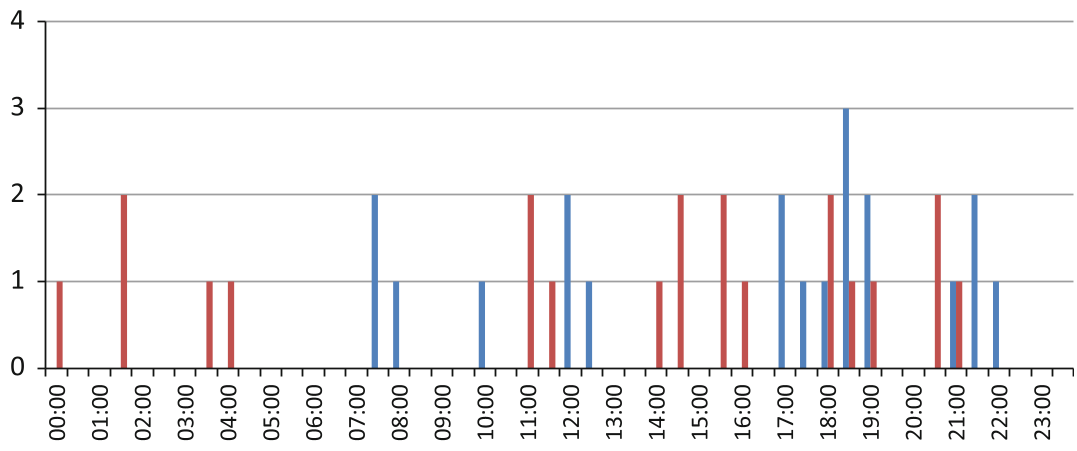
Most users exhibit consistent social media usage patterns—checking Twitter during a commute or posting on Instagram in the evening. By comparing usage peaks and troughs across platforms, a behavioral match can be inferred.
2. The Anchor Points (Home and Work)
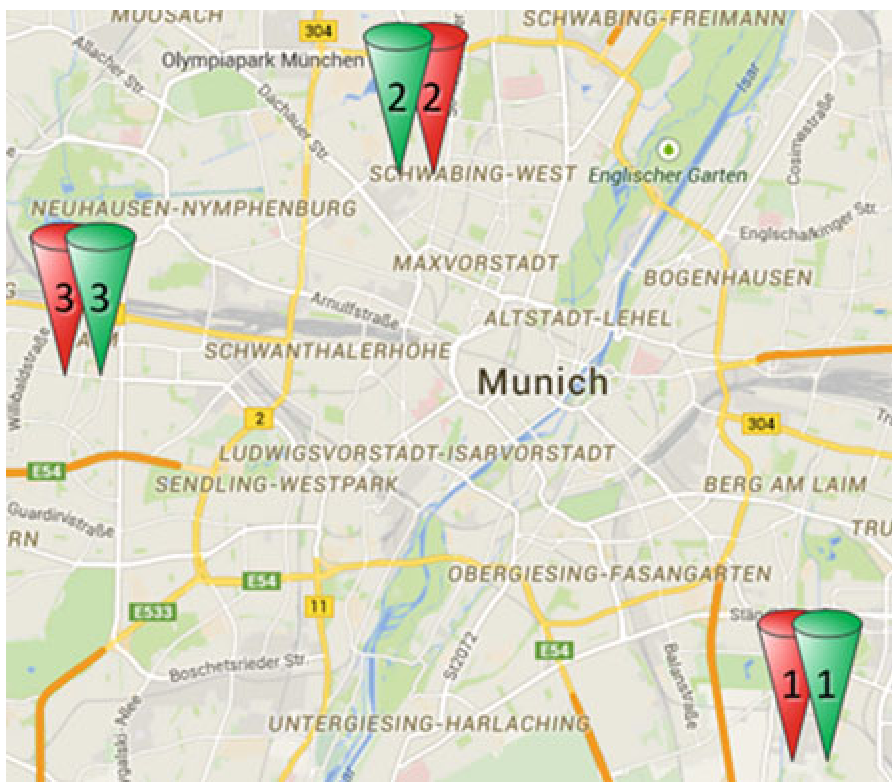
By clustering geo-tags, the algorithm identifies "Anchor Points." High-density clusters in small areas likely represent a home (red), while secondary clusters might represent a workplace (blue).
3. Precision as a Signature
A fascinating insight from the paper is the use of Geo-tag Accuracy. Different devices (old iPhones vs. new Androids or DSLR cameras) report GPS coordinates with different decimal precision. If two accounts consistently post with a rare 8-decimal precision, they likely share the same physical hardware.
Experimental Insights
The researchers analyzed a massive dataset of 2,588,981 geo-tagged tweets over a 35-hour window. Their findings reveal both the potential and the challenges of this approach:
- Data Sparsity: 52.7% of users only posted once in the window, making them impossible to match via sequences. However, 17% posted 4+ times, entering the "matchable" zone.
- Precision Distribution: As shown in the data, the vast majority of tags use 6 decimal places (approx. 0.1 meters accuracy).
| # Decimal Places | % of Tweets |
|---|---|
| 5 | 17.85% |
| 6 | 72.87% |
| 8 | 1.45% |
Critical Analysis & Future Outlook
Takeaway: The study proves that our "passive" digital footprint is far more revealing than our "active" profile. You might change your handle from @User123 to @SecretAgent, but if both accounts post from your living room at 11:00 PM every night, you are linked.
Limitations:
- Spar sity: If a user only posts once a week, the "fingerprint" remains too blurry for a definitive match.
- Countermeasures: Clever users can disable geo-tagging or use "ghosting" apps to spoof coordinates, a topic the authors suggest for future work.
Conclusion: This research is a wake-up call for privacy. In an era where "Big Data" is the business model, the very metadata we ignore is the key that unlocks our entire digital identity across the web.