
Beyond the Lie: Profiling Fake News Spreaders via Psychological Motivations
Profiling Fake News Spreaders on Social Media through Psychological and Motivational Factors
This paper introduces a novel profiling framework to identify fake news spreaders by analyzing psychological and motivational factors such as uncertainty, anxiety, and social rank. Using LIWC-based feature extraction and BERT embeddings, the authors demonstrate that integrating behavioral insights significantly outperforms traditional text-only detection methods.
TL;DR
Why do people share fake news? This paper argues that the secret to stopping misinformation lies not just in the "what" (content) but in the "why" (motivation). By extracting psychological features like anxiety, uncertainty, and social rank and combining them with BERT embeddings, the researchers achieved a massive 25% improvement in F1-score for identifying fake news spreaders.
Context: Why Content Detection is Failing
Detecting fake news is a cat-and-mouse game. Modern disinformation is engineered to be indistinguishable from legitimate reporting. While deep learning models like BERT are excellent at understanding semantics, they often miss the behavioral intent of the user. The authors posit that people spread fake news to cope with uncertainty or to enhance their social standing—signals that are often buried in their broader tweeting patterns rather than a single post.
The Psychological Blueprint: 5 Key Motivators
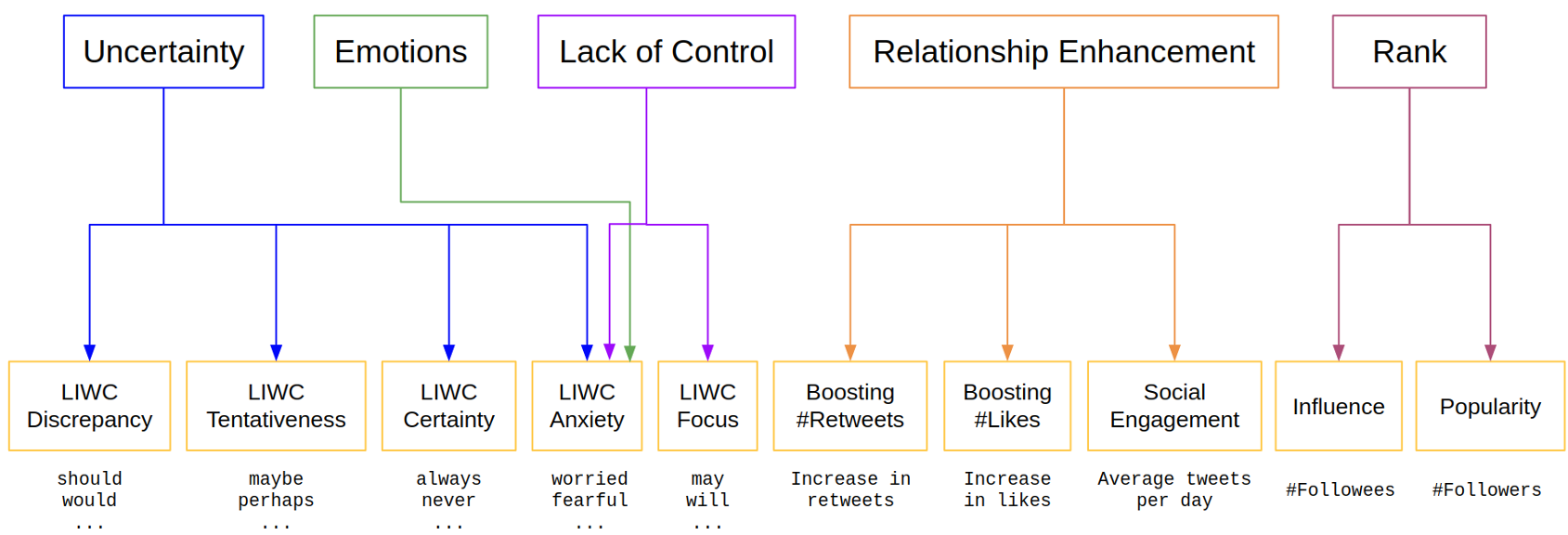
The researchers identified five behavioral pillars derived from established psychological theories:
- Uncertainty: In ambiguous situations (e.g., COVID-19), people use fake news as a "sense-making" tool to fill information gaps.
- Anxiety: High-stress environments make users prone to spreading unverified claims to relieve emotional tension.
- Lack of Control: Secondary control strategies involve predicting outcomes or finding "meaning" in chaos, often leading to susceptibility to conspiracies.
- Relationship Enhancement: Users may share sensationalist content to attract attention or show "care" for their tribe (warning mechanisms).
- Social Rank: Spreading "exclusive" (though false) info can be a self-enhancement mechanism for users seeking higher social status.
Methodology: Fusing Deep Learning with Psychology
The authors utilized a 3-step pipeline:
- Feature Extraction: They used LIWC (Linguistic Inquiry and Word Count) to quantify psychological states from tweets (e.g., words like "maybe" for tentativeness or "nervous" for anxiety).
- Network Analysis: Metrics like "Influence" (followees) and "Popularity" (followers) were used as proxies for social rank.
- Model Fusion: They generated text embeddings using BERT () and concatenated them with the psychological feature vector (). This joint representation was fed into a feed-forward neural network.
Experimental Results: A Significant Leap
The results confirm that fake news spreaders "sound" and "act" differently. For instance, in PolitiFact, fake news spreaders showed significantly higher levels of tentativeness and lack of control signals.
| Model | PolitiFact Accuracy | PolitiFact F1-Score |
|---|---|---|
| BERT (Baseline) | 78.61% | 58.02% |
| BERT + Features | 90.0% | 83.11% |
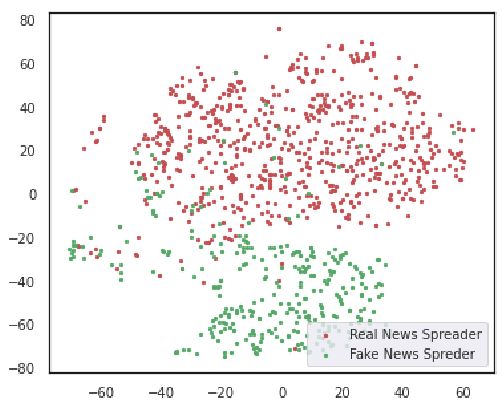
Visualizing the data with t-SNE reveals that while standard BERT embeddings show overlapping clusters, the "Bert+Features" approach creates clearly separable boundaries between real and fake news spreaders.
Critical Insight & Future Work
The most striking takeaway is the Dataset Variance. On GossipCop (celebrity gossip), anxiety was not a significant predictor, whereas, on PolitiFact (politics/disasters), it was. This suggests that the "psychology of the lie" depends heavily on the topic.
Limitations: The study relies on LIWC, which is a dictionary-based approach. Future work could benefit from more nuanced, transformer-based affective computing to capture "anxiety" or "uncertainty" in context-heavy slang.
Conclusion: This research shifts the focus from fact-checking to people-profiling. By understanding the mental state of the spreader, social media platforms can develop intervention strategies that address the root cause—such as reducing uncertainty during crises—rather than just playing "whack-a-mole" with individual posts.