
Beyond the Screen: Why Some People Voluntarily Shun Social Media
Profiling the non-users: Examination of life-position indicators, sensation seeking, shyness, and loneliness among users and non-users of social network sites
This study investigates the psychological and behavioral markers that distinguish Facebook users from non-users among adults aged 19 to 76. By analyzing "life-position indicators," the research identifies that non-users are characterized by higher levels of shyness and loneliness, coupled with significantly lower social activity and sensation-seeking traits.
TL;DR
Is Facebook a bridge for the lonely or a playground for the socially elite? This 2012 study by Pavica Sheldon pivots the academic lens away from active users to the "non-users." The findings suggest that non-users aren't just "behind the times"—they are psychologically and biologically distinct. They tend to be shier, lonelier, less socially active, and less driven by the biological need for "sensation seeking."
The "Rich-Get-Richer" Reality
In the early days of the internet, researchers hoped it would be a "Great Equalizer"—a place where the shy could find a voice (the Social Compensation Hypothesis). However, this paper reinforces the Social Enhancement Hypothesis. It turns out that those who are active in the physical world (traveling, sports, social outings) are the most likely to be active in the digital world. Facebook isn't a substitute for a social life; it’s an amplifier for one.
Methodology: Peering into the Non-User Profile
The study surveyed 327 adults (ages 19–76) to compare Facebook account holders against holdouts. The researcher examined:
- Life-Position Indicators: Physical health, social activity, and life satisfaction.
- Sensation Seeking: A biological drive for novelty and risk.
- Psychosocial Factors: Shyness (Revised Cheek and Buss scale) and Loneliness (UCLA scale).
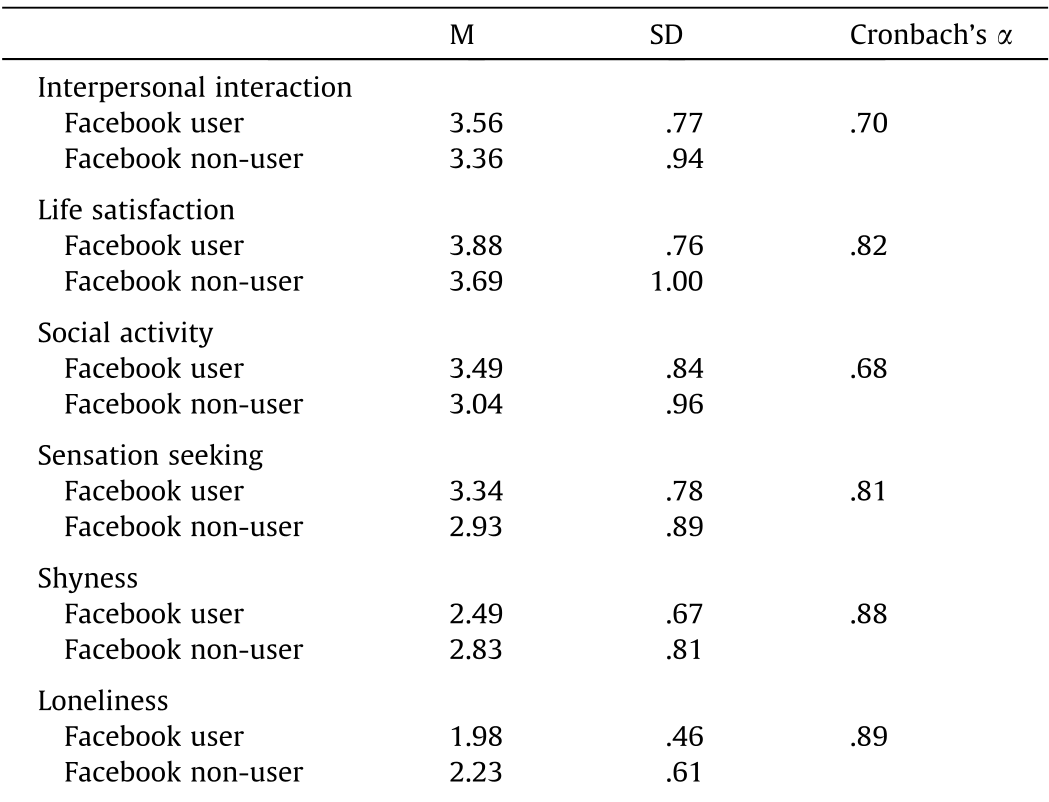 Table 1: Descriptive statistics showing significant gaps in social activity and sensation seeking between groups.
The Results: The Profile of a Non-User
The study found several key differentiators that separate the two groups:
1. The Age Factor
Not surprisingly, age is the biggest predictor. Non-users in the study had a median age of 27, while users had a median age of 21 (with the mean gap being even wider: 35.4 vs 25.7).
2. The Shy and Lonely Paradox
One might think the lonely would flock to Facebook to find connection. The data says otherwise. Non-users scored significantly higher on shyness and loneliness. Because Facebook is "non-anonymous" and built around existing social ties, it represents a high-stakes social environment that shy individuals may find more intimidating than welcoming.
3. Biological Drives: Sensation Seeking
High sensation seekers (HSS) have a physiological profile favoring dopamine-driven "approach" behaviors. The study found that Facebook users score much higher in "experience seeking," "disinhibition," and "boredom susceptibility." To an HSS, the fast-paced, constantly updating nature of a newsfeed provides the "arousal" they crave.
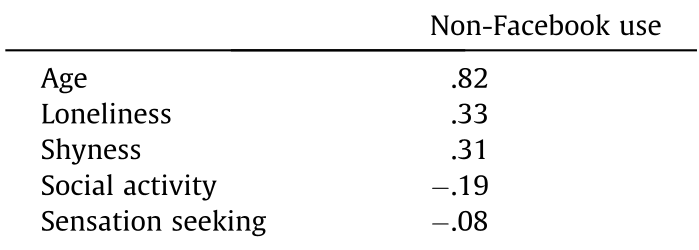 Table 3: Relative importance of variables in predicting non-use. Note how age dominates, but loneliness and shyness follow closely.
Crucial Insight: The Persistence of Personality
A common critique of such studies is that "it's just an age gap." However, Sheldon performed a MANCOVA analysis to control for age. The results were clear: even when you compare a user and a non-user of the same age, the non-user is still likely to be shier, less socially active, and lower on sensation-seeking scales. This confirms that digital platform adoption is as much about who you are as how old you are.
Summary and Future Outlook
This work highlights a subtle but dangerous form of the Digital Divide. If social media is where jobs are found, roommates are vetted, and communities are built, those who are naturally shy and lonely are being left further behind.
Limitations: Written in 2012, this study reflects a world where Facebook was the dominant SNS. Today, we must ask: Does the high-stimulus environment of TikTok attract even more extreme sensation seekers? Does the anonymity of Discord finally provide the social compensation for the shy that Facebook couldn't?
The takeaway remains: Technology doesn't just change our behavior; it selects for it.