
AppWiR: Decoding How Mobile Apps Drain Cellular Network Resources
13441_Profiling Wireless Resource Usage for Mobile Apps via Crowdsourcing-Based Network Analytics.
This paper introduces AppWiR, a crowdsourcing-based network analytics system designed to profile and predict mobile app resource usage in cellular networks. By establishing a two-layer causal mapping between app behaviors, network traffic, and wireless resources, it achieves state-of-the-art accuracy in quantifying individual app impacts on LTE network power consumption.
TL;DR
Mobile carriers have long struggled to pinpoint exactly how much "stress" a specific app—like WeChat or YouTube—puts on their cellular infrastructure. AppWiR is the first industrial-grade system that uses crowdsourcing to build a "causal bridge" between app activities and low-level network power consumption. By leveraging a two-layer mapping model, it predicts resource usage with high accuracy without the prohibitive cost of continuous Deep Packet Inspection (DPI).
The "Invisible" Resource Problem
When you open an app, your phone isn't just using its own battery; it's triggering a cascade of signaling and data transfers that consume Transmission Control Protocol (TCP) power at the local cell tower.
Existing tools were stuck in a dichotomy:
- Device-side profiling: Measures phone battery but ignores the network.
- Network-side monitoring (DPI): Too heavy and expensive to run 24/7.
The authors identified a gap: we lacked a mathematical mapping that shows how "App A's heartbeats" translate into "Cell Tower B's power usage."
Methodology: Building the Two-Layer Bridge
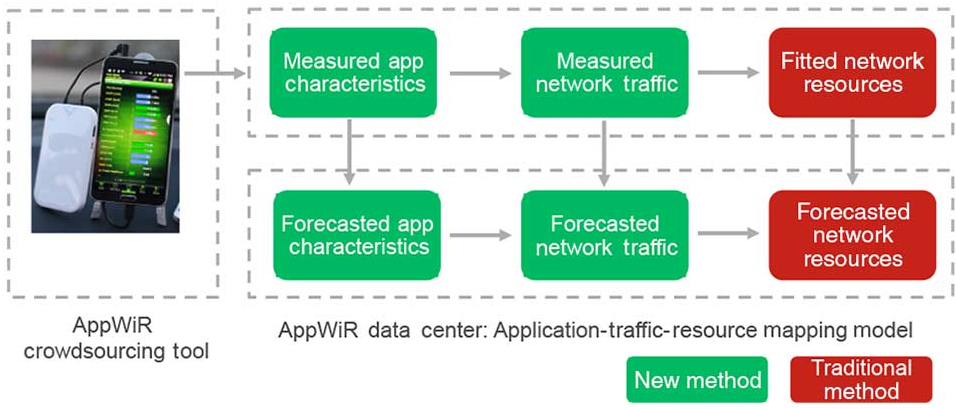
The core innovation of AppWiR is treating network traffic as an intermediate "bridge." Instead of a direct jump from an app to power consumption, the system uses two distinct layers:
1. App Behavior Network Traffic
The system identifies which app indicators (e.g., Active Sessions, Packet Call Frequency) drive traffic.
2. Network Traffic Wireless Resources
The system maps traffic indicators (e.g., PRB usage, RRC Connected Users) to actual TCP Power.
Advanced Mining Algorithms
To make this work, the authors introduced two specific algorithms:
- PMFS (Proximity Matrix-Assisted Feature Selection): Uses Random Forest decision trees to filter out noise and find the indicators that truly matter (e.g., realizing that "Simultaneous Users" is more predictive of power than "Handover" events).
- SW-LOESS: A regression technique with a dynamic window that adapts to the highly variable nature of cellular data, ensuring the mapping stays accurate even during traffic bursts.
Real-World Trial: What's Eating the Network?
The authors deployed AppWiR in a major LTE carrier's network. The findings confirmed long-held suspicions but with quantitative proof:
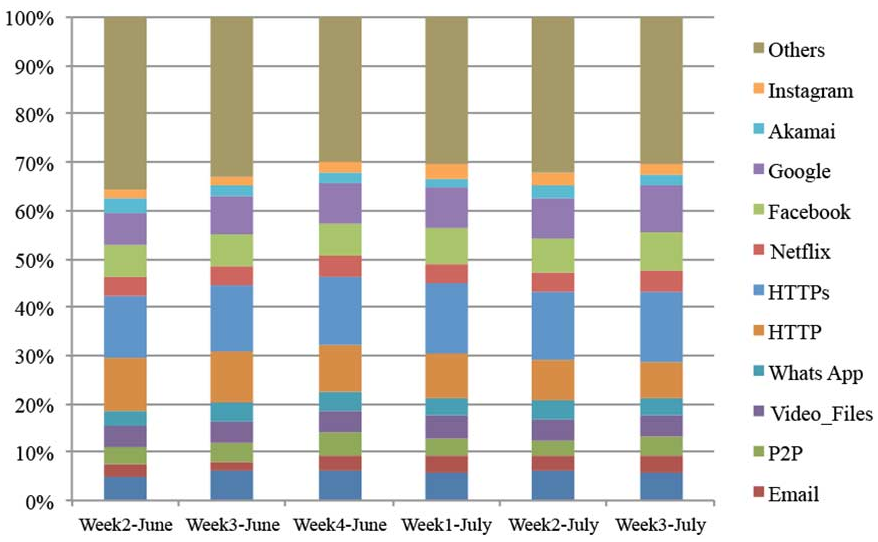
- The Usual Suspects: HTTP/HTTPS (Web browsing) and Video Streaming remain the heavy hitters in terms of raw power consumption.
- The Signaling Storm: "Chatty" apps like Facebook and WhatsApp, while lower in data volume, consume significant resources due to high user counts and frequent signaling.
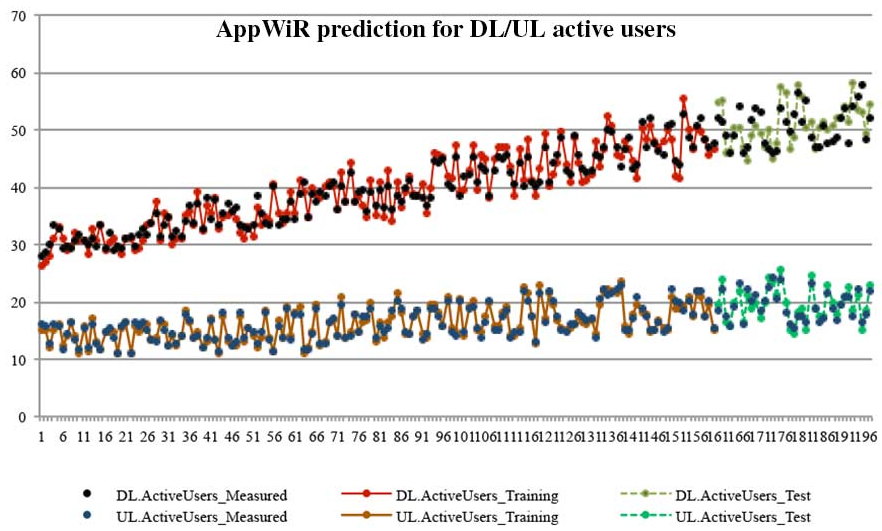
The prediction capabilities were equally impressive. By decomposing time-series data into Trend, Seasonality, Burst, and Noise, the system achieved a Mean Absolute Percentage Error (MAPE) of approximately 12-15% for future traffic prediction.
Critical Insight & Conclusion
The true value of AppWiR lies in its diagnosability. For the first time, a network engineer can see a spike in power usage and trace it back to a specific app behavior.
Takeaway: This work paves the way for "App-Aware" networks. In the future, carriers could use these insights to create smarter data plans or prioritize specific app traffic during peak hours to maintain quality of service (QoS) without over-provisioning expensive hardware.
Limitations: As noted in the trial, the model struggled slightly with "Mobility Indicators" (handovers) because the training was limited to specific test cells. Future iterations will likely need broader geographic data to master the complexities of high-speed user movement.