
Elevating E-Commerce: Deciphering the "Where, When, and What" of Digital Promotions
Promoting where, when and what? An analysis of web logs by integrating data mining and social network techniques to guide ecommerce business promotions
The paper proposes an integrated web mining framework that combines statistical analysis, association rule mining, and Social Network Analysis (SNA) to model e-commerce visitor behavior. By analyzing web logs from the "Music Machines" repository, it identifies navigational patterns to optimize digital marketing strategies.
TL;DR
In the hyper-competitive world of e-commerce, generic marketing is a relic of the past. This paper presents a sophisticated hybrid framework that treats web pages as "social actors." By integrating Association Rule Mining with Social Network Analysis (SNA), the authors transform cold web log data into a dynamic roadmap for targeted promotions, identifying exactly which pages hold the most social "capital" and which user paths lead to the highest conversion probability.
The Cognitive Gap in Web Analytics
Historically, web admins relied on "page hits"—a vanity metric that tells you what happened but never why. The authors argue that the real value lies in the digital footprint: the specific sequence of clicks that signal a user's intent.
The core challenge is three-fold:
- Noise: Distinguishing meaningful navigation from random clicks or media loading.
- Mapping: Visualizing the relationships between seemingly disparate product pages.
- Foresight: Moving from historical reporting to predictive promotion.
Methodology: The Power of the Triple Integration
The paper moves beyond basic statistics into a multi-layered analytical engine.
1. Identifying the "Backtrack" (UX Friction)
By calculating instances where a user reaches a page and immediately returns to the previous one (e.g., A -> B -> A), the authors identify "low-interest" or "high-friction" pages. High backtrack counts are red flags for bad pricing or poor content.
2. Sequential Association Rules
Using the CloSpan algorithm, the system identifies "Closed Frequent Itemsets." This isn't just about what people buy, but the order in which they browse.
- Insight: If a user visits Moog patches and then Roland patches, there is a 92% confidence they will seek Sequential Pro-One patches.
3. The Social Network of Pages
This is the paper’s most innovative "leap." By treating each HTML page as a node and the transition frequency as weighted edges, they construct a directed graph of the entire website.
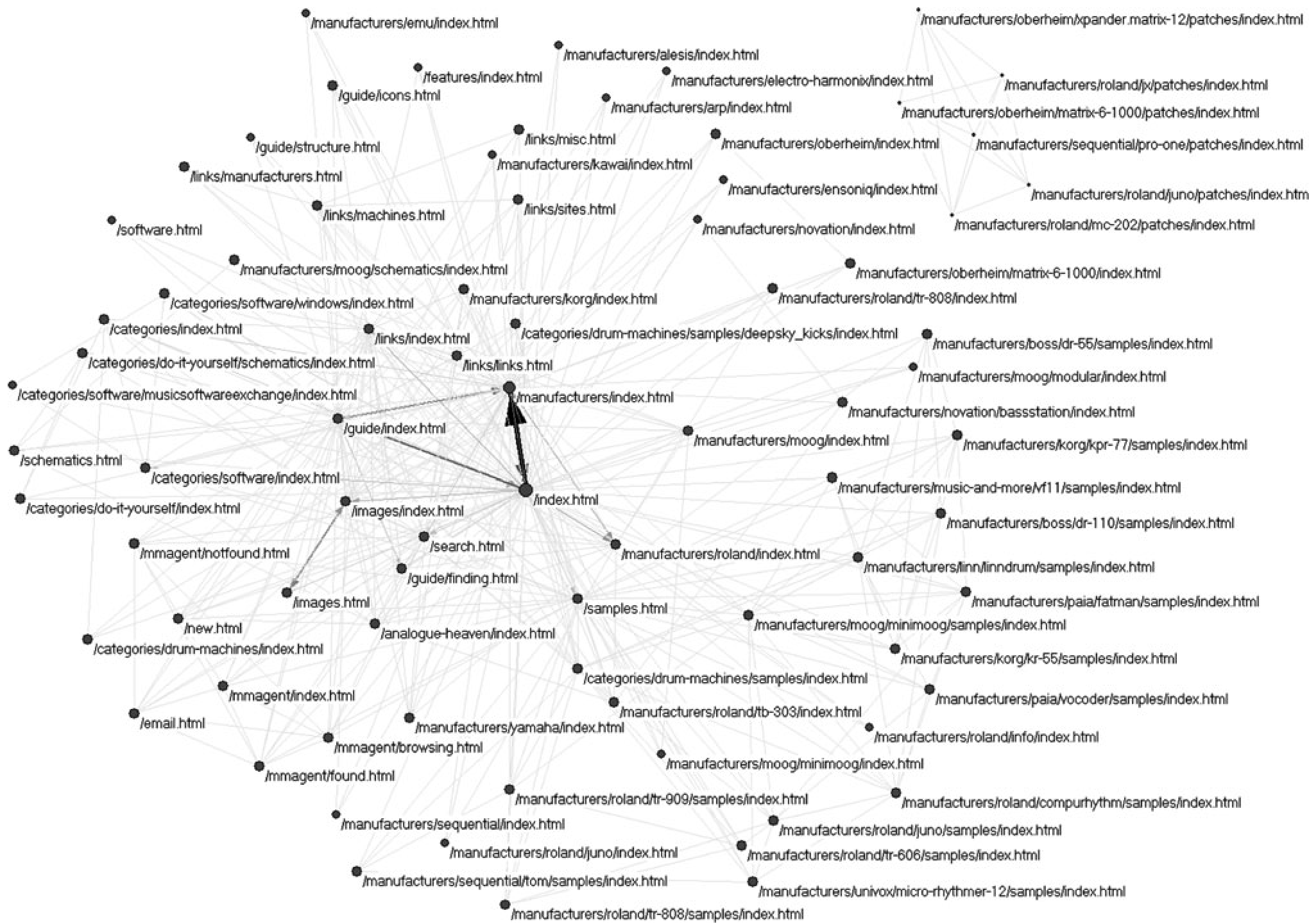 Figure 1: A reduced social network showing page relationships. Thicker/darker lines indicate stronger navigational "ties".
Experiments & Strategic Results
Using the Music Machines dataset (University of Washington), the authors applied several SNA metrics to solve business problems:
Hubs and Authorities (HITS)
The algorithm identifies Authorities (pages that contain the actual info users want) and Hubs (pages that lead to many authorities).
- Business Takeaway: Place your most expensive, high-margin ads on "Authority" pages (like
/guide/index.html) because they are the ultimate destination for most users.
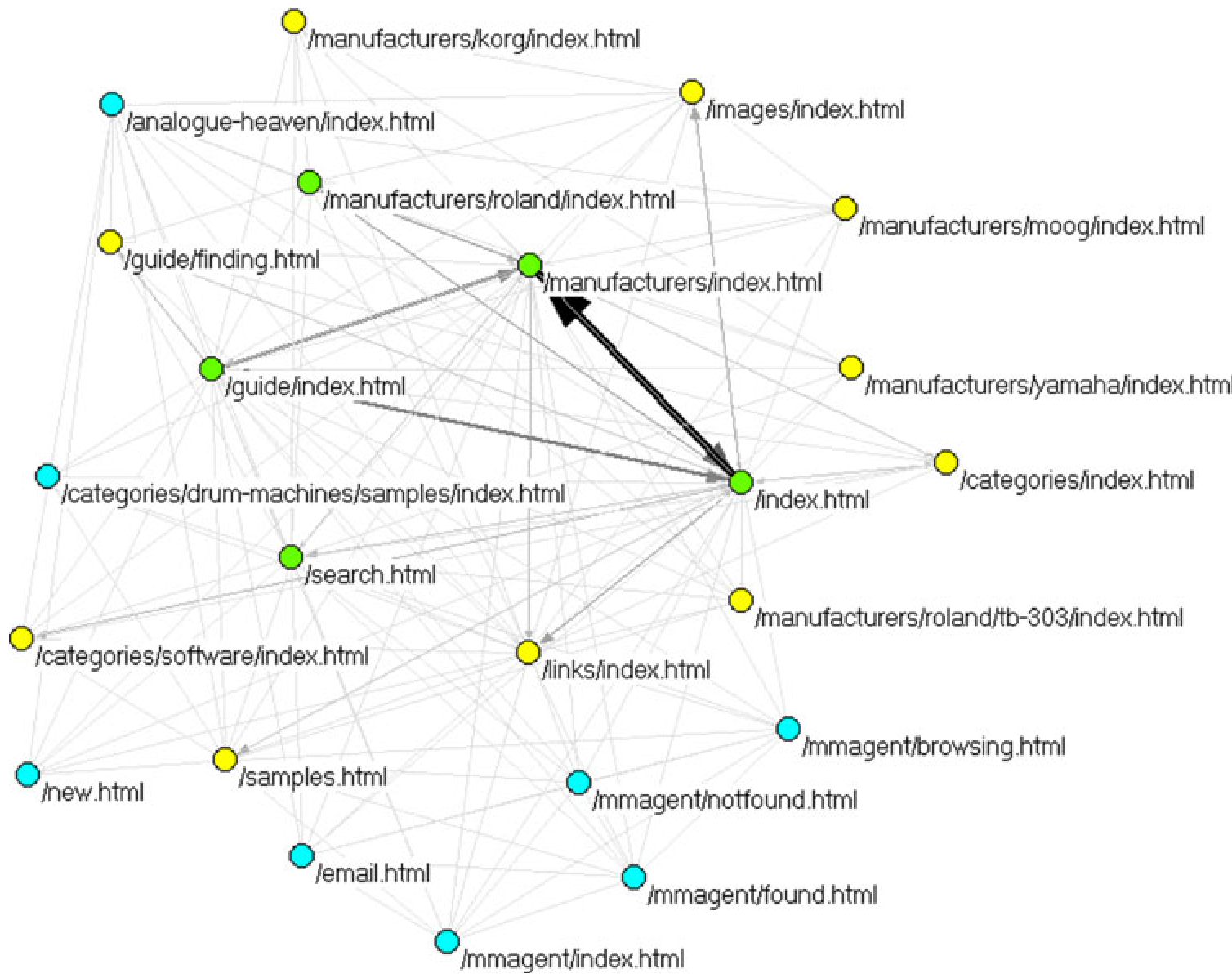 Figure 2: Top Hubs (green) and Authorities (yellow). Managing these nodes is key to controlling site traffic.
Community Detection (Islands)
By partitioning the graph into "islands," the authors found natural user segments. For instance, "Software Patch" seekers form a distinct, tightly-knit community.
- Business Takeaway: If a user enters the "Patch Island," do not show them hardware ads; show them software-specific bundles to maximize relevance.
Critical Analysis & Future Outlook
The beauty of this approach is its inductive bias: it assumes that the structure of the web itself reflects the collective psychology of its users.
Strengths:
- Visual Intuition: Converting logs into a graph makes complex behavior visible to stakeholders.
- Multi-Metric Validation: Combining PageRank, HITS, and Association Rules provides a "3D view" of page importance.
Limitations:
- The data used (1997) is vintage. Modern web logs carry much more noise (bots, AJAX calls).
- The model assumes a relatively static site structure, which may not hold for modern headless CMS platforms.
The Future: The logical next step is the transition from SNA to Graph Neural Networks (GNNs), where a model can learn the "embeddings" of these pages to predict the "Next Best Action" in real-time, even for first-time visitors with no historical data.
Conclusion
This paper serves as a seminal blueprint for data-driven e-commerce. It proves that by applying the mathematics of social relationships to web architecture, we can turn a passive website into an active, intelligent sales agent that knows exactly when to whisper the right offer into the user's ear.