
PSAR: Revolutionizing Multimedia Distribution through Social Propagation Insights
Propagation-based social-aware multimedia content distribution
The paper proposes PSAR (Propagation-based Social-Aware Replication), a multimedia content distribution framework that leverages social, geographical, and temporal propagation patterns. It utilizes a hybrid edge-cloud and peer-assisted architecture to optimize the delivery of user-generated content (UGC) within online social networks.
TL;DR
Current multimedia delivery systems are being "choked" by the sheer volume of user-generated content (UGC). Traditional CDNs, designed for steady blockbusters, fail to handle the volatile, fragmented nature of social sharing. This paper introduces PSAR, a framework that treats social connections as a roadmap for content replication, utilizing a hybrid edge-cloud and peer-to-peer (P2P) architecture to improve local delivery efficiency by up to 40%.
The Crisis of the "Long Tail"
In the era of YouTube and microblogs, content is no longer a few "hits" served to millions. Instead, it’s millions of "niche" videos shared among small social circles. This creates a close-to-uniform popularity profile where traditional caching (like LRU/LFU) breaks down.
- The Pain Point: It’s too expensive to replicate every niche video everywhere, yet users demand high Quality of Experience (QoE).
- The Insight: Social content doesn't move randomly. It follows Localities:
- Social Locality: If I share a video, my direct friends (close in social hops) are the most likely viewers.
- Geographical Locality: Friends often live near each other; 90% of content stays within five geographic regions.
- Temporal Locality: 95% of shares happen within the first 24 hours of posting.
Methodology: The PSF Predictor Trio
The authors move beyond static popularity by introducing three dynamic indices to guide the hybrid architecture.
1. The Global-Audience Predictor (Edge-Cloud Strategy)
Instead of looking at how many views a video had, they look at how it is propagating. The formula incorporates propagation size (), depth (), and time lag (): Logic: A large size () but shallow depth () suggests a viral "explosion" waiting to happen, warranting more server bandwidth.
2. The Geographic Influence Index
This determines where to replicate. By analyzing the locations of a sharer's friends, PSAR pre-positions content at the edge-cloud server geographically closest to the "future" audience.
3. The Local-Audience Predictor (Peer-Assisted Caching)
Peers (users) don't just cache what they watched; they cache what their friends are likely to watch next. This turns your device into a local server for your social circle.
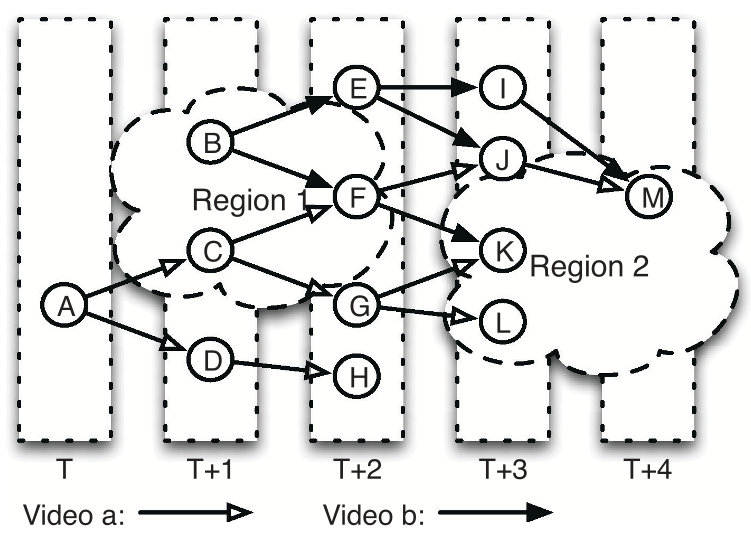 Figure 1: The dual-overlay architecture—Social Propagation Overlay (who shares) and Delivery Overlay (who serves).
Experimental Evidence
The team tested this against real-world Tencent Weibo traces (350k+ videos, 1.4M+ users).
- Server Efficiency: PSAR achieved a 30% higher "Local Download Ratio" than traditional popularity-based methods. This means 30% more traffic stayed within the local regional network, saving massive backbone costs.
- Peer Performance: The Socially-Aware Cache Replacement increased the hit ratio by 40% over LFU/LRU. Specifically, it was twice as effective at ensuring users could download directly from a "1-hop" or "2-hop" social friend.
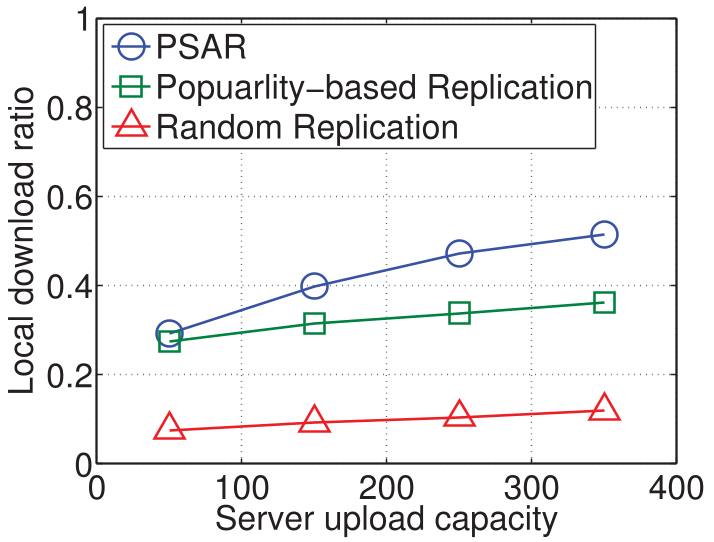 Figure 2: Performance comparison showing PSAR's superior local download ratio as server capacity increases.
Critical Analysis & Future Outlook
Why does it work? PSAR succeeds because it bridges the gap between the Application Layer (social context) and the Network Layer (data replication). It realizes that in the modern web, "Your Data is Your Social Graph."
Limitations:
- Privacy: Tracking friend locations and preferences at the peer level raises significant privacy concerns.
- Device Overhead: Peer-assisted caching consumes battery and storage on user devices, requiring better incentive mechanisms.
The Future: As we move toward the Metaverse and ultra-personalized content, the "Social-Aware" philosophy will likely evolve into AI-driven edge intelligence, where GNNs (Graph Neural Networks) replace these manual indices to predict the next viral hit with millisecond precision.
Conclusion
PSAR provides a robust blueprint for transitioning from "Content-Centric" to "Propagation-Centric" distribution. By acknowledging that a video's value is defined by its social trajectory, we can build a more efficient, decentralized Internet.