
ElderGames: Bridging Kinesiology and Serious Gaming through Adaptive Architecture
A Proposed Serious Game Architecture to Self-Management HealthCare for Older Adults
The paper proposes a holistic Serious Game architecture for elderly healthcare, integrating Microsoft Kinect sensors and Machine Learning to enable home-based kinesiology. The system, aimed at reducing the burden on overloaded hospitals, combines physical motor training with emotional monitoring to provide personalized, remote rehabilitation supervised by healthcare professionals.
TL;DR
With an aging global population, healthcare systems are facing unprecedented strain. This paper presents a specialized Serious Game Architecture designed for older adults. By combining Microsoft Kinect depth sensing, Machine Learning, and psychological mood assessment, the system transforms home-based physical therapy into an engaging, supervised, and highly personalized digital experience.
Background Positioning
Unlike generic fitness apps, this work positions itself as a clinical tool. It bridges the gap between Remote Patient Monitoring (RPM) and Exergaming, specifically targeting the kinesiology domain where disruptions in coordination and balance (common in aging) require expert guidance.
The Core Motivation: Beyond Static Rehabilitation
The authors identify two fatal flaws in current elderly care:
- Resource Scarcity: There aren't enough kinesiologists for 1-on-1 daily sessions.
- The Motivation Gap: Fatigue, depression, and social isolation often lead to high drop-out rates in home exercise programs.
The "Insight" here is Adaptive Calibration: A rehabilitation system should not just measure move accuracy; it must understand the user's willingness and capacity to move on any given day.
Methodology: The "Mood-Physical" Feedback Loop
The proposed architecture is built on five pillars designed to simulate a "virtualized therapist."
1. Mood Temperature Factor
Before any exercise begins, the system uses "Powerful Questions" and the Lüscher Color Diagnostic (mapping colors like Red to excitement or Blue to sadness) to calculate a "Mood Temperature." This factor determines if the session will be Easy, Medium, or Hard.
2. The Multi-Module Architecture
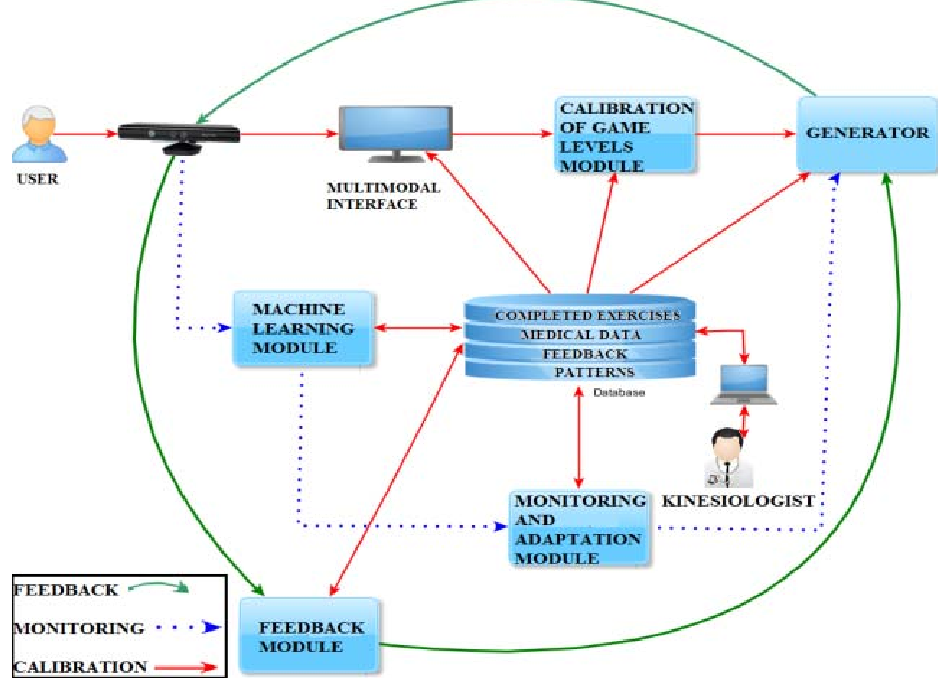
- Calibration Module: Sets limits based on the kinesiologist’s clinical input and the user’s current mood.
- Monitoring & Adaptation: This is the "Brain." It parses frames from the Kinect, identifies skeleton joints, and compares them to an Ideal Exercise Pattern in the Knowledge Base.
- Machine Learning Module: Archives performance data to build a custom "User Profile," allowing the software to learn that Patient A has a limited range of motion in the right shoulder and should not be penalized for it.
Human-in-the-Loop: The Virtual Friend
To combat isolation, the architecture includes a "Virtual Friend" (a chosen avatar like a pet or a digital companion). More importantly, the system provides Visualized Success: users see their movements executed successfully in the virtual world, which the authors argue "strengthens brain pathways" through visualization—a key concept in motor neuro-rehabilitation.
Analysis: Why This Approach Matters
The shift from "recording data" to "interpreting behavior" is critical. By using ML to detect symptoms or falls and providing real-time sound cues (e.g., "You can do better than that!"), the system mirrors the encouragement of a human therapist.
Comparison with Prior Work
| Feature | Traditional Exergames (e.g., Wii Fit) | Proposed Architecture |
|---|---|---|
| Supervision | None | Remote Kinesiologist Oversight |
| Personalization | Static Difficulty | Dynamic (Mood + ML History) |
| Clinical Logic | Entertainment-focused | Medical Pattern Matching |
Conclusions and Future Perspectives
The paper concludes that while Kinect is a powerful starting point, the future of elderly care lies in Sensor Fusion. The authors plan to integrate wearable devices (rHEALTH sensors, Smart T-shirts) to capture heart rate and balance data with even higher precision.
Critical Analysis: While the architecture is robust, the reliance on the Lüscher test—a psychometric tool with debated clinical validity—might be the "weakest link." However, the integration of high-level clinical supervision into a low-cost gaming setup represents a significant step toward scalable, home-based geriatric care.
Takeaway for the Industry: Serious games for health are no longer just about "making exercise fun"; they are becoming sophisticated data-gathering ecosystems that turn a living room into a clinical satellite.