
Inclusive Search: Bridging the Digital Divide with Organizational Semiotics
Prospecting an Inclusive Search Mechanism for Social Network Services
The paper proposes an inclusive search mechanism for Inclusive Social Network Services (ISN) specifically designed for users with low digital literacy or language barriers. It introduces the "Semiotic Web Ontology," which combines Organizational Semiotics with Semantic Web technologies to map colloquial and local vocabularies to formal system concepts.
TL;DR
Standard search engines fail users who don't speak "formal" tech-speak. This paper introduces a search mechanism for Inclusive Social Network Services (ISN) that uses Organizational Semiotics to understand informal, colloquial language. By mapping local vocabulary (like "postinho" for a health center) through a Semiotic Web Ontology, the system ensures that social and digital diversity doesn't lead to information exclusion.
Background: The Literacy Barrier in Search
In developing contexts like Brazil, functional illiteracy and a lack of computer experience create a massive "Search Barrier." Most search engines operate on a lexical-syntactical level—if the exact word isn't in the database, the user gets zero results. For a user with low schooling, who might use highly regional or informal terms, the internet remains a locked box.
The authors argue that for a social network to be truly inclusive, it must respect the Emergence of Meaning: the way communities create their own local dialects and shared understandings through interaction.
Methodology: From Human Action to Machine Logic
The core innovation is the move from a static, formal ontology to a Semiotic Web Ontology. This is achieved through the Semantic Analysis Method (SAM).
1. Agents and Affordances
Unlike standard Semantic Web models that treat concepts as abstract entities, SAM focuses on:
- Agents: Individuals or groups (e.g., a "seamstress" or "grocer").
- Affordances: Repertoires of behavior or actions (e.g., "sewing" vs. "selling").
2. Disambiguation via Context
By understanding the agent, the system can solve the Polysemy problem (words with multiple meanings).
- If a Seamstress searches for "manga," the system prioritizes sleeves.
- If a Grocer searches for "manga," the system prioritizes mangoes.
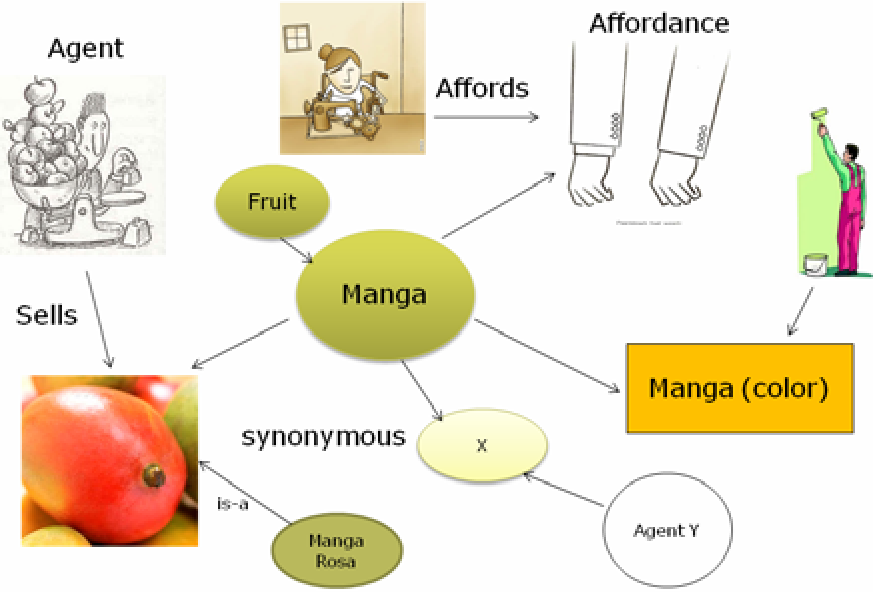 Figure 1: Illustration of how different agents (Grocer, Seamstress) relate to the same signifier (Manga) through different affordances.
3. The Extraction Pipeline
The authors propose a semi-automatic method to keep the ontology updated with the community’s evolving language:
- Extraction: Mining the ISN database (chats, posts) for new terms.
- Modeling: An engineer uses SAM to create an Ontology Chart (OC).
- Transformation: The OC is converted into a computationally tractable OWL ontology.
Experimental Insights: How Real Users Search
The authors conducted workshops within the "Vilanarede" ISN. The results were eye-opening:
- Natural Language Instincts: Users often typed full questions (e.g., "How do I make a medical appointment?") rather than keywords.
- Synonym Struggles: Users searching for "popularize" used Brazil-specific idioms like "boca-a-boca" (word-of-mouth).
- Broad vs. Specific: Users recognized that searching for "food" (comida) was easier because it "covered everything" they didn't know how to name specifically.
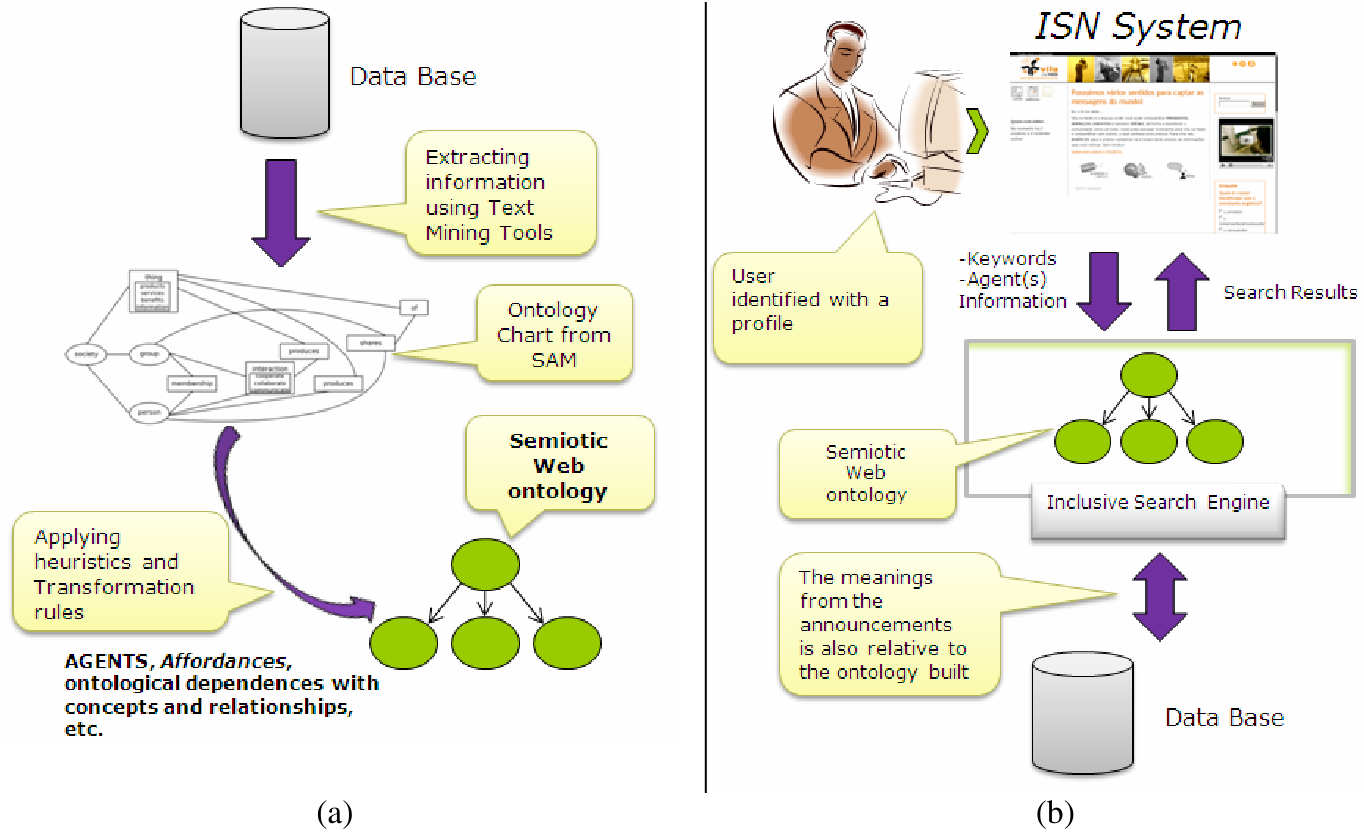 Figure 2: The dual-process architecture: (a) building the ontology from database interactions, and (b) the semantic search execution flow.
Critical Analysis: Why This Matters
The brilliance of this work lies in its Inductive Bias toward social context. While Silicon Valley focuses on "Vector Embeddings" and "Neural Search," these researchers emphasize that meaning is a social construct.
Strengths:
- Human-Centric: It acknowledges that users aren't just "requesting data"; they are "making sense" of a community.
- Learning Opportunity: When a user searches with a colloquial term and receives a formal result, the system acts as a bridge for literacy improvement.
Limitations:
- Scalability: The semi-automatic nature requires an "ontology engineer" to intermediate, which might struggle with the explosive growth of a massive social network.
- Cold Start: The system requires a significant amount of interaction data to begin "understanding" the local dialect.
Conclusion
This paper is a vital reminder that Universal Access isn't just about providing more Wi-Fi; it's about building systems that speak the user’s language. By grounding Semantic Web tech in Organizational Semiotics, we can build platforms that don't just index data, but respect human diversity.