
KH-inv-LD: Safeguarding Sensitive Labels in the Age of Weighted Social Networks
Protecting Sensitive Labels in Weighted Social Networks
This paper introduces the k-histogram-inverse-l-diversity (KH-inv-LD) model, a novel privacy-preserving framework for weighted social networks. It focuses on anonymizing both edge weights and sensitive node labels simultaneously to prevent identity and attribute disclosure in data publishing.
TL;DR
While many social network privacy techniques focus on "who is connected to whom," they often ignore the specific "labels" (like salary or medical data) attached to those users in weighted graphs. This paper proposes the KH-inv-LD (k-histogram-inverse-l-diversity) model. It ensures that no user can be uniquely identified by their connection weights, and even if a group is identified, their sensitive attributes remain diverse enough to prevent disclosure.
Background: The Hidden Leakage in weights
In a typical recommendation system or professional network, edges represent interactions with specific intensities (weights). An attacker with "background knowledge" might know that "Alice has 5 connections with specific involvement levels." This set of weights—a weight bag—acts as a fingerprint.
Previous studies focused on making these weight bags indistinguishable (k-histogram anonymity). However, the authors argue this is insufficient. Even if you hide Alice among people, if all people in that group share the same sensitive label (e.g., "Salary: 100K"), Alice's privacy is still compromised.
The Challenge: Balancing Utility and Privacy
The core difficulty lies in preserving the "Utility" of the graph. If we scramble weights or labels too much, the data becomes useless for researchers or recommendation algorithms. The authors identify two main hurdles:
- Weight Bag fingerprinting: Hiding the identity within a group of similar nodes.
- Sensitive Label homogeneity: Reaching -diversity without losing the semantic meaning of the labels.
Methodology: The KH-inv-LD Framework
The authors propose a robust two-step pipeline to solve this:
1. k-histogram Anonymization
The algorithm maps every node's weight bag into a d-dimensional space. By sorting these bags and grouping nodes with the most similar degrees, they modify weights minimally to make all nodes in a group identical in their weight distribution.
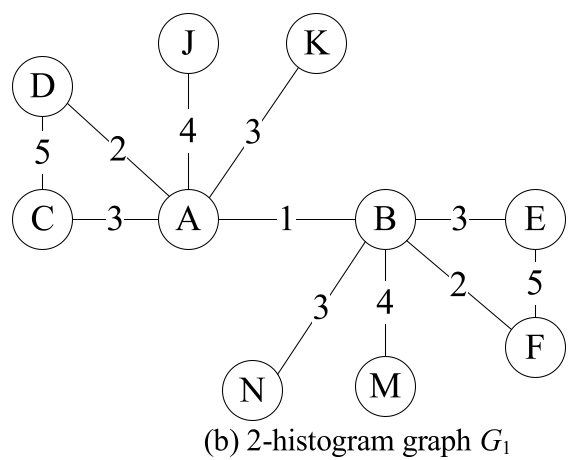 In the figure above, (a) shows the original graph vulnerable to sub-graph attacks, while (b) demonstrates the 2-histogram graph where nodes like A and B become indistinguishable.
2. Multi-Sensitive Attribute Generalization (MSAG)
Unlike simple -diversity which might just replace values, the authors use Generalization Trees.
- Numerical values (like Salary) are converted into ranges (e.g., 80K-100K).
- Categorical values (like Disease) are moved up to a "parent" category in a hierarchy (e.g., "Flu" becomes "Respiratory").
The innovation here is the Split-Domain Generalization. Instead of generalizing everything (which destroys utility), they calculate the similarity between attributes to group similar labels together, minimizing the "Information Loss" (IL).
Experimental Results: High Stakes, High Utility
The researchers tested their methods on scientific collaboration datasets (Hep-Th and Cond-Mat-2005).
- Runtime Efficiency: The algorithm (MSAG) processes complex multi-attribute data efficiently. While affects the runtime due to larger grouping calculations, the diversity parameter has a negligible impact on speed.
- Data Integrity: The edge weight distribution of the anonymized graph (KHG) closely mimics the original, ensuring that graph-theoretic analysis remains valid.
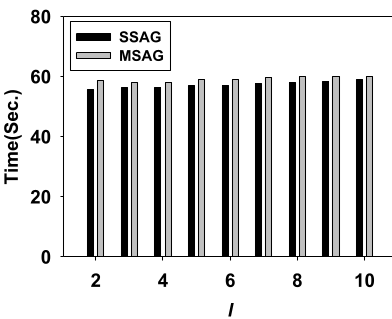 The Error Rate (RQ) remains acceptable (around 0.2-0.3) even as privacy constraints () increase, proving that their similarity-based generalization preserves the core data utility.
Critical Insight & Conclusion
This work bridges a critical gap between Graph Theory and Relational Data Privacy. By treating weight bags as quasi-identifiers and node labels as sensitive attributes, the KH-inv-LD model provides a holistic shield for social network data.
Takeaway for Practitioners: When publishing graph data, structural anonymity is only half the battle. If your nodes carry sensitive metadata, you must ensure attribute diversity within your structural partitions to prevent "homogeneity attacks." The split-domain generalization presented here offers a practical roadmap for maintaining high utility while meeting strict privacy requirements.