
Selective Exposure: Solving the Fine-Grained Privacy Crisis in Distributed Social Networks
Protecting User Profile Data in WebID-Based Social Networks Through Fine-Grained Filtering
The paper proposes a fine-grained filtering mechanism for WebID-based Distributed Social Networks (DSNs) using SPARQL CONSTRUCT queries. By implementing a graph-to-graph transformation, it enables users to protect sensitive RDF triples within a single profile document, providing requester-specific views without data fragmentation.
TL;DR
Current Decentralized Social Networks (DSNs) face a "binary privacy" trap: you either share your whole profile or nothing at all. This paper introduces a sophisticated graph-to-graph transformation approach that uses SPARQL to filter sensitive data on-the-fly. Instead of splitting your digital identity into a dozen confusing files, you keep one profile and give each friend (or stranger) a uniquely filtered view.
The Core Motivation: The "All-or-Nothing" Problem
In the vision of the Semantic Web, a WebID acts as your global passport. However, the standard access control (WAC) is remarkably blunt. If Alice wants to share her work email with a recruiter but keep her home address for close friends, WAC forces her to store these in separate files.
This creates a maintenance nightmare:
- Fragmentation: Data is scattered across the cloud.
- Migration Friction: Moving your profile to a new provider requires re-linking dozens of fragmented permissions.
- Privacy Leaks: Metadata in an unprotected WebID profile often leaks more than intended during the initial "handshake" of authentication.
Methodology: Graph Transformation as a Shield
The authors move away from "file-level" security to "triple-level" security. They model the user profile as a mathematical graph . When a requester asks for the profile, the system doesn't just return ; it applies a transformation function .
1. The Filtering Logic
The system uses a fallback hierarchy to determine visibility:
- Specific ID: If you have a specific rule for "Bob," he sees the "Bob-view."
- Categories: If not, it checks if the requester is a "Friend" or an "Authenticated User."
- Public/Anonymous: Default view for the general internet.
2. Implementation via SPARQL
Rather than inventing a proprietary language, the authors leverage SPARQL CONSTRUCT. This is a powerful move because SPARQL is already the "native language" of the Semantic Web. By using "Property Paths," the system can handle complex relationships—for example, it can hide a street attribute only if it's attached to a homeAddress node, while leaving a businessAddress visible.
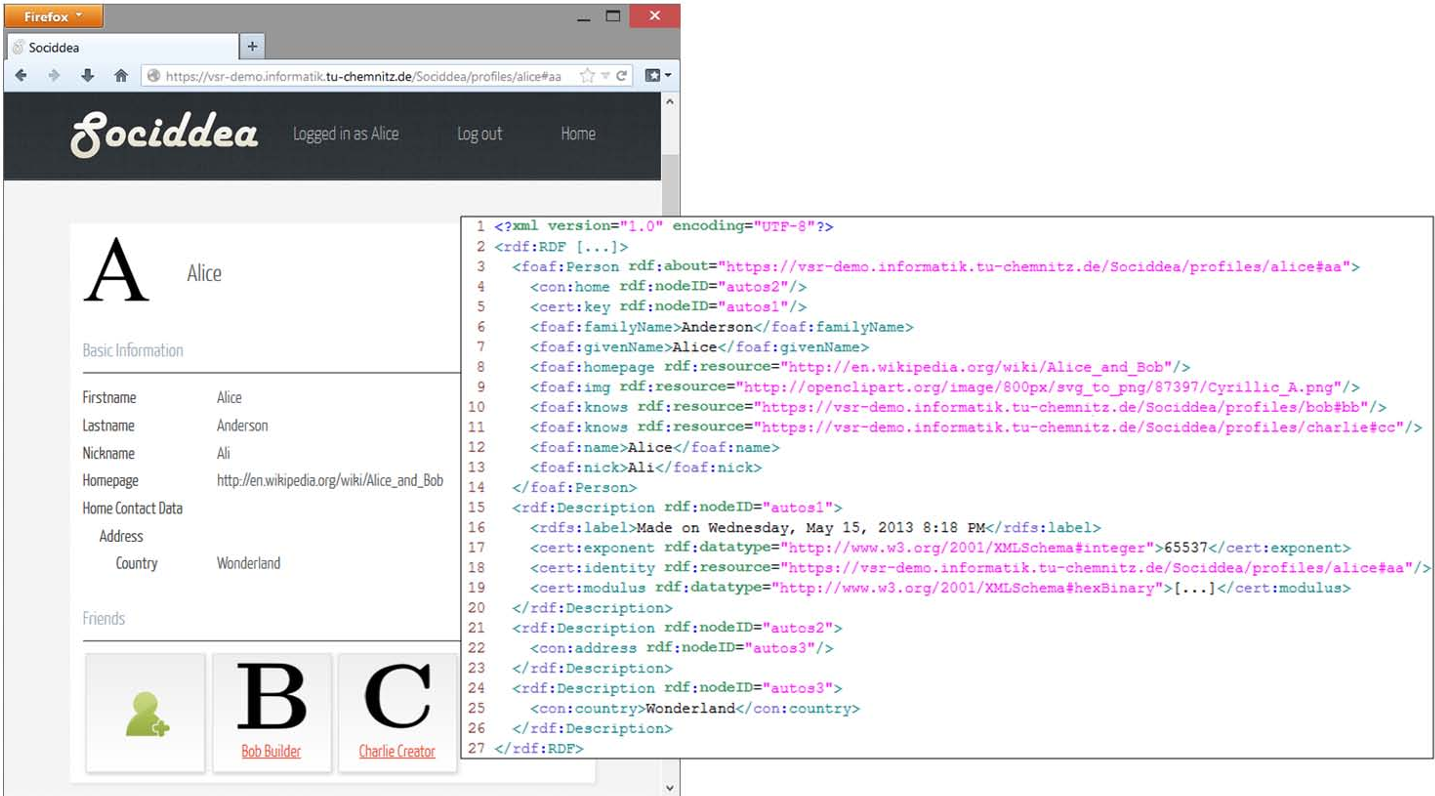 Figure: The Sociddea interface allows users to check visibility per attribute, which the backend then converts into a SPARQL query.
Experiments & Integration
The authors integrated this into Sociddea, an ASP.NET-based WebID provider. The evaluation highlights several key advantages over prior work (like ACO or standard WAC):
- Whitelisting over Blacklisting: By default, everything is hidden unless explicitly shared. This prevents "speculative" attacks where a requester might guess what is missing.
- Minimal Overhead: Setting up a new filter requires only three RDF triples in the profile metadata.
- Standard Compliance: Because it uses standard SPARQL, any compliant engine can process these filters, ensuring the profile remains portable.
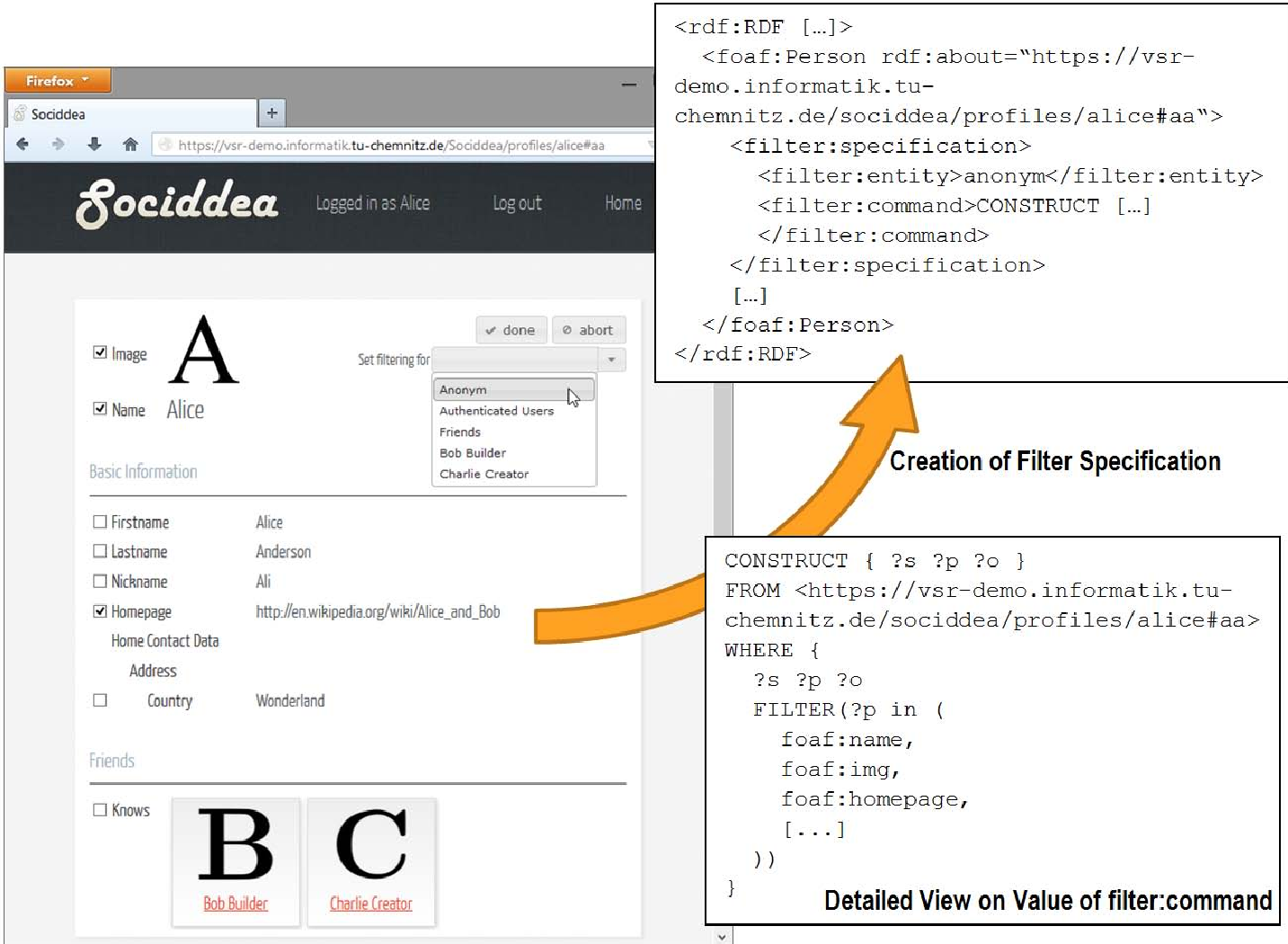 Figure: Comparison between the full owner's view and the filtered view presented to an anonymous requester.
Critical Analysis & Takeaways
This work identifies a crucial bridge between identity management and data sovereignty.
Strengths:
- Physical Intuition: Treating a profile as a dynamic "view" rather than a static file aligns with how we share information in real life (context-dependent disclosure).
- Technical Elegance: Using SPARQL's existing infrastructure avoids the "new standard" trap that often dooms academic projects.
Limitations:
- User Complexity: While Sociddea provides a GUI, writing complex SPARQL filters is still out of reach for average users.
- Performance at Scale: Dynamic graph transformation adds latency to every profile request. For a social network with millions of requests, the SPARQL engine would need significant optimization.
Conclusion
The transition from resource-based access to fine-grained data filtering is essential for the future of the Decentralized Web. This paper provides the theoretical and practical blueprint for a world where we can be "publicly private"—sharing exactly what we want, with exactly who we want, without the overhead of data silos.