
Unified Identity: Solving the Privacy Fragment Across Social Platforms
Provider-Independent Online Social Identity Management--Enhancing Privacy Consistently Across Multiple Social Networking Sites
The paper introduces a provider-independent model for Online Social Identity Management (SIdM) to help users maintain consistent privacy settings and personas across multiple Social Networking Sites (SNS). It proposes a global conceptual framework that decouples identity management from specific platforms, synchronizing "Segregated Audiences" and "Personas" across services like Facebook, Google Plus, and LinkedIn.
TL;DR
As our digital lives fragment across Facebook, LinkedIn, Twitter, and more, maintaining a "consistent self" becomes a privacy nightmare. This paper proposes a Provider-Independent SIdM model that allows users to define their social audiences and personas once in a global interface and synchronize those settings across all their social networking sites (SNS).
The "Context Collapse" Problem
In the physical world, we naturally segregate our audiences: you don't act the same way with your boss as you do with your college friends. On the web, however, we suffer from Context Collapse.
The authors identify three critical pain points in current SNS usage:
- Redundant Representations: You have to manage the same contact on multiple sites.
- Inconsistent Personas: You might update your profile picture on Facebook but forget to do so on LinkedIn, leading to a fragmented professional image.
- Attribute Conflicts: Current SNS don't allow you to show different values for the same attribute (like a "work" email vs. "personal" email) to different groups easily.
Methodology: The Global Identity Model
The core of the paper is the Global Provider-Independent Model (). Instead of thinking in terms of "Facebook Settings," users think in terms of:
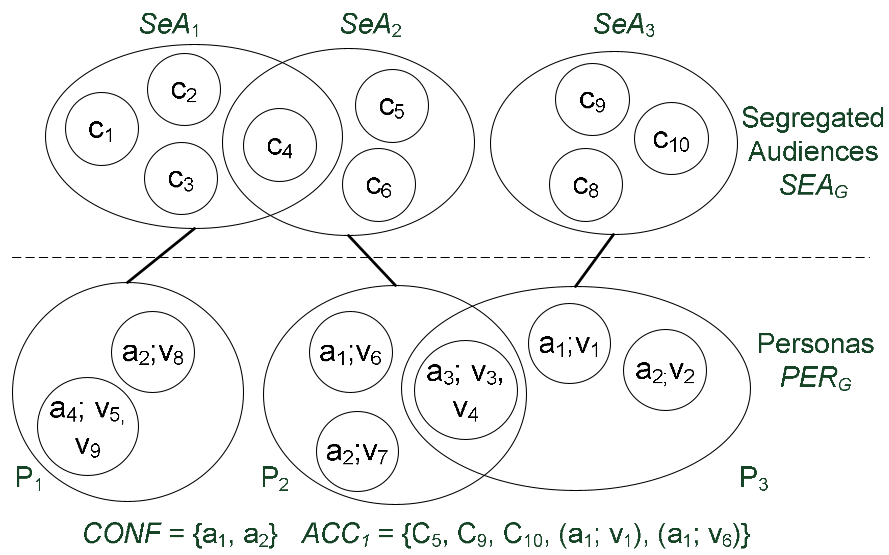
- Segregated Audiences (SeA): Groups of contacts regardless of their platform.
- Personas (PER): Bundles of attribute values (e.g., "Professional Persona" vs. "Casual Persona").
- Allocations: Mapping specific personas to specific audiences.
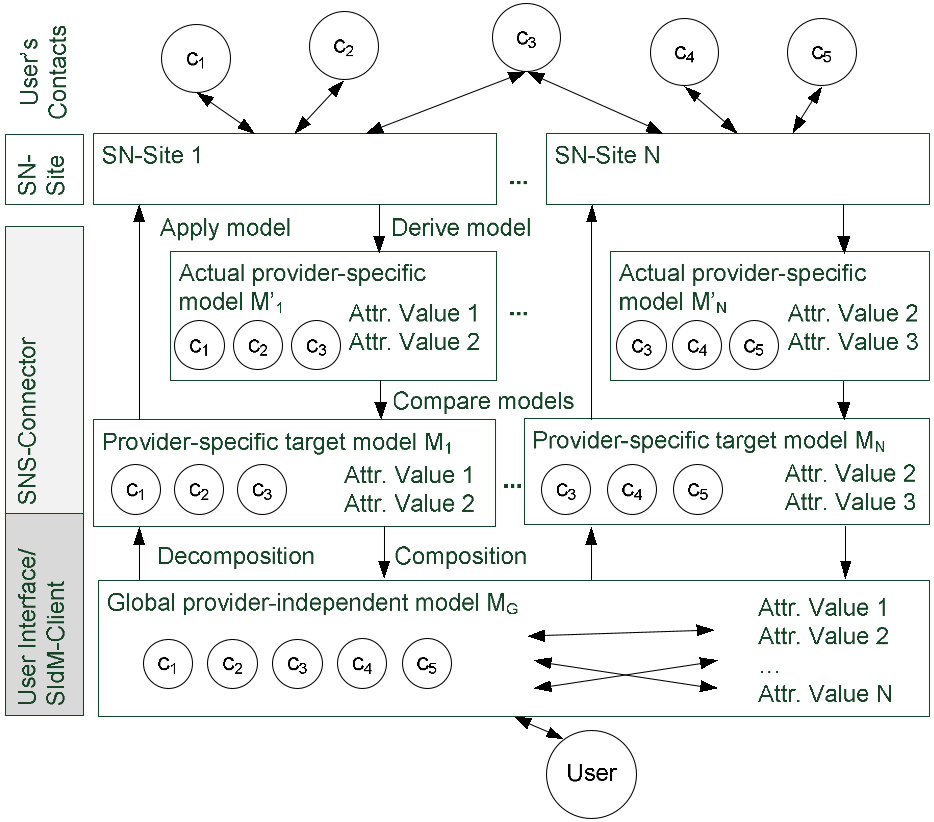
The bridge between the "Global Model" and the "Real World" is the Decomposition Process. The system breaks down the user's high-level desires into site-specific instructions. If Facebook supports "Friend Lists," the system uses them. If a site doesn't support audiences, the model suggests creating separate accounts—a "workaround" that highlights the current platform limitations.
Reality Check: Can Current SNS Handle This?
The authors surveyed 10 major platforms to see if they could actually support this provider-independent vision. The results were a mixed bag for privacy advocates:
- Granularity Gap: Google Plus (at the time) and Facebook led in audience segregation, but most others (Twitter, LinkedIn) were "all or nothing" regarding profile visibility.
- The "Static" Wall: Most platforms allow you to hide "posts" from certain people, but almost none allow you to show different values for static attributes like your name or profile picture.
- API Bottlenecks: Even if a site has the settings, their APIs often prevent external tools from changing them. Facebook's Graph API is relatively robust, while others provide no way to automate privacy settings.
Critical Insight & Future Outlook
This work highlights a fundamental tension: Users want privacy via context, but SNS providers want data via consolidation.
The transition from provider-centric to user-centric identity is not just a technical challenge—it's a policy one. While the paper provides a mathematical foundation for cross-platform identity management, its success depends on the "openness" of APIs.
Takeaways for Developers & Researchers:
- Inductive Bias: We must assume users inhabit multiple conflicting contexts simultaneously.
- API Design: Future social APIs must include "Visibility" as a first-class citizen in their CRUD operations.
- The Future is Decentralized: As current SNS remain "walled gardens," the logic proposed here will likely find its greatest application in decentralized social protocols (like Diaspora or newer Web3 social graphs) where the user truly owns the mapping of their attributes.
Conclusion
Provider-Independent SIdM offers a blueprint for a world where privacy is a global setting, not a per-app chore. By abstracting the "Social Graph," we can finally reclaim the handle on our digital personas.