
pMatch: Redefining Privacy-Preserving Task Matching in Multi-User Crowdsourcing
Proxy-Free Privacy-Preserving Task Matching with Efficient Revocation in Crowdsourcing
This paper introduces pMatch, a proxy-free privacy-preserving task matching scheme for multi-requester/multi-worker crowdsourcing. By eliminating the need for proxy re-encryption and interaction during matching, it achieves secure, scalable keyword-based matching over encrypted data with efficient worker revocation mechanisms.
TL;DR
In modern crowdsourcing (like MTurk or Kaggle), the "who" and "what" of tasks are sensitive metadata. pMatch is a groundbreaking framework that allows a crowd-server to match workers to tasks while everything remains encrypted. By removing the need for risky "proxies" and introducing a dual-tier revocation system, it sets a new SOTA for speed (60% faster matching) and security in dynamic environments.
The "Proxy" Problem: A Single Point of Failure
Traditional privacy-preserving schemes often utilize Proxy Re-Encryption (PRE). In PRE, a server holds a "re-key" to transform ciphertexts into a format the user can search.
The critical flaw? If the server is compromised and the re-keys leak, a malicious actor can often recover the master secret key, blowing the entire system's security. Moreover, most existing systems require the worker to interact with the server or requester for every single query, creating a massive bottleneck in systems with thousands of participants.
pMatch Methodology: No Proxies, No Interactions
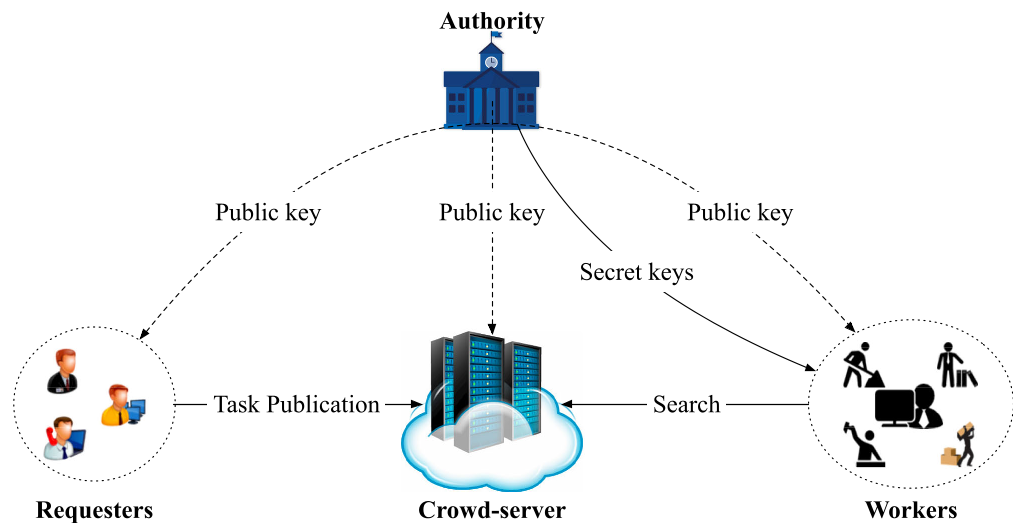
The core innovation of pMatch lies in its Proxy-Free design. It leverages Bilinear Maps and Shamir Secret Sharing to ensure that both requesters (owners) and workers (users) can generate their encrypted payloads independently.
1. The Matching Mechanism
The system utilizes a specific mathematical property of bilinear pairings. When the Crowd-Server receives a trapdoor and a ciphertext , it evaluates: If the underlying keywords match, the equation balances. This allows the server to act purely as a "blind" matching broker.
2. Intelligent Worker Revocation
Handling workers who leave the platform is usually computationally expensive. pMatch solves this with a two-step approach:
- Server-Local Revocation (SLR): A lightweight "blacklist." The server checks trapdoors against a Revocation List before matching. No key updates required.
- Global Revocation (GR): Periodically, the system performs a "clean-up" by updating version numbers and rolling over keys, preventing the Revocation List from growing too large and slowing down the server.
Experimental Results: Scaling to Millions
The authors didn't just theoretically prove pMatch; they tested it against a dataset of 1,000,000 Human Intelligence Tasks (HITs) crawled from MTurk.
Key Performance Metrics:
- Matching Efficiency: Using parallelized execution (144 threads), pMatch completed 1 million matches in 180 seconds—roughly 60% faster than the previous state-of-the-art (SEMEKS).
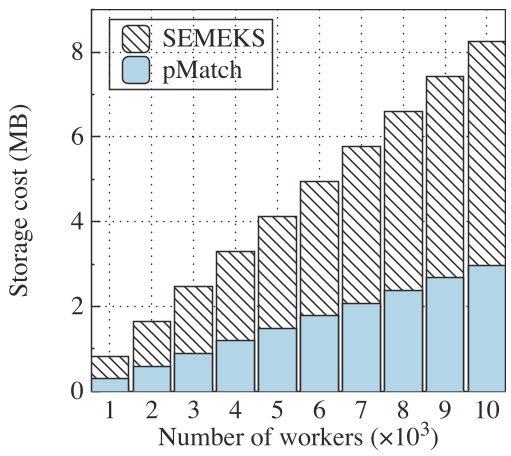
- Communication Overhead: Secret keys are drastically smaller. 10,000 worker keys take only 1.6MB compared to 8.2MB in SEMEKS.
- Revocation Scalability: The SLR check is lightning fast, with a linear time cost that remains negligible for standard-sized blacklists.
Deep Insight: Why This Matters
The value of pMatch isn't just in the speed—it’s in the security model. By proving the scheme's security under the Decisional q-Combined Bilinear Diffie-Hellman (q-DCBDH) assumption, the authors provide mathematical guarantees that the server learns nothing about the keywords, even if it tries to guess.
Limitations & Future Work: While pMatch protects keyword privacy, it does not fully hide access patterns (i.e., the server can see which tasks a worker matches with over time). Solving this requires integrating ORAM (Oblivious RAM) or Private Information Retrieval (PIR), which are currently too slow for real-time crowdsourcing but represent the next frontier.
Conclusion (Takeaway)
pMatch proves that privacy doesn't have to come at the cost of scalability. Its proxy-free nature removes the risk of master-key leakage, while its dual revocation strategy ensures the system remains fast even as users churn. For any enterprise building a multi-tenant matching engine, pMatch offers a compelling blueprint for secure, high-speed data brokerage.