
The AI-Psychology Nexus: How Attackers Use Personality Profiling to Weaponize Targeted Emails
Analysis of the Relationship Between Psychological Manipulation Techniques and Both Personality Factors and Behavioral Characteristics in Targeted Email
2020-01-01
Summary
Problem
Method
Results
Takeaways
Abstract
The paper explores the synergy between OSINT and AI to automate highly personalized targeted email attacks. By combining the Big Five personality model with Cialdini’s principles of persuasion, the authors prove that an individual's susceptibility to specific psychological manipulation triggers is significantly correlated with their personality traits and base behavioral tendencies.
## TL;DR
In a world where our digital footprints (Twitter, blogs, LinkedIn) are open books, attackers are moving beyond simple information gathering. This paper reveals a terrifying new frontier: using AI to estimate your **Big Five personality traits** and **behavioral characteristics** to select the exact "psychological trigger" (like **Authority** or **Scarcity**) that is most likely to make *you* click that malicious link.
## The Evolution of the Targeted Attack: From OSINT to AI-Powered Manipulation
Historically, Targeted Email Attacks (Spear Phishing) relied on **OSINT (Open Source Intelligence)** to gather names, titles, and project details to make emails look legitimate. However, the authors of this study point out a critical shift. With current AI tools (like IBM Watson Personality Insights), an attacker doesn't just know *where* you work—they know *how you think*.
The core motivation of this research is to prove that if an attacker knows your personality, they can choose a psychological manipulation technique (Cialdini’s Principles) that bypasses your specific mental filters.
## The Methodology: Decoding Human Vulnerability
The researchers set up an experiment to map the relationship between two specific frameworks:
1. **The Big Five Personality Model**: Neuroticism, Extroversion, Openness, Agreeableness, and Conscientiousness.
2. **Cialdini’s Principles of Persuasion**: Scarcity, Reciprocation, Authority, Commitment/Consistency, Liking, and Social Proof.
### The Experiment Setup
Participants were shown "Pseudo Targeted Emails." Some were "Plain Emails" (no manipulation), and others were "Cialdini Emails" (containing specific triggers). By subtracting the response score of the plain email from the manipulated one, the authors calculated the **Relative Reactivity Score**—a pure measure of how much a specific psychological trick influenced the subject.
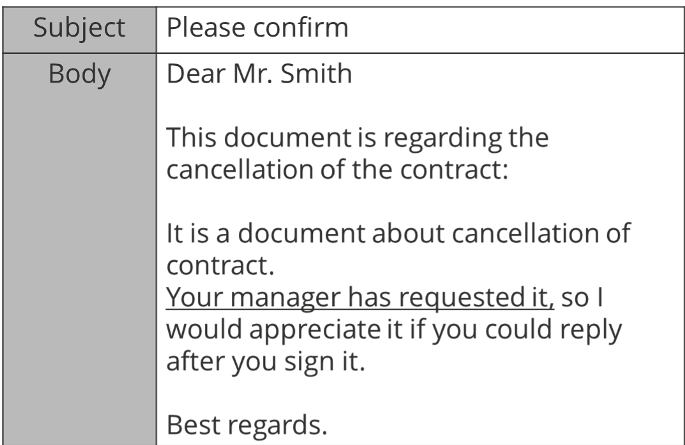
*Figure 1: Examples of email templates used to test Scarcity and Authority triggers.*
## Key Insights: Why Your Personality Matters
The paper’s most significant finding is that psychological triggers work differently depending on your baseline behavior. The researchers split participants into two groups: the **"Hard-Obey Group"** (people who ignored plain emails) and the **"Easy-Obey Group"** (people who tended to follow instructions even in plain emails).
### 1. The "Hard-Obey" Extroverts vs. Authority
Interestingly, for people who are generally cautious (Hard-Obey), a high **Extroversion** score was strongly linked to a vulnerability to **Authority**.
* **The Logic**: Extroverts value social standing. While they might ignore a random email, if the email appears to come from a high-ranking official (Authority), they fear that *disobeying* will damage their social position.
### 2. The "Easy-Obey" Neurotics vs. Scarcity
For those already prone to following instructions, high **Neuroticism** (sensitivity to stress) made them highly susceptible to **Scarcity**.
* **The Logic**: When told "Time is running out!" or "Only 1 hour left!", these individuals experience heightened restlessness and anxiety, forcing a sub-optimal decision to comply with the email.
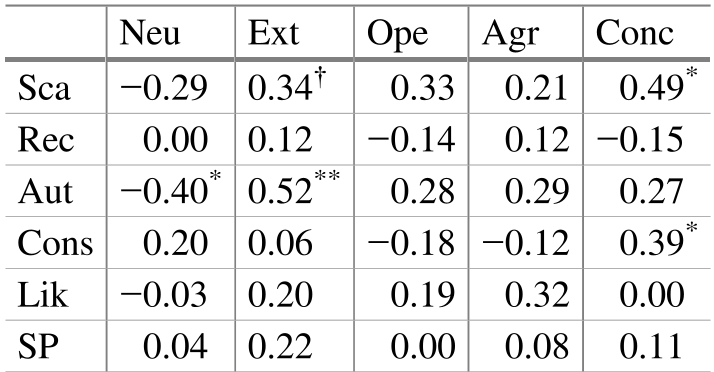
*Table 1: Correlation between Big Five factors and Cialdini reactivity for the "Hard-Obey" group. Note the high correlation (0.52) for Extroversion and Authority.*
## Critical Analysis: A Double-Edged Sword
The implications of this study are profound for both attackers and defenders:
* **The Threat**: Attackers can now build automated pipelines. OSINT tools scrape your tweets $\rightarrow$ AI estimates your personality $\rightarrow$ LLMs generate an email using the specific Cialdini trigger you are weakest against.
* **The Defense**: The authors argue that organizations should use this same data to provide **Personalized Security Training**. If an employee is identified as high-extroversion, their training should specifically focus on spotting fake "Authority" figures.
### Limitations
The study was conducted in a controlled web environment with 100 participants. Real-world "in-the-wild" behavior might vary. Furthermore, the authors suggest a "third factor" might exist—contextual variables (like current workload or mood) that could further influence susceptibility.
## Conclusion: Review Your Defense Strategy
This paper serves as a wake-up call. Targeted attacks are no longer just about *identity*; they are about *psychology*. As AI continues to refine its ability to profile human behavior, our defense mechanisms must become equally personalized. The era of "one-size-fits-all" cybersecurity training is officially over.
**Takeaway**: Be mindful of what your social media says about your personality—it might just be the blueprint an attacker uses to craft your "perfect" phishing email.