
Beyond the Ivory Tower: Decoding the Altmetric Impact of Psychology
#Psychology: a bibliometric analysis of psychological literature in the online media
This paper presents a comprehensive bibliometric analysis of over 245,000 psychological publications (2010-2012) to compare traditional impact metrics with Altmetric Scores (AS). It introduces the "Score Factor" (SF) to better evaluate a journal's online resonance by weighing density against coverage, finding that while field-level correlations are high, individual article metrics diverge significantly.
TL;DR
In an era where a tweet can spread research faster than a keynote address, how do we measure "impact"? This study analyzes 245,000 psychology papers to bridge the gap between traditional citations and social media "fame." It reveals that while fields like General Science dominate the web, the relationship between being "liked" and being "cited" is complex, prompting the creation of a new metric: the Score Factor (SF).
The "Invisible" Impact of Social Media
For nearly a century, Lotka’s Law and citation indices have been the gold standard for measuring scientific productivity. However, these metrics are "slow" and "insular." They reflect what other scientists think months or years later.
The authors argue that in the Information Age, the "immediate academic and non-academic influence" captured by Altmetrics—mentions in news, blogs, Twitter, and Wikipedia—is just as crucial. The core friction? Existing metrics often ignore the "zero-score" problem: most papers (over 70% in this study) never receive a single social media mention, skewing traditional averages.
Methodology: The Birth of the Score Factor
To solve the imbalance between high-engagement "viral" papers and the vast majority of silent publications, the authors proposed the Score Factor (SF).
Instead of just looking at the average Altmetric Score (AS), which can be hijacked by a single viral hit, the SF balances Coverage (percentage of a journal's papers mentioned) with Intensity (the average score of those mentioned papers).

The study utilized:
- 245,630 papers across 21 psychological subfields.
- Altmetric.com data, where News mentions (weight = 8) and Blogs (weight = 5) are prioritized over Tweets (weight = 1).
Key Results: Field-Level Harmony vs. Article-Level Chaos
The research found a fascinating trend: Correlation increases with aggregation.
- Macro Level (Fields): There is a strong (r = .50) correlation between citations and AS. Fields like General Science score high on both.
- Micro Level (Articles): The correlation drops to r = .30. A paper can be a "star" on Twitter but a "ghost" in the Science Citation Index.
- Source Dominance: Twitter accounts for 80% of mentions, but Blogs are actually better predictors of whether a paper will eventually be cited.

Table 1 illustrates that "soft" sciences or general topics often enjoy higher social media coverage than formal or "hard" topics like Mathematics and Statistics.
The Top 10 "Viral" Papers
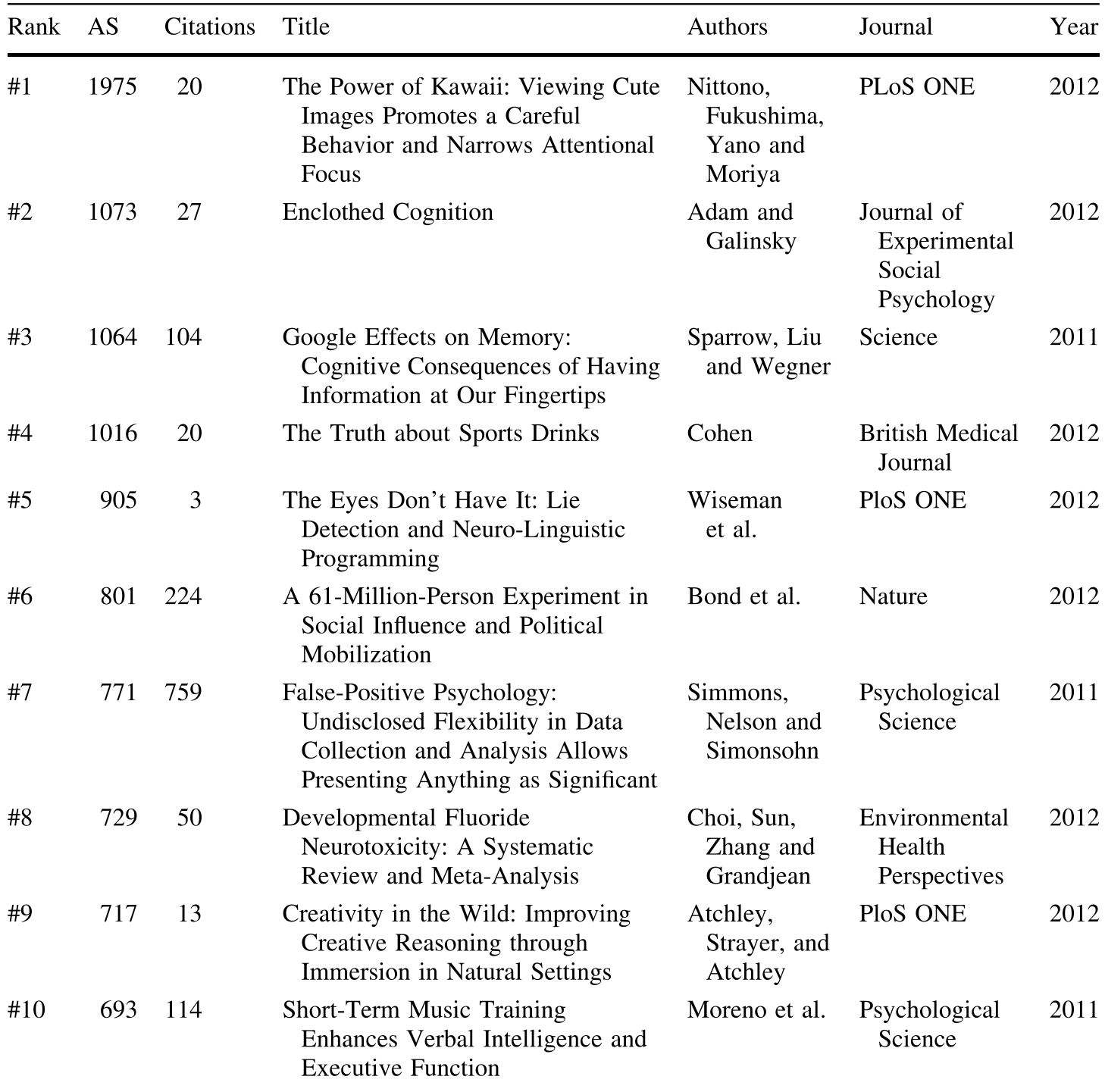
Interestingly, the top-performing papers in Altmetrics often feature "buzzwords" or relatable content. One of the highest-scoring papers involved how viewing "cute" images (Kawai) promotes careful behavior. These papers often fail to achieve a corresponding rank in citations, reinforcing the idea that online attention is driven by titles and perceived relevance, not necessarily by methodological rigor.
Deep Insight & Conclusion
The study concludes that Altmetrics are a complement, not a substitute. Citations remain the best indicator of long-term academic quality, whereas Altmetrics measure real-time societal resonance.
Critical Analysis: While the Score Factor provides a more balanced view of journal impact, the study admits that Altmetrics are susceptible to "gaming." A catchy title might trigger a high AS, but it doesn't guarantee the paper "gives something back to the public" in terms of actionable evidence. For the academic community, the takeaway is clear: if you want to be cited, write a rigorous paper; if you want to be known, start a conversation on a blog or Twitter.
Future Outlook: As social media algorithms change, the stability of Altmetrics is under threat. Future research must look beyond simple counts and investigate the sentiment and reputation of those sharing the research to create a truly meaningful "scholarly network."