
PTA-SC: Bridging the Gap Between Geometric Accuracy and Location Privacy in Crowdsourcing
PTA-SC: Privacy-Preserving Task Allocation for Spatial Crowdsourcing
PTA-SC is a privacy-preserving framework for Spatial Crowdsourcing (SC) that utilizes prefix encoding and Ciphertext-Policy Attribute-Based Encryption with Hidden Policy (CP-ABE-HP). It achieves secure task allocation by encoding locations as attributes and irregular task regions into access policy trees, enabling fine-grained, location-based access control.
TL;DR
Spatial Crowdsourcing (SC) requires tasks to be performed at specific locations, but exposing those locations to a central server creates a privacy nightmare. PTA-SC (Privacy-Preserving Task Allocation for Spatial Crowdsourcing) solves this by treating "being inside a region" as a cryptographic key matching problem. By decomposing irregular regions into rectangles and then into prefix-based access policies, it ensures only users in the right place can "unlock" the task—all while keeping the server completely in the dark.
The Dilemma of Digital Footprints
In modern SC platforms like Amazon Mechanical Turk or Gigwalk, location is the primary filter. However, this creates a Privacy-Utility-Efficiency Trilemma:
- Prior Arts (DP/Cloaking): Adding noise (DP) protects privacy but makes task allocation hit-or-miss.
- Prior Arts (Grid-based): Splitting the world into fixed squares is efficient but fails when a task region doesn't align perfectly with the grid (as seen in Figure 1).
- The Bottleneck: How do you prove you are in a specific, irregularly shaped park without telling the server your exact GPS coordinates?
Methodology: From Geometry to Bitstream
The core innovation of PTA-SC lies in its ability to translate physical space into a logical "access policy."
1. Prefix Encoding: The Bridge
Instead of using raw coordinates, PTA-SC converts an integer coordinate into a Prefix Family . For example, the number 5 (binary 0101) is represented by prefixes like 010* and 01**. If a task is assigned to a range , it is also turned into a minimum set of prefixes. If your location's prefix and the range's prefix overlap, you are mathematically proven to be inside that range.
2. Irregular Regions as Rectangles
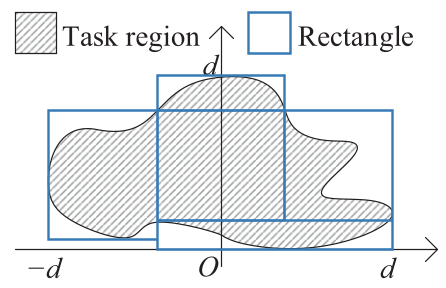
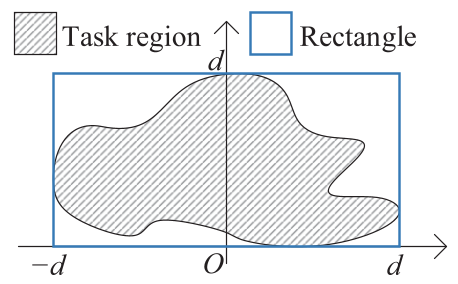
Since any 2D shape can be approximated by rectangles, the requester can choose how many rectangles to use based on the required accuracy. A single rectangle (low accuracy) is fast; five rectangles (high accuracy) better fit the shape but require more computation.
3. CP-ABE with Hidden Policies
The "magic" happens here: the task content is encrypted using Ciphertext-Policy Attribute-Based Encryption (CP-ABE). The "Access Policy" is the geometry of the task region itself. Crucially, the policy is hidden, meaning the SC server cannot look at the ciphertext and deduce where the task is located—only the user with the correct location-derived key can decrypt it.
Results: Efficiency vs. Accuracy
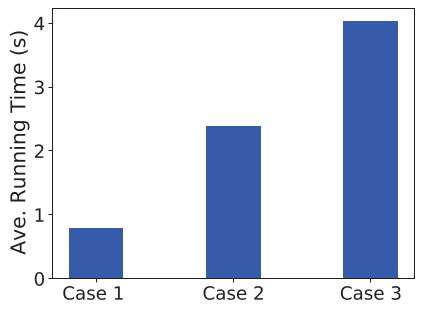
Using the Brightkite location check-in dataset, the authors tested PTA-SC's performance on a semi-circular task region.
- Speed: Even with five rectangles (Case 3), the task decryption takes only ~0.35 seconds on a standard PC, making it highly feasible for mobile users.
- Accuracy: By moving from one rectangle to five, the Region Representation Error (RRE) dropped significantly from 0.215 to 0.139.
Critical Insight: The "Zero-Knowledge" Matchmaker
The true value of PTA-SC is its shift in perspective. It treats the SC server not as a decision-maker (allocating tasks to users), but as a blind bulletin board. The allocation logic is embedded inside the encryption. This "Zero-Knowledge" approach ensures that even a compromised server cannot leak user trajectories or sensitive task locations.
Conclusion & Limitations
PTA-SC successfully demonstrates that adaptive accuracy control and strong privacy are not mutually exclusive. However, a potential limitation is the reliance on a Trusted Authority (TA) for initial key distribution. Future iterations might explore decentralized identity or Multi-Party Computation (MPC) to remove this single point of trust, paving the way for a truly decentralized spatial crowdsourcing economy.