
Integrated or Isolated? Decoding the Reality of Mixed-Income Housing
Integrated or isolated? The impact of public housing redevelopment on social network homophily
This study investigates the impact of public housing redevelopment (HOPE VI) on the social network diversity of low-income residents in Seattle. Using longitudinal egocentric data, it examines whether moving to mixed-income housing reduces social isolation by increasing network mixing across ethnic, educational, and economic lines.
TL;DR
Does moving the poor into wealthier neighborhoods actually help them "get ahead" through better social connections? This study of Seattle's High Point redevelopment reveals a sobering reality: physical proximity to more affluent neighbors rarely translates into more diverse social networks. Instead, social "homophily"—the instinct to stick with people like ourselves—remains a powerful barrier that housing policy has yet to solve.
The "Mixing" Myth: Why Proximity Isn't Integration
For decades, U.S. housing policy has been driven by the "Wilsonian" concern of social isolation. The logic is simple: if the poor are isolated in high-poverty ghettos, they lose access to the "social leverage" (job tips, professional references) that wealthier neighbors provide. Programs like HOPE VI were designed to solve this by creating mixed-income communities.
However, the authors of this paper identify a critical technical flaw in this logic: The Homophily Principle. In sociology, homophily is the robust pattern where "birds of a feather flock together." Just because a low-income renter lives next door to a market-rate homeowner doesn't mean they will talk. "Social distance"—created by differences in education, wealth, and lifestyle—often overrides "propinquity" (physical closeness).
Methodology: Tracking Ties Over Time
This research stands out by using longitudinal egocentric data. Instead of just asking people if they "liked" their neighbors, the researchers tracked specific social and job-related ties for the same individuals over several years, covering the period before and after the redevelopment of the High Point site in Seattle.
The Two Tiers of Ties:
- "Getting Along" (Social Support): Emotional support and emergency help.
- "Getting Ahead" (Social Leverage): Information about jobs or career advancement.
The study also examined a unique linguistic split: English speakers vs. Vietnamese speakers, providing a rare look at how ethnicity and language capacity influence the ability to navigate a changing neighborhood.
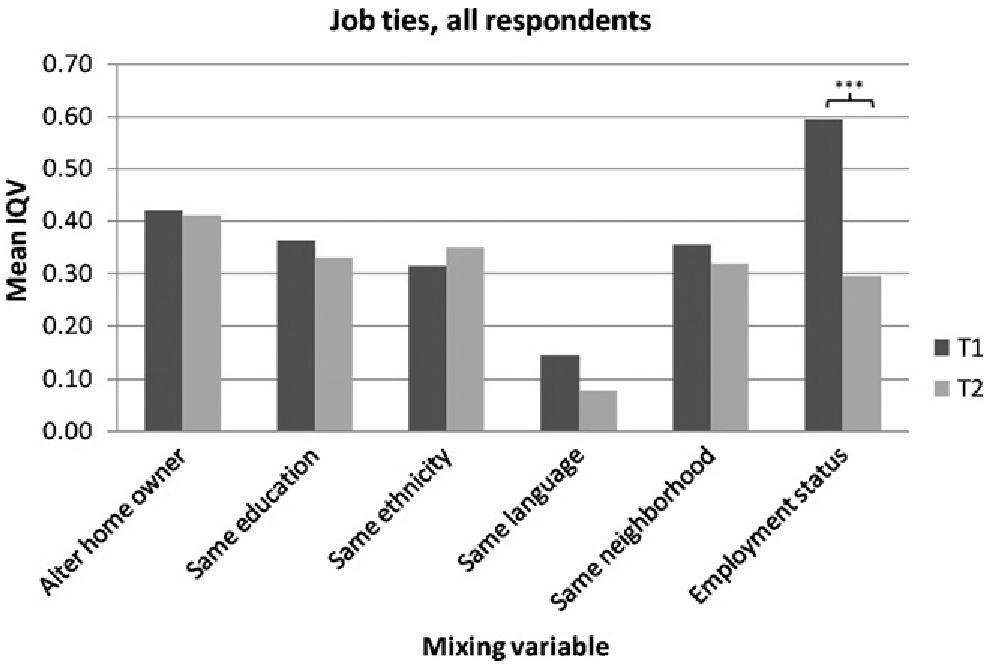 Figure 1: Comparison of network heterogeneity (IQV) before and after redevelopment. Note the minimal shifts in most categories except for specific types of job ties.
Key Findings: The Disruption Effect
The results provide a counter-intuitive insight into urban relocation:
- The On-Site Paradox: Those who returned to the brand-new, mixed-income High Point site did see an increase in ethnic mixing, but they did not see a significant increase in ties with higher-income or better-educated individuals.
- The Off-Site Advantage: Surprisingly, residents who moved away from the site (using vouchers to find housing elsewhere) experienced more diversification in their job search networks regarding education and employment status.
- Language Matters: Vietnamese speakers initially appeared more isolated, but after controlling for length of residence, they actually showed a higher propensity for ethnic mixing post-redevelopment than English speakers.
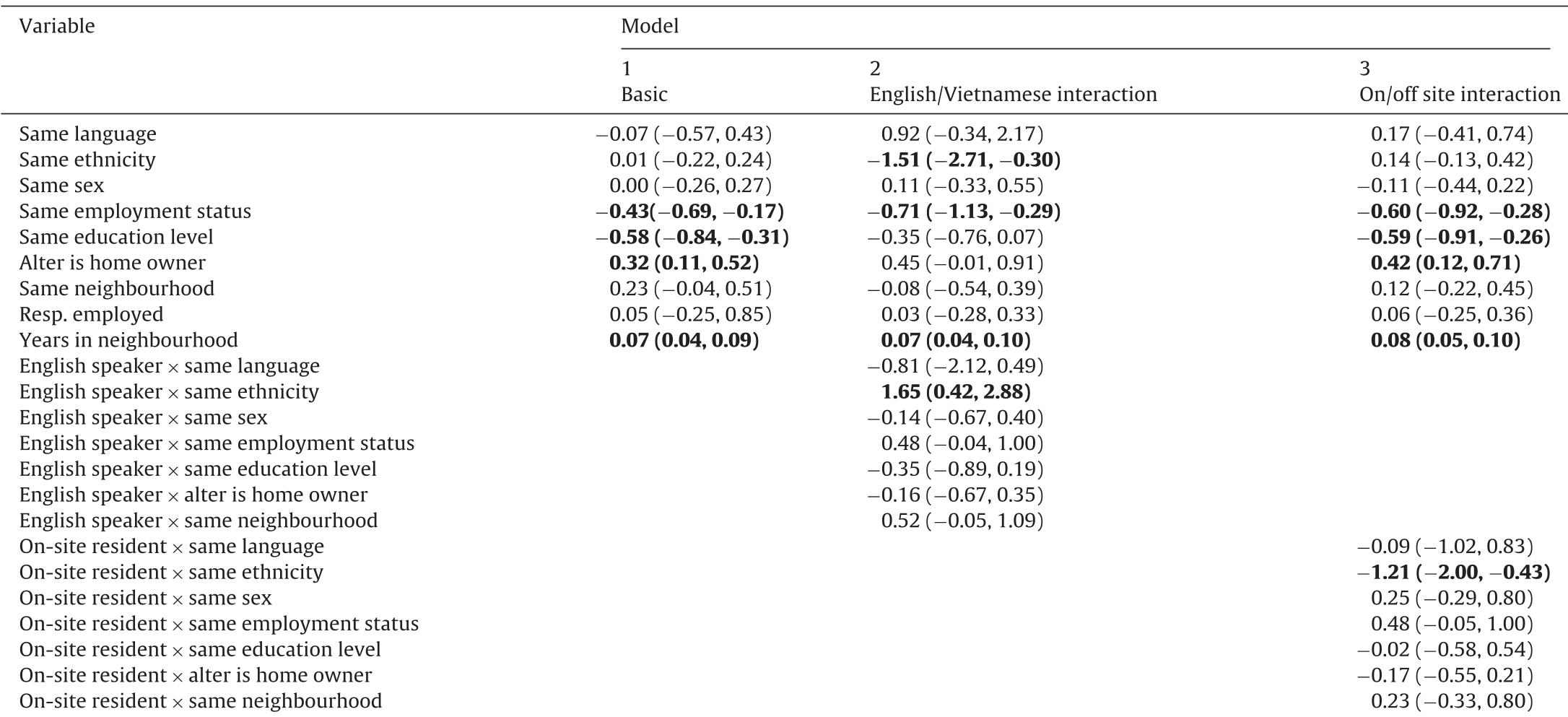 Table 9: Multilevel change models showing that 'Years in Neighborhood' is a much stronger predictor of social ties than the actual mixed-income nature of the site.
Critical Insight: The Failure of the "Spatial Fix"
The study concludes that the mere spatial arrangement of housing is an insufficient tool for social engineering. The data suggests that the "disruption" of moving forces people to rebuild their networks, which can lead to more diversity, but the mixed-income environment itself doesn't facilitate the "get ahead" ties that policymakers hope for.
Why was on-site mixing so low?
- Construction Lag: Residents moved back while the site was still a "construction zone," limiting natural social interaction.
- Tenure: Returning residents had lived there for an average of 14 years; their old, homogeneous ties were likely too "sticky" to be replaced by new neighbors.
- Social Distance: The wealth gap between subsidized renters and market-rate homeowners creates a "status" barrier that a shared sidewalk cannot fix.
Future Outlook: Beyond Bricks and Mortar
The takeaway for urban planners and sociologists is clear: if we want mixed-income housing to truly reduce isolation, we must invest in strategic community building. This means creating shared goals (e.g., community councils, shared resources) that force "equal-status contact" across class lines. Without this, mixed-income housing remains just a collection of different people living in parallel, isolated universes.
Final Takeaway: Social networks change due to life disruption, not just new neighbors. To bridge the opportunity gap, we need more than just shared zip codes; we need shared lives.