
Deploying Predictive Models in Healthcare: An Open Source Blueprint for the Modern Clinic
Despite dramatic progress in the application of predictive modeling and data mining techniques to problems in modern medicine, a major challenge facing technical practitioners is that of delivering models to clinicians. We have developed an easily implementable framework for publishing predictive models written in R or Python in a way that allows them to be consumed by practically any downstream clinical application, as well as allowing them to be reused in a wide variety of environments without modification. The approach makes models available as web services embedded in containers and uses only open source technology. We provide a template, practical explanation and discussion of involved technologies for a model production framework. We currently use this framework to deliver a model for predicting readmission to hospital following discharge to skilled nursing facilities. The flexibility and simplicity of this methodology will allow it to be readily adopted at a wide variety of institutions. We also provide source code for an example model
The paper presents an open-source framework for deploying healthcare predictive models written in R or Python. It leverages REST APIs and Docker containers to enable seamless integration with diverse clinical applications, achieving a "write once, deploy anywhere" capability for medical environments.
TL;DR
The gap between a high-performing "laptop model" and a functional "clinical tool" is often a chasm of technical incompatibility. This paper introduces a streamlined, open-source framework using Docker and REST APIs (Plumber/Flask) to deploy R and Python models. By decoupling the model's logic from the hospital's diverse IT infrastructure, the authors demonstrate how a readmission model remained operational at the Mayo Clinic even through major system overhauls.
The Deployment Chasm: Why Healthcare AI Stalls
In the academic world, a model's success is measured by AUC or F1-score. In the clinical world, success is measured by availability and integration.
The authors identify two primary bottlenecks:
- Heterogeneity: A single hospital might use .NET applications, Linux scripts, and proprietary EHRs simultaneously. Rewriting a complex model for each "consumer" is a recipe for logic drift and high maintenance.
- Scale Inconsistency: Moving from a small pilot (Research Production) to an institutional rollout (Enterprise) often requires a total rewrite of the infrastructure, wasting precious development time.
Methodology: The Two Pillars of Portability
The proposed framework relies on two mature technical concepts applied to the unique constraints of medical informatics.
1. The Web Service (The "How we talk")
Instead of embedding code directly into a consumer application, the model is "published" as a REST API. Using libraries like plumber for R or flask for Python, the model waits for an HTTP request (like a webpage) containing patient data and returns a JSON prediction.
- Logic Isolation: The clinical application doesn't need to know Python; it just needs to know how to send a URL request.
- Graceful Failure: The authors emphasize "Input Checking" (matching categorical levels) and descriptive error messages to prevent the "Silent Failure" of medical models.
2. The Container (The "Where we live")
To solve the "it works on my machine" problem, the authors use Docker. A container packages the specific version of R/Python, the exact library versions (e.g., xgboost 1.2), and the OS dependencies into a single executable image.
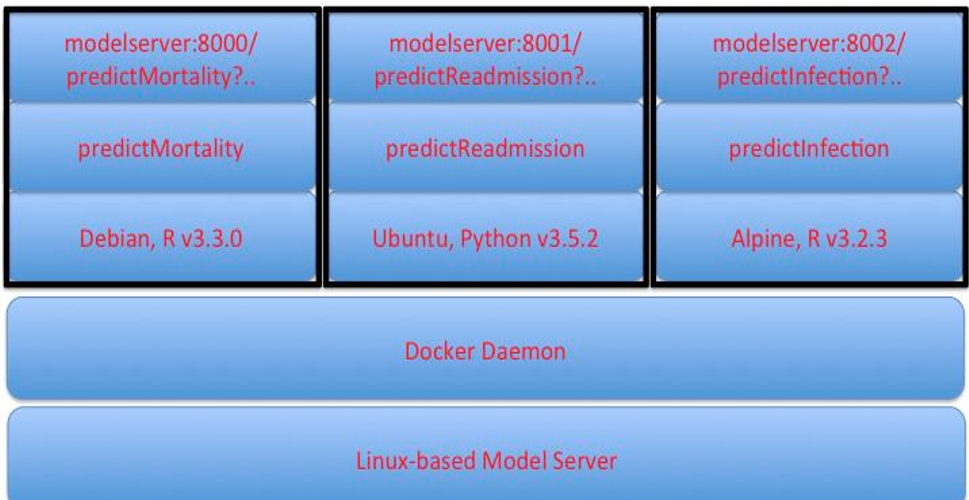 Figure 1: Multiple Docker containers (R, Python, different OS versions) running independently on a single host, each serving a unique clinical need.
Prototypical Implementation: Hospital Readmission
The paper highlights a real-world application: 30-day readmission prediction for patients moving to skilled nursing facilities.
| Feature | Research Production Implementation |
|---|---|
| Model Language | R (Wrapped in Plumber) |
| Deployment | Docker Container |
| Consumer | .NET Dashboard |
| Outcome | 3 months of stable uptime; unaffected by EHR system migration. |
The authors provide a template for a Dockerfile, illustrating how to automate the environment setup:
# Prototypical Dockerfile structure
FROM r-base:3.3.0
RUN R -e "install.packages('plumber')"
COPY predictMortality.R /app/
EXPOSE 8000
ENTRYPOINT ["R", "-e", "pr <- plumber::plumb('/app/predictMortality.R'); pr$run(host='0.0.0.0', port=8000)"]
Deep Insight: Beyond Code - Monitoring and Compliance
A significant contribution of this paper is its focus on Post-Deployment Hygiene. The authors argue that a model is a living entity that requires:
- Calibration Monitoring: Tracking if the distribution of incoming patient data shifts (Data Drift).
- Ground Truth Logging: Storing Patient IDs and timestamps to later verify if the prediction was actually correct.
- Security: The framework assumes a "Private Network" model, ensuring HIPAA compliance by keeping the model server within the hospital firewall.
Critical Analysis & Conclusion
Takeaway: This work provides a pragmatic "middle ground." It avoids the extreme complexity of FHIR-only architectures while offering far more robustness than manual code translation.
Limitations: While Docker solves environment issues, the paper does not deeply explore "Horizontal Scaling" (e.g., Kubernetes) for ultra-high-volume environments, though it mentions the ease of copying containers. Furthermore, security relies heavily on the internal network's integrity.
In conclusion, the future of healthcare AI isn't just better algorithms—it's better plumbing. By adopting standardized containerized services, clinical teams can ensure their research actually reaches the bedside.