
PUED: Solving the Spammer Detection Dilemma with PU and Ensemble Learning
PUED: A Social Spammer Detection Method Based on PU Learning and Ensemble Learning
PUED is a novel social spammer detection framework that integrates Positive and Unlabeled (PU) Learning with Ensemble Learning to identify malicious users. By utilizing a two-step approach involving recursive voting and Random Forest classification, it achieves state-of-the-art performance on Twitter and YouTube datasets without requiring labeled negative samples.
TL;DR
Detecting spammers in social networks usually requires a large amount of labeled data, which is rare and expensive to obtain. PUED (Positive and Unlabeled Ensemble Detector) flips the script by using PU Learning. It identifies "Reliable Negative" samples from a pool of unlabeled data using an ensemble of classifiers and then trains a robust detector, outperforming traditional supervised methods that struggle with imbalanced data.
Context & Motivation: The Imbalance Trap
In the world of social media security, we face a "needle in a haystack" problem. While we have plenty of "normal" users (Positive samples) and millions of "unlabeled" users, we have very few confirmed "spammers" (Negative samples).
Most current SOTA methods are supervised, meaning they need both labels to function. When negative labels are scarce, these models suffer from high bias and poor recall. The authors of PUED argue that we should stop trying to label every spammer and instead focus on what we do know (the normal users) and what we can infer (the reliable spammers).
Methodology: The Two-Step PUED Framework
PUED decomposes the detection task into a two-stage pipeline designed to maximize the utility of unlabeled data.
Step 1: Discovering Reliable Negatives (RN)
The model doesn't guess; it builds a "jury." By using an ensemble of five distinct classifiers—Logistic Regression, Naive Bayes, Decision Tree, Random Forest, and GBDT—the system looks at unlabeled samples. Only when the jury reaches a high-confidence threshold (set at 0.75 in the paper) is an unlabeled user tagged as a "Reliable Negative" (RN).
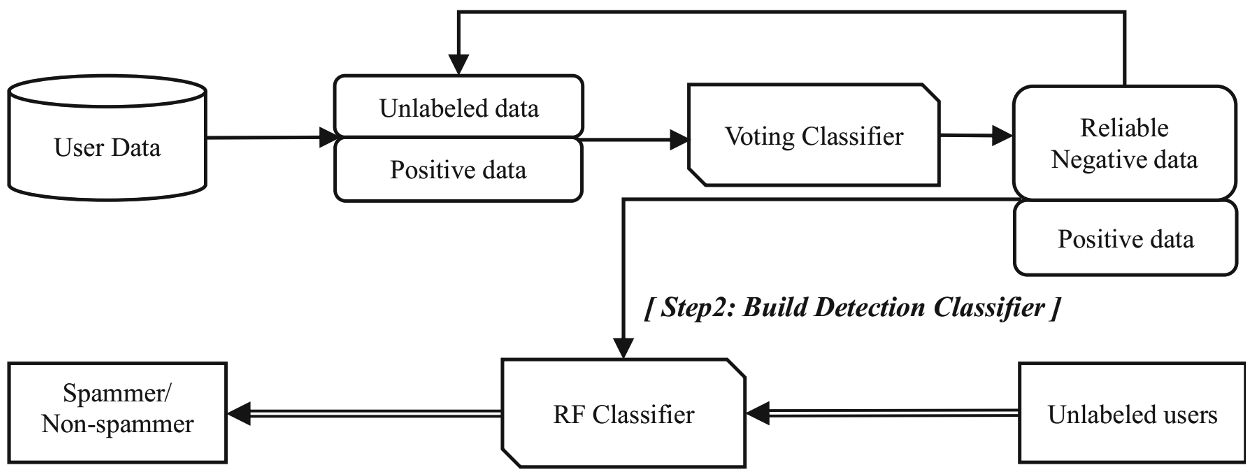
Step 2: Training the Final Detector
With a balanced set of Positive samples and the newly mined Reliable Negatives, the system trains a final Random Forest classifier. Random Forest is chosen here for its inherent resistance to noise and its ability to handle high-dimensional feature spaces (the paper uses 60+ features per user).
Experimental Evidence
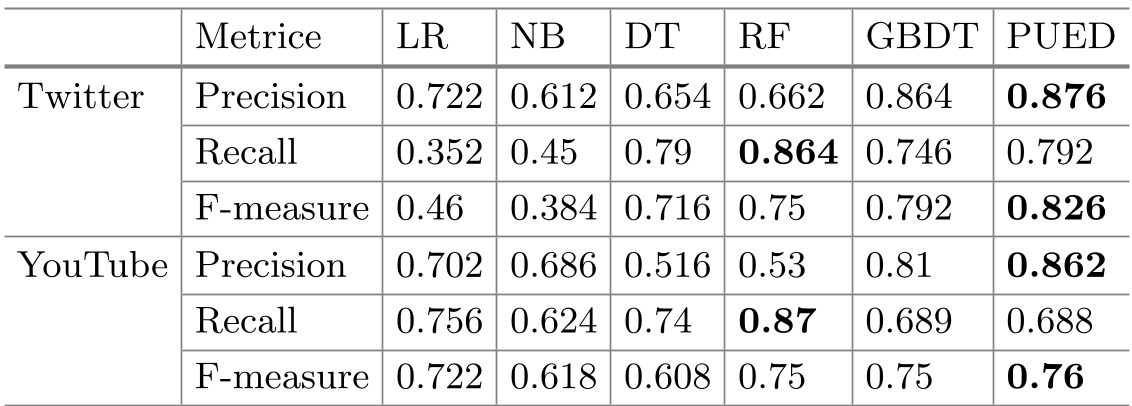
The authors tested PUED against two rigorous benchmarks: the Twitter and YouTube datasets.
Key Findings:
- Superiority in Data Scarcity: When labeled spammers make up less than 30% of the training data, traditional supervised models fail significantly. PUED, however, remains stable because it doesn't rely on those labels in the first place.
- Precision vs. Recall: On Twitter, PUED reached a Precision of 0.876, proving that the ensemble voting strategy is highly effective at avoiding false positives.
Parametric Insight: The Balancing Act
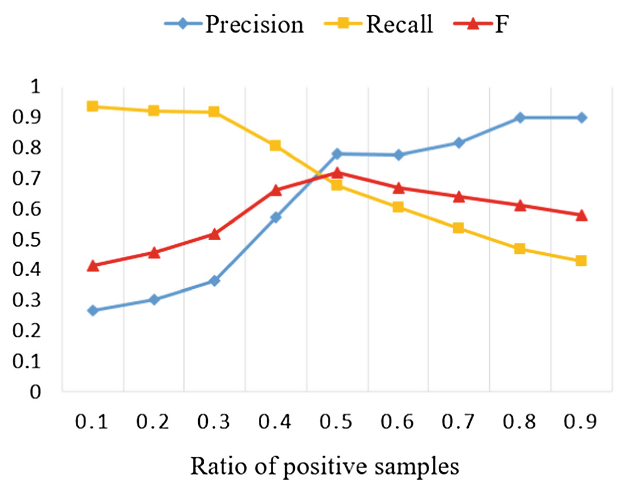
The paper introduces a parameter to control the proportion of positive samples. The researchers found that an provides the optimal balance. As increases, precision goes up, but recall drops—a classic trade-off in anomaly detection.
Critical Perspective & Conclusion
PUED is a significant step forward because it addresses the economic reality of data science: labels are expensive. By leveraging Ensemble Learning to "clean" unlabeled data, it creates a self-supervised loop that identifies spammers more accurately than models that have "seen" more labeled data.
Future Work: While PUED is powerful, it currently relies on tabular features. Future iterations could integrate Graph Neural Networks (GNNs) to capture the structural relationships between users, further refining the "Reliable Negative" selection process.