
Beyond Blood Pressure: Leveraging PWV and Machine Learning to Predict Cardiovascular Risk
Pulse Wave Velocity and Machine Learning to Predict Cardiovascular Outcomes in Prediabetic and Diabetic Populations
This longitudinal study demonstrates that Pulse Wave Velocity (PWV), a measure of arterial stiffness, is a robust independent predictor of Major Adverse Cardiovascular Events (MACE) in high-risk prediabetic and diabetic populations. By utilizing a hybrid approach of LASSO-penalized Cox regression and Random Forest, the authors established a parsimonious predictive model where PWV outperformed traditional clinical markers.
TL;DR
Predicting heart attacks and strokes in patients who are "pre-symptomatic" but high-risk (diabetic, obese, hypertensive) is notoriously difficult using standard charts. This study reveals that Pulse Wave Velocity (PWV)—a direct measure of how "stiff" your arteries are—is a much more accurate crystal ball than standard blood pressure. By using Machine Learning (LASSO and Random Forest), the researchers proved that PWV is the single most important predictor in a high-risk cohort, even when traditional metrics like glucose levels fail to provide clarity.
The "Preclinical" Paradox
In modern cardiology, we often encounter a specific type of patient: they are obese, have high blood sugar (prediabetes/diabetes), and high blood pressure, yet their kidneys still function well and they haven't had a heart attack... yet.
The problem is that traditional office blood pressure readings are often too "noisy" to tell us who will suffer a Major Adverse Cardiovascular Event (MACE) in the next decade. Standard statistical models also break down when the number of patients is small; they tend to "overfit," seeing patterns where there is only noise.
Methodology: High-Tech Stats for Small Data
The authors followed 88 high-risk patients for over 12 years. To solve the "small data" problem, they didn't just use standard regressions. They turned to two powerful Machine Learning tools:
- LASSO-Cox Regression: Think of this as a "smart filter." In a standard model, every variable (age, weight, smoking, etc.) gets a coefficient. LASSO applies a penalty that shrinks the coefficients of irrelevant variables to exactly zero. It effectively "deletes" the fluff, leaving only the most important predictors.
- Random Forest (RF): This algorithm builds hundreds of decision trees to classify data. The researchers used RF to determine Feature Importance—calculating exactly how much the model's accuracy would drop if a specific variable (like PWV) were removed.
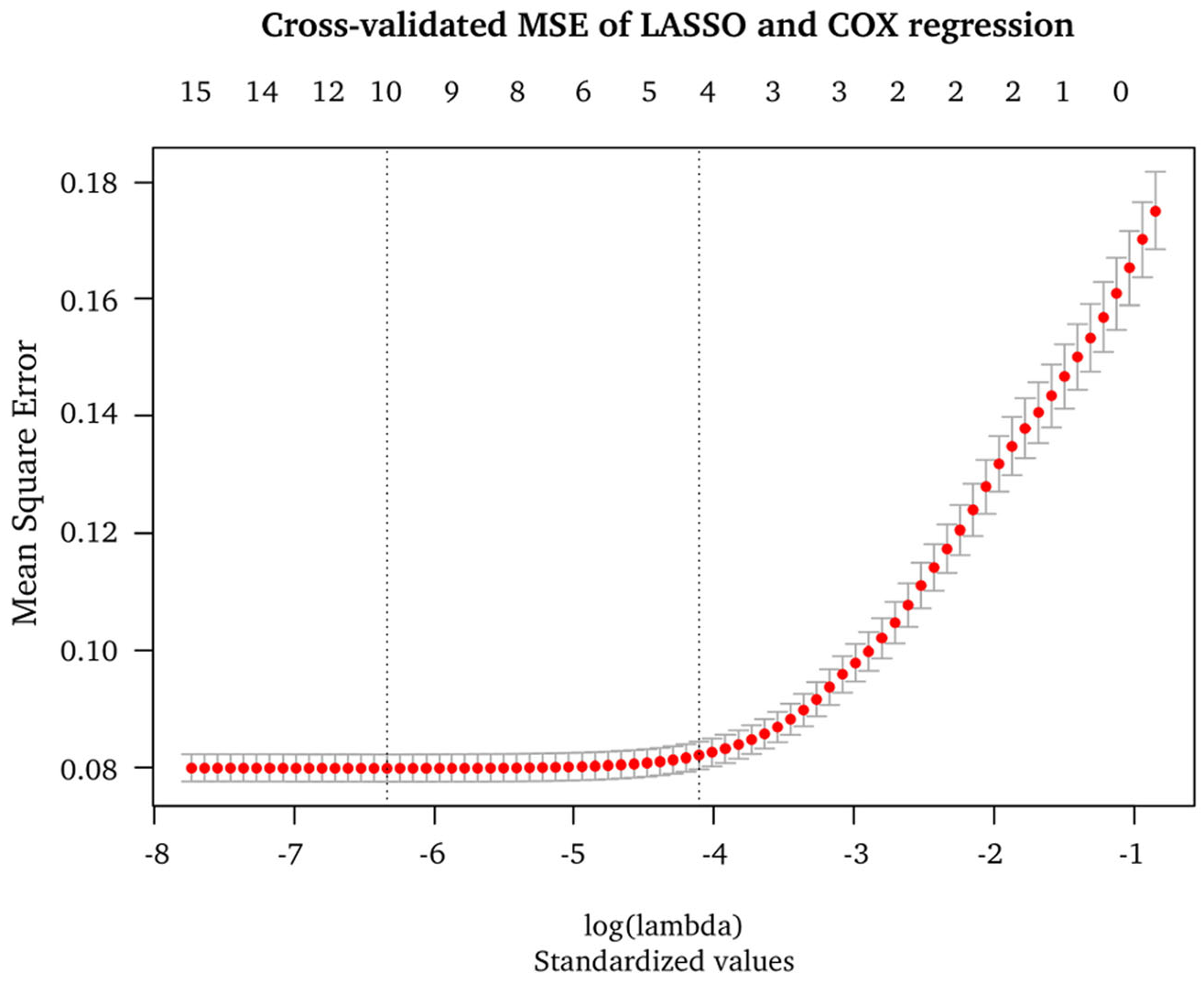 Figure: The LASSO path showing how the model simplifies by increasing the penalty (lambda). Only 4 variables survived the final "parsimonious" cut.
Key Results: The Stiffness Factor
The results were striking. Out of 16 potential clinical variables, the LASSO model stripped away almost everything except:
- Pulse Wave Velocity (PWV)
- Body Mass Index (BMI)
- Type 2 Diabetes status
- Gender (Male)
PWV emerged as the heavyweight champion. The Random Forest model achieved a staggering 98% accuracy, and as shown in the importance plot below, removing PWV caused the largest drop in predictive power.
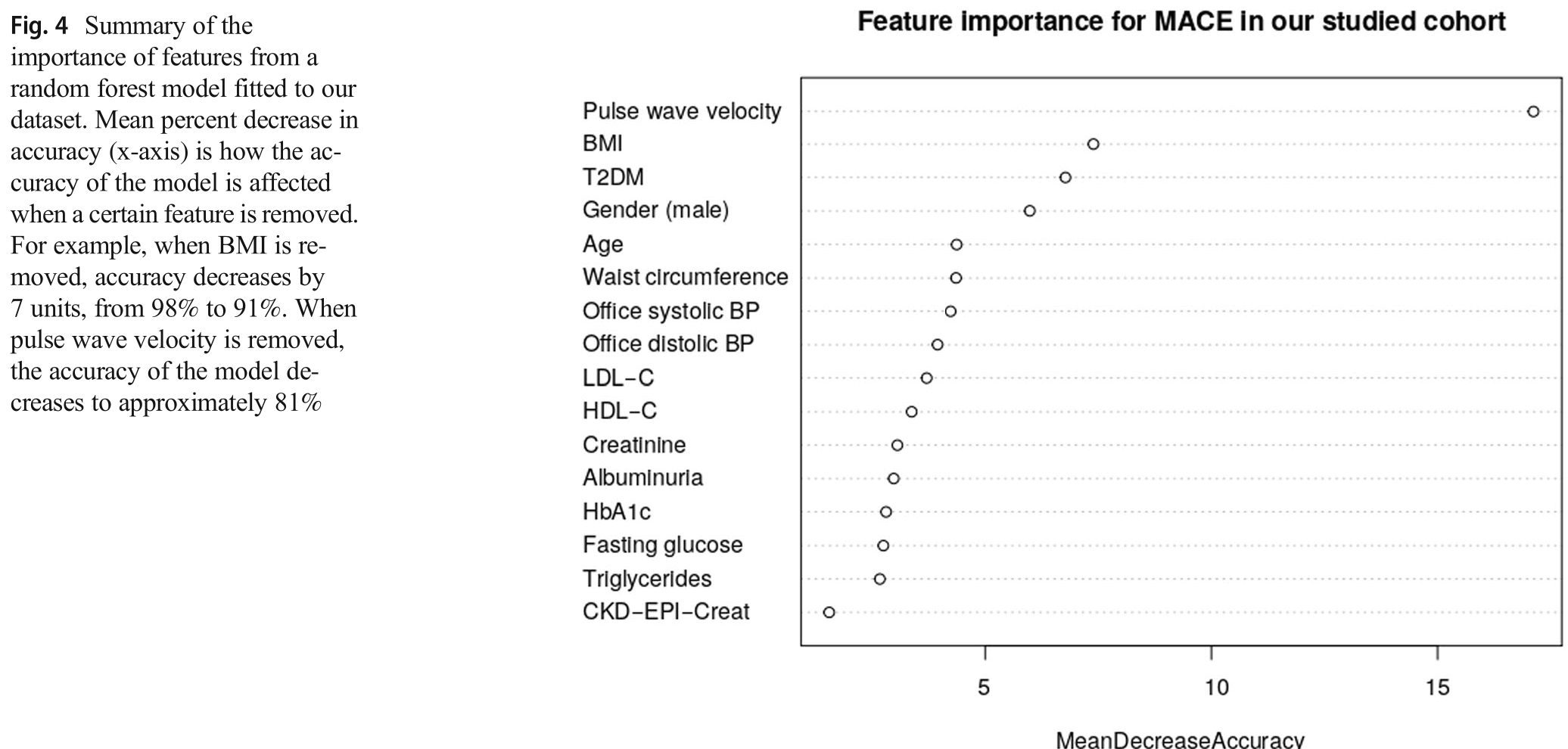 Figure: Feature importance ranking. PWV stands at the top, while traditional markers like fasting glucose and triglycerides are at the bottom.
Why PWV Wins
Why is PWV so effective? Unlike a blood pressure cuff, which measures the pressure of a single moment, PWV measures the structural integrity of the arterial wall. As arteries stiffen due to arteriosclerosis, the pulse wave travels faster. It is a direct "readout" of the cumulative damage caused by years of hypertension and diabetes.
Critical Insights & Future Outlook
- Clinical Takeaway: For high-risk patients, measuring arterial stiffness via tonometry (PWV) is not just an "extra" test—it is likely the most important prognostic tool available in an outpatient setting.
- Methodological Lesson: This paper serves as a blueprint for clinical researchers. It proves that even with a "small" dataset (n=88), robust conclusions can be drawn if ML techniques like LASSO are used to prevent overfitting.
- Limitations: The study was retrospective and lacked an external validation cohort. Future work should see if these ML models hold up across different ethnic populations.
The bottom line: If we want to catch cardiovascular events before they happen, we need to stop looking just at the "pressure" in the pipes and start measuring the "stiffness" of the pipes themselves.