
Punctuation: The Hidden Architecture of Computational Linguistics
Current approaches to punctuation in computational linguistics
This paper provides a comprehensive survey of punctuation in computational linguistics, moving beyond prescriptive rules to a descriptive, information-based framework. It highlights the shift from viewing punctuation as a mere speech proxy to a distinct linguistic system that facilitates syntactic parsing, discourse structuring, and "information packaging" in natural language processing (NLP).
TL;DR
Punctuation is far more than a set of stylistic rules; it is a vital linguistic subsystem that provides essential cues for machine understanding. This paper surveys how computational linguistics has transitioned from ignoring punctuation to leveraging it through "text-grammars" and information-based frameworks like SDRT to drastically reduce parsing ambiguity and clarify discourse structure.
Contextual Positioning
Historically, punctuation was the "Cinderella" of linguistics—prescribed by style guides but ignored by formal theorists. Say and Akman argue that in the digital age, where writing is often more "visible" than "spoken," punctuation functions as the logic-gate of written language. This work positions itself at the intersection of corpus linguistics and symbolic NLP, advocating for a formalization of punctuation that is as rigorous as lexical syntax.
The Problem: The "Syntax-Only" Fallacy
The authors identify two fatal flaws in traditional NLP:
- The Elocutionary Myth: The belief that punctuation is merely a transcription of intonation.
- Sentence-Centricity: The assumption that the "sentence" is the fundamental unit, while ignoring that punctuation often creates "orthographic sentences" that differ from grammatical ones.
Without a formal "text-grammar," parsers often drown in a sea of ambiguity. For instance, a simple comma placement doesn't just change the rhythm; it can entirely redirect anaphoric references (who a "he" or "she" refers to) in subsequent sentences.
Methodology: From Syntax to SDRT
The core insight of the paper is the application of Segmented Discourse Representation Theory (SDRT). Instead of just seeing a semicolon as a separator, the authors see it as a "Discourse Relation" signal.
The Informational Grouping
The authors build upon Nunberg’s (1990) idea of a "text-grammar" where punctuation governs text-categories (clauses, adjuncts, phrases). They extend this using Information Packaging, where punctuation dictates how propositional content is "bundled" for the reader’s mental model.
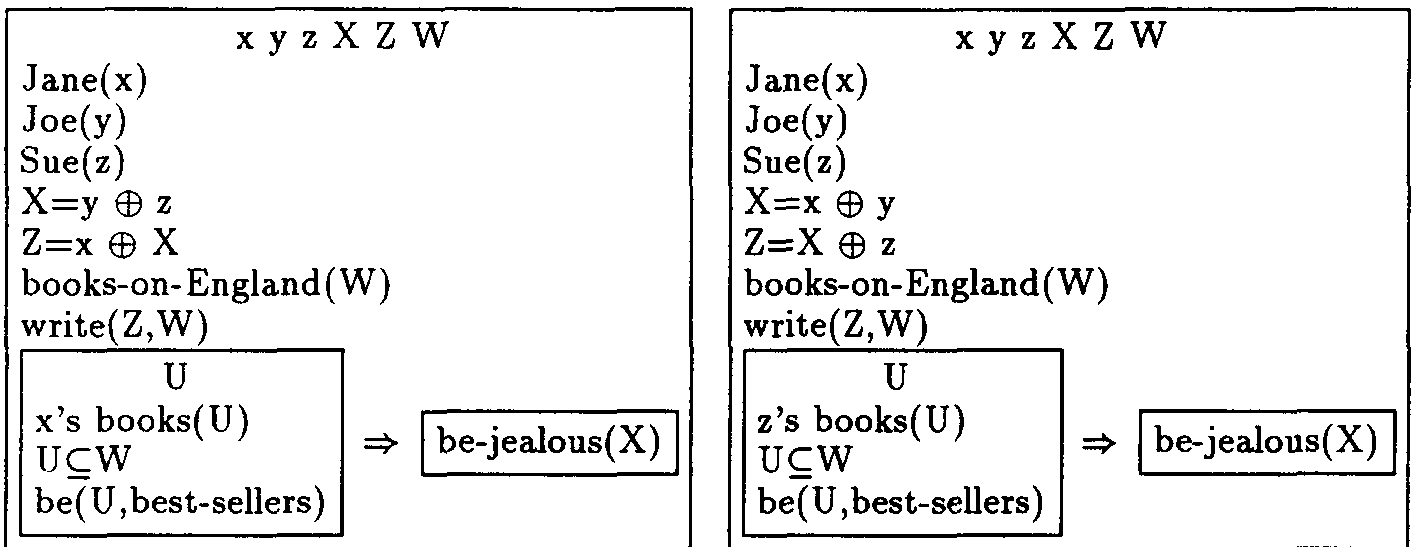 Figure 1: Comparison of DRS models showing how comma placement (9a vs 9b) alters anaphora resolution for "her" and "they".
Experimental Evidence: The Cost of Ignoring the Dot
The survey highlights several critical computational findings:
- Parsing Efficiency: In systems like those of Briscoe and Carroll, using punctuation labels as lexical categories reduced the number of parses for complex sentences by multiple orders of magnitude.
- The "Divide and Conquer" Strategy: Chinking complex sentences based on punctuation markers before parsing led to a 21% error reduction.
- Structural Stability: Studies on the Wall Street Journal corpus showed that certain punctuation marks (like the comma) possess high "stability" in signaling specific semantic classes, making them reliable features for machine learning.
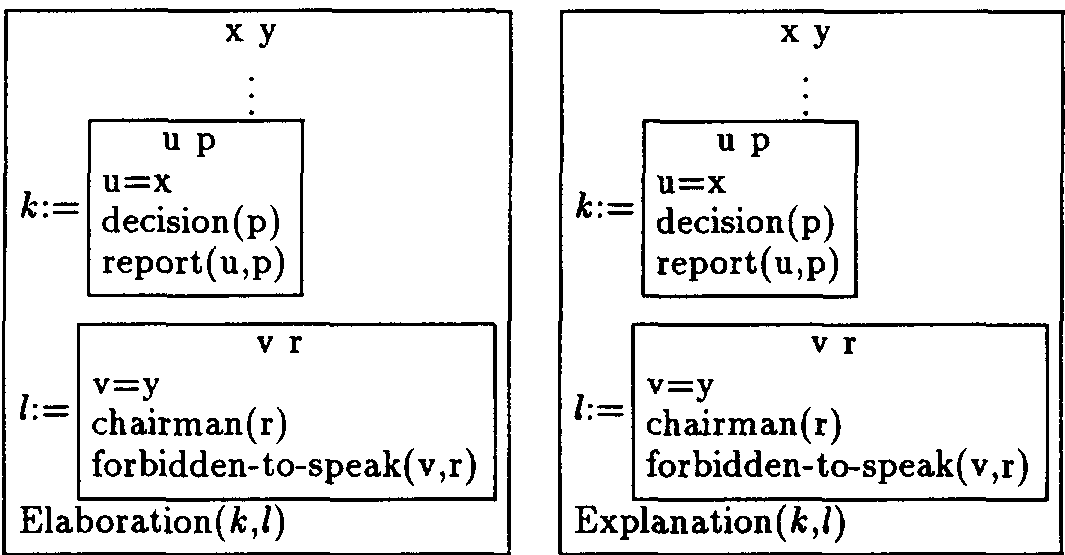 Figure 2: Segmented Discourse Representation Structures (SDRS) showing how colons (11a) vs semicolons (11b) change the discourse relation from 'Elaboration' to 'Explanation'.
Critical Analysis: A Unified Theory
The paper concludes with a call for a Unified Theory of Punctuation. The authors argue that a truly robust NLP system must account for:
- Structural Punctuation: Standard marks like periods and commas.
- Text-Level Punctuation: Paragraphing, font changes, and lists.
Limitations & Future Work
While the SDRT approach is powerful, the authors admit that trying to map non-truth-conditional constructs (like "tone") onto a truth-conditional theory (like DRT) is technically challenging. Future work needs to focus on cross-linguistic studies, particularly for non-Latin scripts where punctuation conventions differ wildly.
Conclusion: Why It Matters
As we move toward more sophisticated Natural Language Generation (NLG), the "visibility" of punctuation becomes a design choice. This paper reminds us that a computer that cannot understand a semicolon will never truly understand the "rhythm" of human thought.