
ProbRough: Bridging the Gap Between Business Reality and Database Marketing Prediction
Purchase Prediction in Database Marketing with the ProbRough System
The paper introduces ProbRough, a data mining system based on probabilistic rough set theory designed for purchase prediction in database marketing. Applied to a European mail-order company dataset, it generates transparent decision rules that effectively identify potential buyers while accounting for real-world business constraints.
TL;DR
The ProbRough system leverages Probabilistic Rough Set Theory to solve the classic "to-mail-or-not-to-mail" dilemma in database marketing. Unlike black-box models, it generates transparent rules while explicitly optimizing for the high cost of missed sales versus the low cost of wasted catalogs. It proves that when the stakes are uneven, "accuracy" is a secondary metric to "minimized total cost."
The "Real World" Problem: It's Not Just About Accuracy
In database marketing, not all mistakes are equal. Most academic models aim to maximize overall accuracy, but a Marketing Manager knows two things:
- Buyers are rare: The probability of a purchase (prior) is usually much lower than the 50/50 split found in experimental datasets.
- Missing a sale is expensive: Predicting a buyer is a "non-buyer" costs the company significant profit; predicting a non-buyer is a "buyer" only costs the price of one brochure.
The authors argue that existing systems fail to integrate these "background knowledge" factors into the model's DNA.
Methodology: ProbRough and the Art of Space Partitioning
The core of ProbRough is its ability to divide the "attribute space" (all your customer data points) into segments that make business sense.
1. Global Segmentation Phase
The system uses a beam search strategy. It isn't just looking for patterns; it is searching for a model that minimizes the Global Cost Criterion. This means if you tell the model that a False Negative is 3x more expensive than a False Positive, it will proactively adjust its decision boundaries.
2. Rule Reduction
To keep the model "human-readable," ProbRough merges adjacent partitions if they lead to the same decision, resulting in a concise set of "If-Then" rules.
 The domain of decision rules is expressed as a Cartesian product of feasible subsets, ensuring clear interpretability.
Experimental Insights: RFM and Beyond
The study utilized a dataset of 6,800 customers from a European mail-order company, focusing initially on RFM variables: Recency, Frequency, and Monetary value.
Key Findings with Standard Costs:
Under equal costs, the model generated simple rules focused on:
- Recency: Days since last purchase.
- Frequency: Transactions in the last 6-12 months.
- Performance: ~75% of customers were correctly categorized.
The Shift: What Happens When Costs Change?
When the authors increased the misclassification cost ratio to 3:1 (penalizing missed buyers more heavily), the model's behavior shifted dramatically:
- Temporal Expansion: The "cutoff" for recency expanded from 180 days to 365 days. The model became more "forgiving," deciding to mail to customers who hadn't bought in a year because the risk of missing them was too high.
- New Variables Alpha: Suddenly, "Social Class," "State" (geography), and "Household Type" became statistically significant. The model realized that for high-risk decisions, transactional data (RFM) wasn't enough; it needed context.
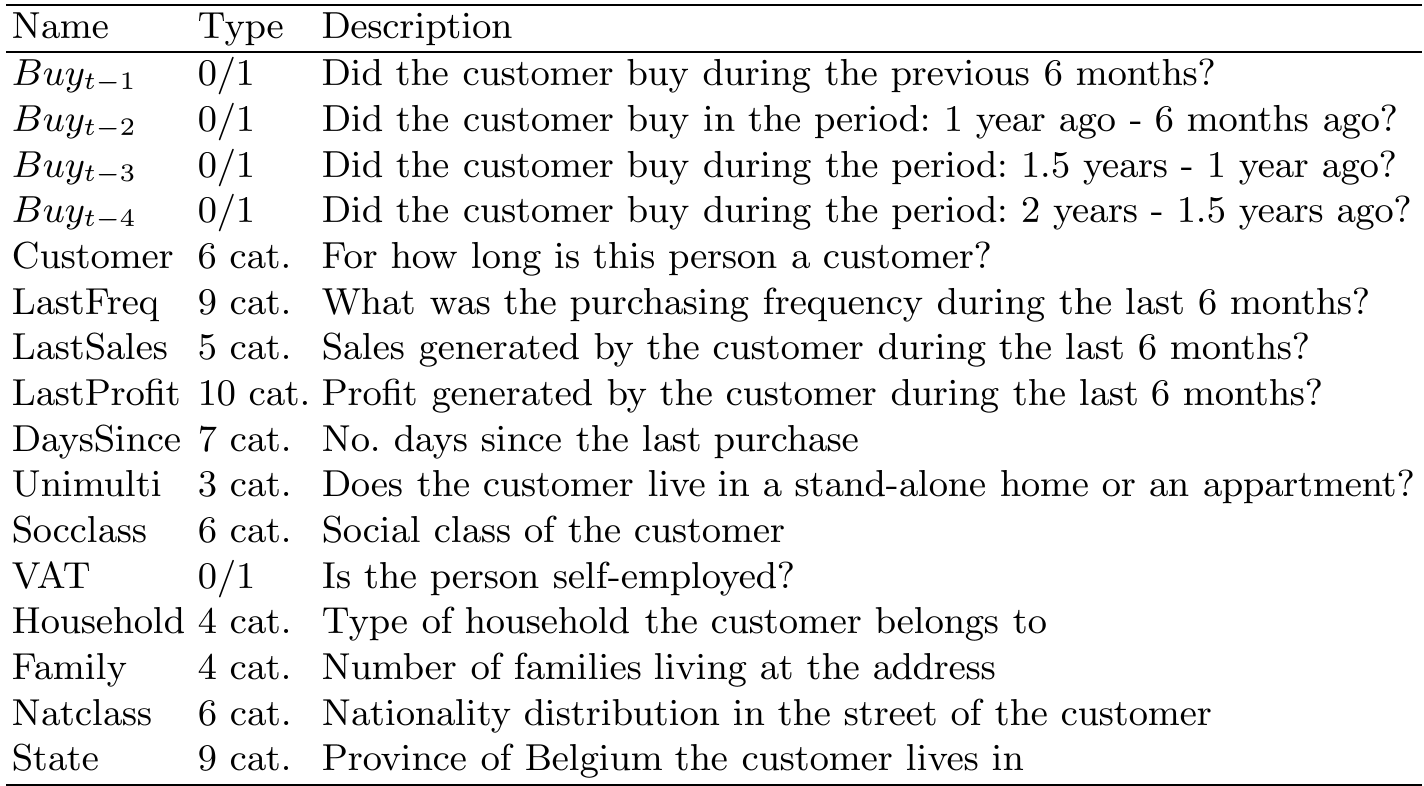 Table 1: The diverse set of categorical attributes used to enrich the prediction beyond simple transaction history.
Critical Analysis & Conclusion
Takeaway
ProbRough succeeds because it views data mining as a Business Decision Support task rather than a pure mathematical optimization problem. Its transparency allows marketing managers to validate the rules against their own intuition before launching a million-dollar mailing campaign.
Limitations
The study primarily used pre-categorized data. While ProbRough has a built-in discretization module for continuous data (like exact spending amounts), this wasn't fully tested in the paper. Furthermore, in the age of Deep Learning, "If-Then" rules might struggle with high-dimensional cross-features that a transformer or neural network might catch.
Future Outlook
The most profound insight here is the importance of non-transactional data when costs are asymmetric. Future research could explore how to integrate these "Rough Set" logic gates into the final layers of a neural network to combine deep feature extraction with cost-sensitive, interpretable decision-making.