
PViz: Bridging the Gap Between Logic and Intuition in Social Privacy
The PViz comprehension tool for social network privacy settings
This paper introduces PViz, a novel visualization tool designed to help users comprehend complex social network privacy settings by aligning with their group-based mental models. Utilizing a hierarchical community-detection algorithm and automated keyword labeling, PViz achieves superior accuracy in group-based privacy tasks compared to standard interfaces like Facebook’s Audience View.
TL;DR
Managing who sees what on social media is a nightmare of "Custom Lists" and manual auditing. PViz solves this by automatically grouping your friends into natural "communities" (like "High School" or "Co-workers") and visualizing your privacy settings through a zoomable, color-coded map. It proves that when tools match how we actually think—in groups, not individual rows of data—we become significantly better at protecting our digital boundaries.
The Problem: The "Audience View" Fallacy
Most privacy tools follow a one-by-one logic. Facebook's "Audience View" lets you see your profile as a specific friend sees it. This is fine for checking if your ex can see your posts, but it’s useless for answering: "Can any of my professional contacts see my party photos?"
To answer that today, you’d have to manually check every single coworker. Rule-based interfaces aren't much better; they lead to "policy conflicts" where overlapping rules make it impossible to know the truth. The researchers found that users' mental models are group-centric, but the tools were item-centric.
Methodology: Visualizing the Social Fabric
PViz flips the script by focusing on the structure of your network.
1. Community Detection
Instead of asking you to build lists, PViz uses Modularity Optimization to find clusters of friends who are heavily connected to each other but sparsely connected to others. These are your "natural" communities.
2. Hierarchical Zooming
At the top level, you might see a node for "University." Zoom in, and it splits into "Dorm Friends," "Chemistry Class," and "Study Group." Each node is color-coded: dark for 100% visibility, light for 0%.
3. Automated Labeling (The F-Measure Approach)
A cluster of nodes is useless if you don't know who they are. PViz scans profile metadata (tags) and uses an F-Measure algorithm to pick the "best" label—choosing a name that is common within the group (high recall) but rare outside of it (high precision).
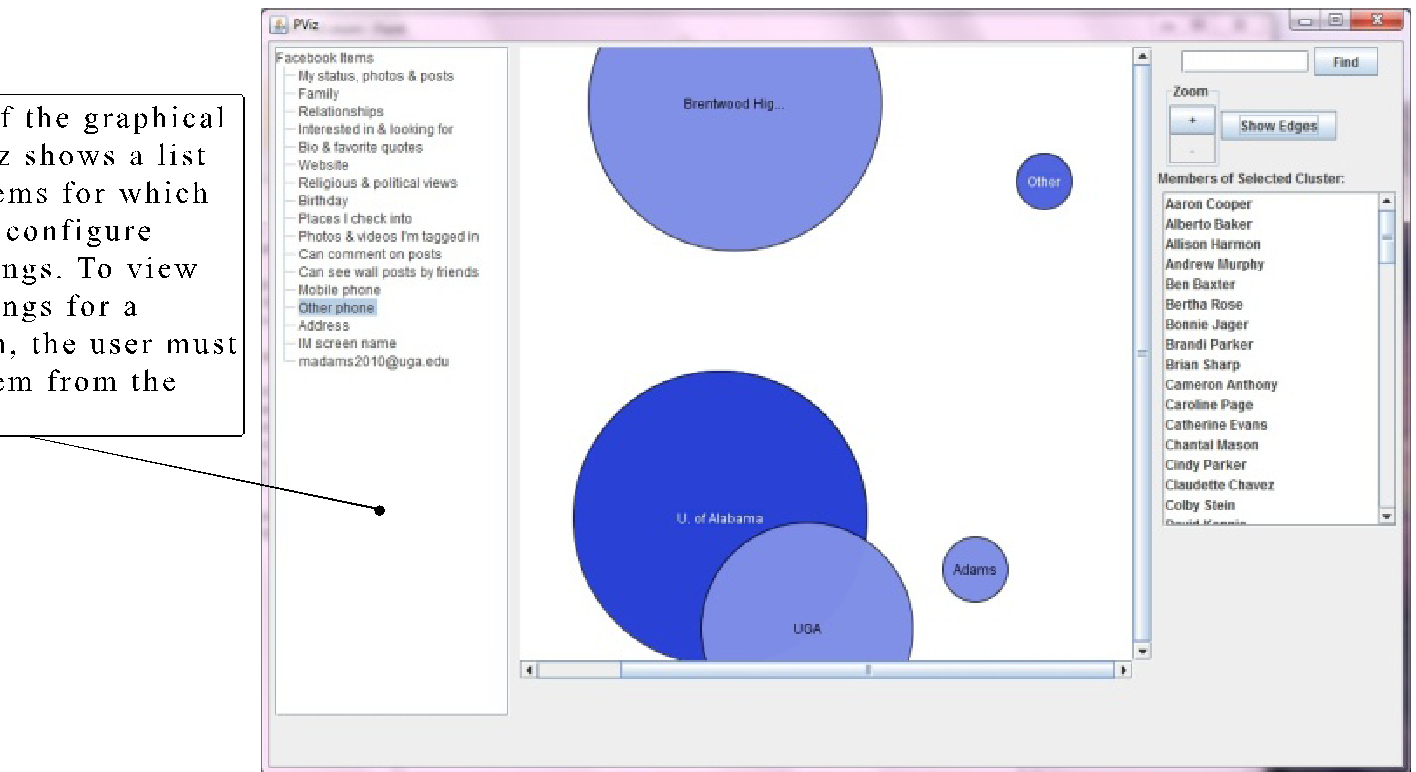 Figure 1: PViz hierarchical view, showing coarse granularity and the ability to drill down into specific sub-communities like "Brentwood High School".
Experiments: Accuracy Over Speed
The team pitted PViz against the industry standards of the time. While "Audience View" was slightly faster for checking a single person, PViz was the clear winner for Group Tasks.
- Accuracy Boost: PViz significantly increased the probability of a user correctly identifying privacy leaks in large groups.
- Conflict Resolution: In scenarios with conflicting privacy rules (e.g., "Show to Friends" but "Hide from High School List"), PViz made the final "visibility truth" immediately obvious through color intensity.
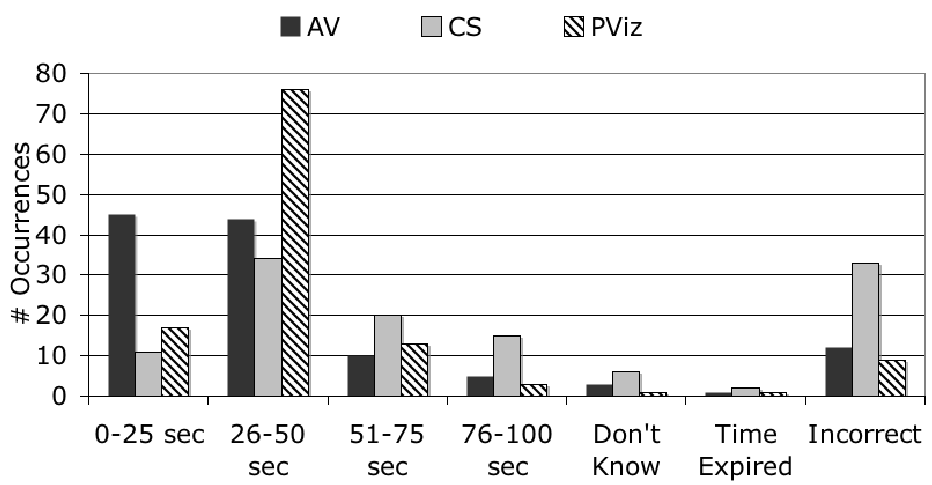 Figure 2: Statistical comparison of Single Tasks vs. Group Tasks. Note the significantly higher error rates for Group Tasks in traditional tools (AV/CS) compared to PViz.
Deep Insight: Beyond Comprehension
One of the most powerful features added in PViz 2.0 was Outlier Detection. If 95% of your "Work" group is blocked from seeing a photo, but 5% can see it, PViz highlights that node in Red. This "Privacy Mirror" effect forces users to confront accidental exposures they didn't even know existed.
Critical Analysis & Conclusion
Takeaway
PViz succeeds because it addresses the "Policy Comprehension Problem"—it doesn't just show you the rules; it shows you the outcome of the rules. By using structural network analysis to group friends, it reduces a list of 500 individuals into 5-10 meaningful clusters.
Limitations
- Dynamic Networks: The study was conducted on static snapshots. In the real world, social networks shift; names and groups change.
- Default Bias: As the authors noted, many users never change default settings. No tool can help if the user has no motivation to use it.
The Future
The authors suggest that PViz isn't just for seeing settings, but setting them. Imagine dragging a "Privacy: Private" tag onto a whole cluster in a single motion. In an era of AI-driven social graphs, the "Group-based" paradigm of PViz is more relevant than ever for reclaiming our digital privacy.
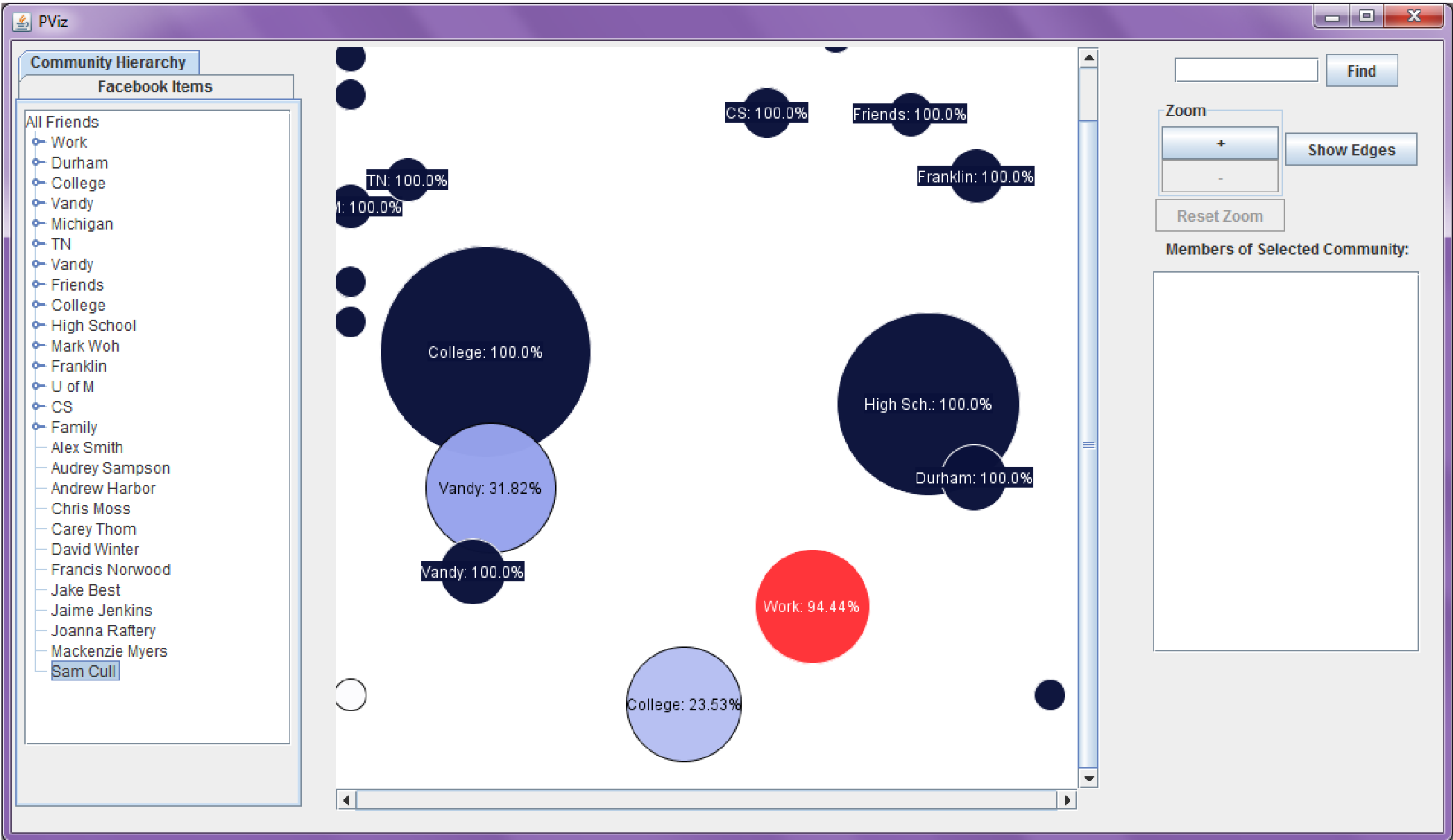 Figure 3: PViz 2.0 interface showing the outlier alert (red node) and the integrated expandable tree for easier navigation.