
Pythia: Restoring Privacy to the "Village Model" of Social Search
Pythia: A Privacy Aware, Peer-to-Peer Network for Social Search
Pythia is a decentralized, peer-to-peer (P2P) architecture designed for "live social search" that enables users to ask and answer questions while preserving privacy. It utilizes a combination of social network partitioning into "flood zones," onion routing, and dummy traffic to achieve anonymity and unobservability in a village-model search context.
TL;DR
Pythia is a decentralized P2P network that allows users to perform "live social search"—asking real humans for help instead of just searching documents—without sacrificing their privacy. By combining social-aware clustering with onion routing and traffic padding, Pythia prevents both central authorities and network peers from definitively linking specific interests or expertise to individual identities.
Background: The Library vs. The Village
In the digital age, we've moved from the Library Model (searching static indexed documents like Google) to the Village Model (asking the community for real-time expertise). However, centralized platforms like Aardvark or Facebook Questions present a massive privacy risk: they know exactly what you are curious about and what you are an expert in.
If you want to ask a sensitive health question or field a query about political activism, a centralized server is a "single point of failure" for your anonymity. Current tools like Tor don't work here because social search needs to know who is "near" you in the social graph to provide high-quality, trusted answers.
The Core Challenge: Selective Exposure
The fundamental tension is this: How do you reveal enough of the social structure to route a message to a friend-of-a-friend, without revealing who everyone is?
Pythia solves this by introducing Controlled Flooding within Anonymizing Communities.
Methodology: The Pythia Architecture
Pythia’s architecture is built on three pillars:
- Social Communities (Flood Zones): The global social network is partitioned into smaller clusters (e.g., ~100-1000 nodes). This keeps the "human" quality of the search by finding experts relatively close to the asker (typically within 3 hops).
- Onion Routing within the Cluster: Instead of sending a question directly, a user sends it through a 6-hop onion circuit within their community to a "representative." This ensures that even the representative doesn't know who the original asker was.
- Unobservability via Dummy Traffic: Every node sends a message (either a real question/answer or a dummy packet) at every time interval. To an outside observer (or even a global eavesdropper), the network looks like a constant, rhythmic pulse of data, making it impossible to tell who is actually active and who is just idling.
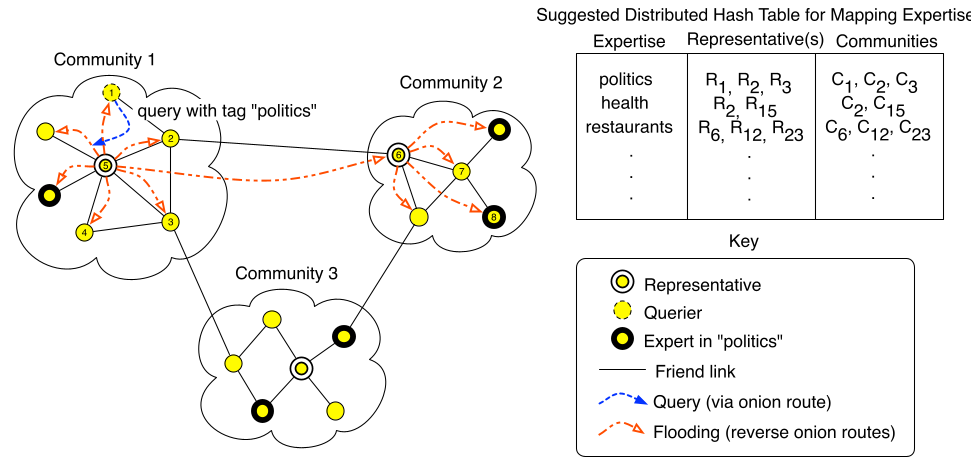 Figure 1: The routing logic showing how Node 1 uses an onion route to social-search privately across communities.
Performance and Privacy Analysis
The authors evaluated Pythia against four types of adversaries, ranging from local colluding nodes to global eavesdroppers who can link messages based on writing style (stylometry).
- Traffic Scalability: Even with 10,000 nodes in a community, the representative only handles ~17MB of traffic. For typical communities of hundreds, the overhead is negligible—a critical win for P2P scalability.
- Plausible Deniability: Under the "Unlinkable" model—where an attacker cannot prove two messages came from the same person—Pythia maintains a "precision" rate of 0.1. This means an attacker identifying you as an expert is no better than guessing within a small crowd.
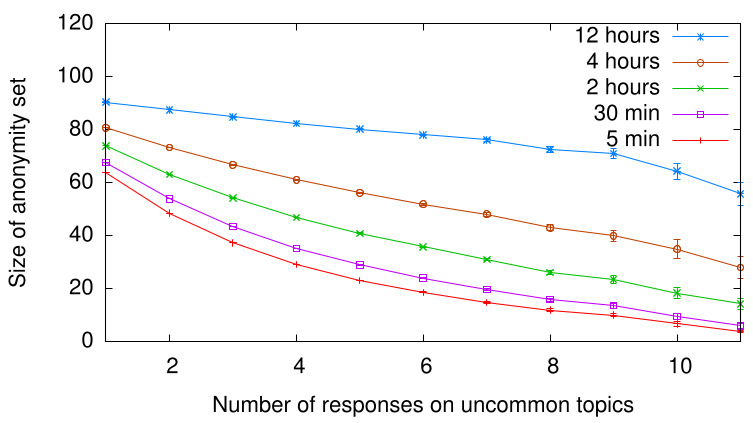 Figure 2: Experimental results showing how anonymity sets degrade over time if an attacker can link messages by content style.
Critical Insight: The Stylometry Threat
One of the most profound takeaways from the paper is that anonymity is not just a network layer problem. As shown in Figure 2, if an adversary can link your responses together via your unique writing style (Linkable-Adversary), your anonymity "set" shrinks rapidly over 4 weeks. This highlights a future need for "privacy-aware writing" or automated obfuscation of text content in social search.
Conclusion
Pythia demonstrates that we don't need to give up our data to a tech giant to get answers from our social circles. By decentralizing the "village model" and using cryptographic routing, we can build a world where "expertise unlinkability" protects activists, patients, and even the "ignorant" asker alike.
Future Directions: The authors suggest that "shielding sets" (only asking questions when a specific set of users are online) and decentralized reputation systems (using anonymous digital cash) are the next frontiers for truly robust social search.