
Beyond the Feed: Why Technical Tools Alone Can't Solve Knowledge Management
Qualitative analysis of a social knowledge management initiative in an inovation institute
This paper presents a qualitative analysis of a.m.i.g.o.s., a social knowledge management (SKM) platform implemented at C.E.S.A.R, a Brazilian innovation institute. The study maps Web-Based Social Network (WBSN) features to classic KM processes and evaluates their effectiveness in a professional R&D environment.
TL;DR
The paper investigates a social-network-based Knowledge Management (KM) initiative at C.E.S.A.R, a major Brazilian innovation institute. By deploying a.m.i.g.o.s., a platform mimicking social media dynamics (profiles, stories, tags), the institute sought to capture the "tacit" knowledge of its 400+ collaborators. While the technical implementation was sound, qualitative results highlight a critical "human-centric" gap: a tool is only as effective as the organizational culture that supports it.
Background: The Shift to Social KM
In innovative software environments, static databases and Wikis often become "data graveyards." The authors argue that Knowledge Management must shift from a purely system-oriented approach to a dynamic-oriented one. By using social networks, organizations can tap into informal interactions, allowing knowledge to emerge naturally through "stories" and community dialogues.
Methodology: Mapping Social Features to KM Lifecycle
The authors didn't just build a social network; they mapped it to the theoretical framework of Bose (2004). This ensures that every "like" or "post" serves a structural purpose in the KM lifecycle:
- Creation & Capture: Handled via "Stories." Instead of dry technical docs, employees share success or failure narratives.
- Refinement & Storage: Occurs through community forums where dialogue creates a searchable, persistent history.
- Management: Replaces centralized "KM managers" with Folksonomies (user-driven tagging) and peer ratings.
- Distribution: Uses an automated recommendation engine that monitors user activity to suggest relevant content, breaking the "information silo" effect.
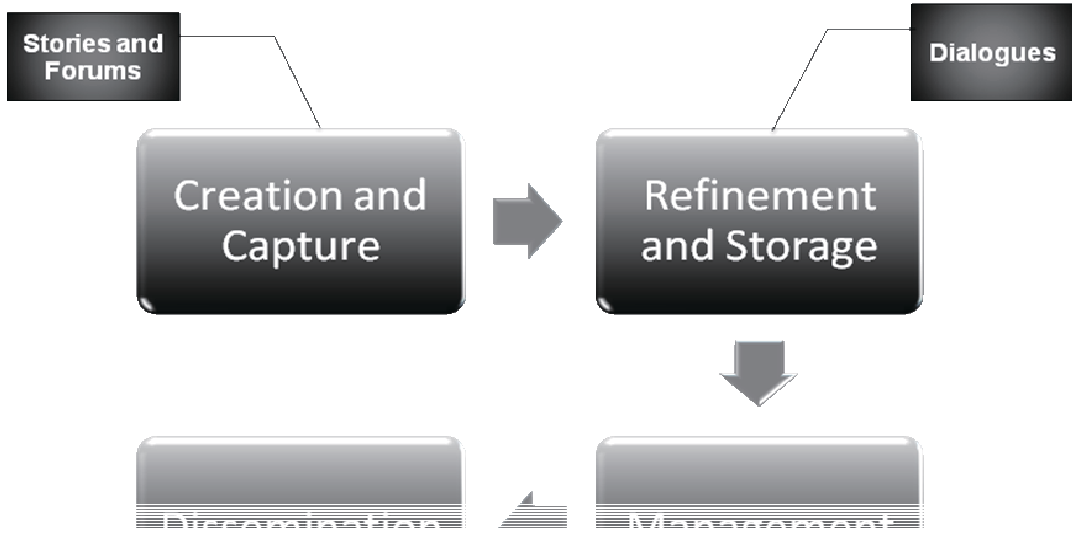 Figure 1: The mapping of social functionalities to the four stages of the KM process.
Qualitative Insights: The "Culture Gap"
The study interviewed 19 "power users" and veterans (avg. 12 years experience) to measure effectiveness. The results reveal a stark contrast between tool satisfaction and process success.
Key Findings:
- High Tool Acceptance, Low Cultural Integration: Users liked the interface and the project modules, but struggled to know what to post.
- The "Fear factor": Employees expressed hesitation about writing for the entire organization, fearing judgment or breaking unspoken rules.
- The Importance of Institutional Support: Strong points included the fact that the institute officially recognized time spent on the platform as "valuable work."
| Weak Point | Frequency Cited |
|---|---|
| Absence of a culture of use | 13 |
| Usability | 7 |
| Integration with other tools | 3 |
| Content Quality | 1 |
Deep Insight: The "Social" in Social KM
The authors conclude that the "Social" aspect of the tool is a double-edged sword. While it facilitates rapid sharing, it introduces social anxiety and ambiguity. The primary "bug" in the system wasn't in the code, but in the policy of use.
For a KM initiative to reach SOTA (State-of-the-Art) effectiveness, the organization must define:
- Conduct Rules: What is safe to share?
- Incentives: Why should an engineer take 20 minutes to write a "Story" instead of coding?
- Education: Employees need to see KM not as an "extra task," but as a core part of their professional growth.
Conclusion
This paper serves as a vital reminder for tech leaders: Software is the easy part. To turn an organization into a "Knowledge Enterprise," one must debug the corporate culture with the same rigour applied to the codebase. The a.m.i.g.o.s. experiment proves that social mechanics are the future of KM, provided they are backed by clear institutional guidelines and a fearless culture of transparency.
Future Work
The authors are now focusing on a "Policy of Use" framework and better integration with daily developer tools (IDE/E-mail) to reduce the friction of knowledge capture.