
Decoding Cross-Cultural Friction: The VTIO Model and the Future of International Joint Ventures
On the Qualitative Research Approach and Application of the "VTIO" Model Based on Cultural Differences - A Case Study of Changan Ford Mazda Automobile Co., Ltd
This paper introduces the "VTIO" model (Value, Thinking mode, Interpersonal relationship, and Organizational behavior) to analyze cross-cultural management challenges in Sino-foreign joint ventures. Using a qualitative case study of Changan Ford Mazda Automobile Co., Ltd (CFMA), it identifies how "sentiment, ethics, and law" drive cultural conflicts between Chinese, American, and Japanese management styles.
TL;DR
Why do nearly 40% of international joint ventures fail? It’s rarely about the technology—it's about the "people logic." This paper proposes the VTIO Model, a framework that deconstructs cultural differences into four dimensions: Value, Thinking mode, Interpersonal relationship, and Organization. By examining the trilateral culture of Changan Ford Mazda (China-US-Japan), the authors reveal how the fundamental core of "sentiment, ethics, and law" dictates organizational productivity.
The "Cultural Core" Problem
Traditional management theories often treat culture as a static set of scores (like Hofstede's index). However, this paper argues that culture is a living byproduct of a society’s production mode.
The authors identify a persistent failure in Sino-foreign joint ventures: 15% terminate prematurely due to inharmonious cooperation. The friction arises because Western models, focused on individualism and "Law," collide with Chinese models rooted in "Sentiment" (Guanxi) and the "Doctrine of the Mean" (Centeredness).
Methodology: The VTIO Framework
The VTIO model was built through a rigorous qualitative process. After analyzing over 8,000 data points from articles and BBS comments, the researchers used the Delphi method—iterative consultation with a panel of experts across sociology, economics, and business—to narrow down the most influential representations of culture.
The hierarchy of the VTIO model is as follows:
- Economic Base: Production Mode.
- Cultural Core: Sentiment (soft), Law (hard), and Ethics (the mediator).
- Representations (VTIO):
- V (Value): Materialism vs. Spiritualism.
- T (Thinking): Imagery (holistic) vs. Quantitative (analytical).
- I (Interpersonal): Obligatory circles vs. Free choice.
- O (Organization): Seniority and dependency vs. Talent-based competition.
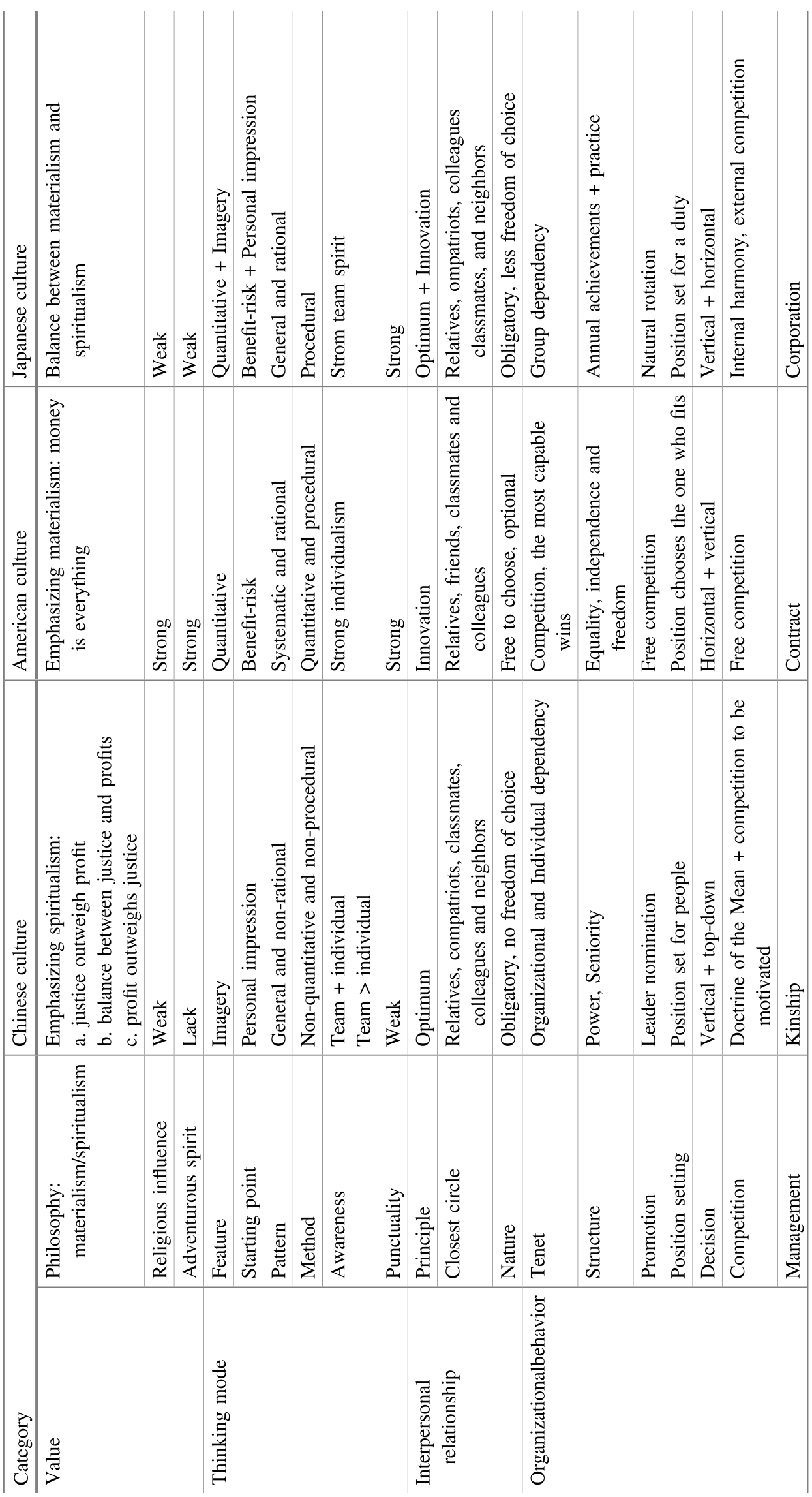
Deep Dive: The Changan Ford Mazda (CFMA) Case Study
The study provides a fascinating look at CFMA, a melting pot of Chinese, American, and Japanese management styles.
1. Conflict in Accountability
At CFMA, American managers divide tasks with surgical precision. Chinese employees, however, often perceive this "clarification" as indifference. Conversely, the American managers view the Chinese hesitation to ask for help as a lack of initiative.
2. The Psychology of Punishment
Should a mistake be publicized?
- Chinese View: Publicizing punishment serves as a "useful warning" to the group (Ethics/Law balance).
- American View: This violates privacy and destroys self-esteem (Individualism). This seemingly small operational difference stems from deep-seated views on the status of "the self" versus "the group."
3. Decision-Making Speed
The study highlights the Responsibility-Right-Interest imbalance.
- US: High individual empowerment allows American managers to make lightning-fast decisions.
- China/Japan: Collective responsibility leads to cautious, slower, top-down or consensus-based decisions, which can frustrate Western partners in fast-paced markets.
Critical Insight: Integrating Complexity
The paper’s greatest contribution is the realization that "transplanting" management styles is a recipe for disaster. The "Doctrine of the Mean" in Chinese culture is not a lack of opinion, but a pursuit of social equilibrium.
To thrive, a joint venture must build a Third Culture:
- Combine Imagery Thinking (valuable for reading market sentiment) with Quantitative Thinking (essential for production efficiency).
- Transition from Traditional Collectivism to Modern Cooperation Spirit, where individuals are empowered but remain aligned with the group’s success.
Conclusion
The VTIO model serves as a "cultural diagnostic tool." For researchers and practitioners, the takeaway is clear: understanding the Why (production mode and historic sentiment) is far more important than reacting to the What (a disagreement in a meeting). By creating a "universal cultural system" within the enterprise, joint ventures can turn cultural friction into a competitive advantage.