
Beyond the Click: Assessing Crowdwork Quality via the Windows of the Soul
Quality Assessment of Crowdwork via Eye Gaze: Towards Adaptive Personalized Crowdsourcing
2021-01-01
Summary
Problem
Method
Results
Takeaways
Abstract
This paper introduces a novel framework for the rapid quality assessment of crowdwork by estimating the correct answer rate using eye gaze information. The authors propose a Self-Supervised Learning (SSL) approach to extract diagnostic gaze features, achieving State-Of-The-Art (SOTA) performance in predicting task accuracy without needing human evaluation.
## Executive Summary
**TL;DR**: Researchers from Osaka Prefecture University have developed a way to predict how accurately a crowdworker is performing by looking at their eyes. By applying **Self-Supervised Learning (SSL)** to eye-gaze data, they can estimate the "correct answer rate" of a worker with high precision (MAE 0.09), paving the way for platforms that adapt to a worker's actual skill levels in real-time.
**Academic Positioning**: This work moves beyond simple "behavioral fingerprinting" (like mouse clicks) toward **biometric-aware quality assurance**. It addresses the challenge of label-scarcity in deep learning by leveraging SSL on a large unlabeled dataset of gaze patterns.
---
## The Problem: The High Cost of Trust
Crowdsourcing is the engine behind AI, yet "quality control" remains its Achilles' heel. Currently, task providers use two main (and flawed) methods:
1. **Gold Standards**: Mixing in questions with known answers (expensive to produce).
2. **Consensus**: Having multiple people do the same task (expensive to pay for).
When workers fail, they are often blocked or denied pay entirely. This is inherently unfair to "low-skill" but honest workers who might be struggling with a specific task type. The authors ask: *Can we sense the quality of work implicitly, as it happens, without needing the answer key?*
---
## Methodology: Capturing Cognitive Fingerprints
The core insight of this paper is that **eye gaze is a proxy for confidence**. When we are unsure of an answer, our eyes dance between choices and the question in predictable, non-linear patterns.
### 1. Handcrafted vs. Automated Features
The authors compared traditional metrics (Fixation counts, Saccades, answering time) against a deep learning approach. While features like "answering time" are helpful, they don't capture the nuance of *how* a person processes information.
### 2. The SSL Pipeline
To train a deep model without thousands of labeled "correct/incorrect" gaze samples, the authors used **Self-Supervised Learning**:
* **Gaze-to-Image**: They transformed raw (x, y) coordinates of eye movement into 64x64 images.
* **Pretext Tasks**: They trained a CNN to recognize if a gaze-image had been rotated or reflected. This forced the model to learn the structural "shape" of human reading and searching behavior.
* **Fine-tuning**: The model was then tuned on a smaller labeled set to predict if a task was answered correctly.
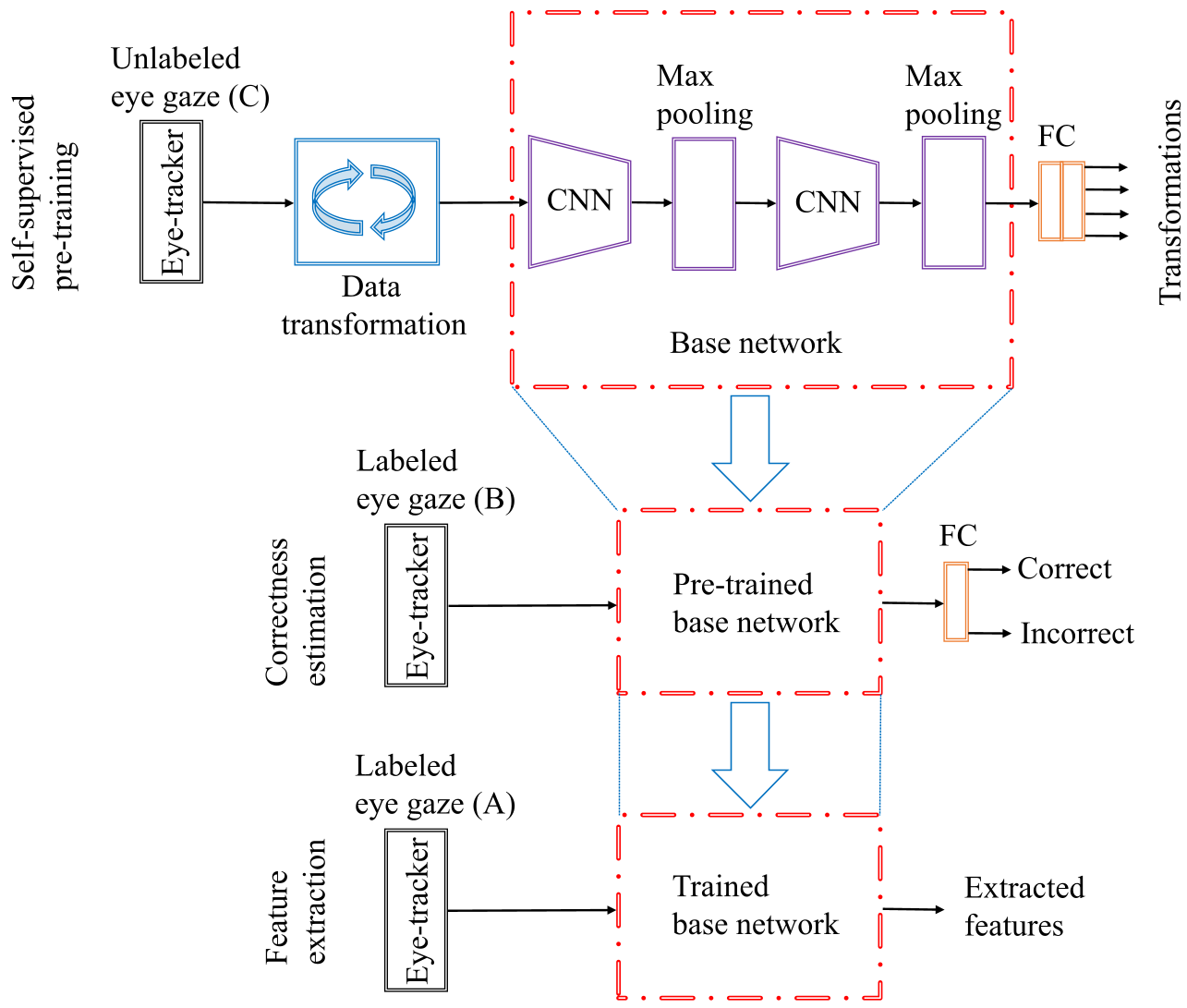
*Caption: The proposed SSL architecture, moving from pretext rotation tasks to correctness estimation.*
---
## Experimental Insights
The study used three datasets (A, B, and C) totaling over 68,000 samples, ranging from high schoolers to university students.
### Key Findings:
* **Window Size Matters**: For a single task, prediction is hard. However, as the "window" of observed tasks grows, the accuracy of the quality estimation improves significantly.
* **SSL Dominance**: The SSL-generated features outperformed every handcrafted combination. Even "Confidence labeling" (where the worker tells you how sure they are) wasn't as effective as the implicit signals extracted by the CNN.
*Caption: Results showing the SSL method (lowest line) achieving the minimum error rate as the observation window increases.*
---
## Critical Analysis & Future Outlook
### Value to the Field
This research provides a roadmap for **Adaptive Personalized Crowdsourcing**. If a platform detects (via gaze) that a worker’s accuracy is dropping, it could dynamically:
* Provide a hint or a tutorial.
* Switch the worker to a different task type that better suits their current cognitive state.
* Adjust the pay rate dynamically rather than rejecting the work.
### Limitations
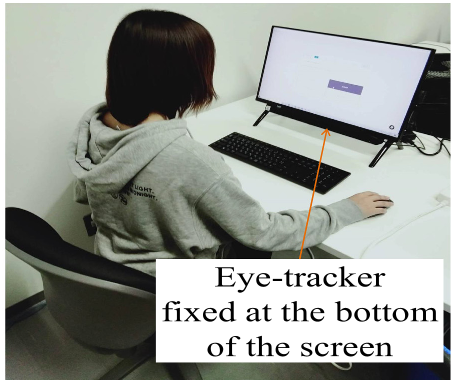
1. **Hardware Dependency**: While eye-trackers are becoming cheaper (like the Tobii 4C used here), they are not yet standard in the average crowdworker's home setup.
2. **Privacy Concerns**: The authors briefly mention ethics, but collecting biometric gaze data at scale raises significant privacy and "bossware" surveillance concerns that must be addressed before deployment.
## Conclusion
By treating eye gaze as a "richer fingerprint," Islam et al. have demonstrated that we can evaluate the *work*, not just the *worker*. This shift from punitive monitoring to diagnostic assessment could make the future of digital labor both more efficient and significantly more humane.