
Decoding Implicit Collaboration: A Big Data Approach to Wikipedia Quality
Quality Assessment of Peer-Produced Content in Knowledge Repositories Using Big Data and Social Networks: The Case of Implicit Collaboration in Wikipedia
This paper introduces "Implicit Collaboration," a novel framework for assessing the quality of peer-produced content in knowledge repositories like Wikipedia. By modeling editor interactions through social network analysis (SNA) and big data, the author achieves a significant leap in automated quality grading accuracy (SOTA).
TL;DR
Wikipedia's growth has far outpaced its ability to manually review article quality. This paper presents a breakthrough by defining Implicit Collaboration—the hidden network of how editors "work together" without knowing each other. By analyzing these dyadic relationships through social networks, the author created a model that predicts article quality with 90.16% accuracy, outperforming previous strategic and content-based models.
Context: The Manual Bottleneck
In the world of peer-produced content, quality is king. However, at Wikipedia's scale (~6 million English articles), the "Featured Article" (FA) badge is a rare honor held by only 0.1% of entries. The problem? The review process is human-intensive and subjective. While previous researchers looked at word counts or the "mix of roles" (e.g., who is a leader vs. a filler), they ignored the operational logic: the specific way two editors interact over an edit or a discussion thread.
The Core Insight: Implicit Collaboration
The author, Srikar Velichety, argues that collaboration isn't just about being in the same room; it’s about modifying someone else's contribution. He breaks this down into four quadrants:
- Within-Edit: Precedence relationships (X changed Y's sentence).
- Across-Edit: Experience brought from other articles.
- Within-Discussion: Comment-reply chains on talk pages.
- Across-Discussion: Collaborative dialogue experience across the repository.
Methodology: From Networks to Quality
The research transforms these interactions into Social Networks.
1. Model Architecture
For "Within-Article" actions, the author builds directed graphs where nodes are editors and edges are changes. The weights reflect functional diversity (e.g., did they change a link, a reference, or a whole sentence?).
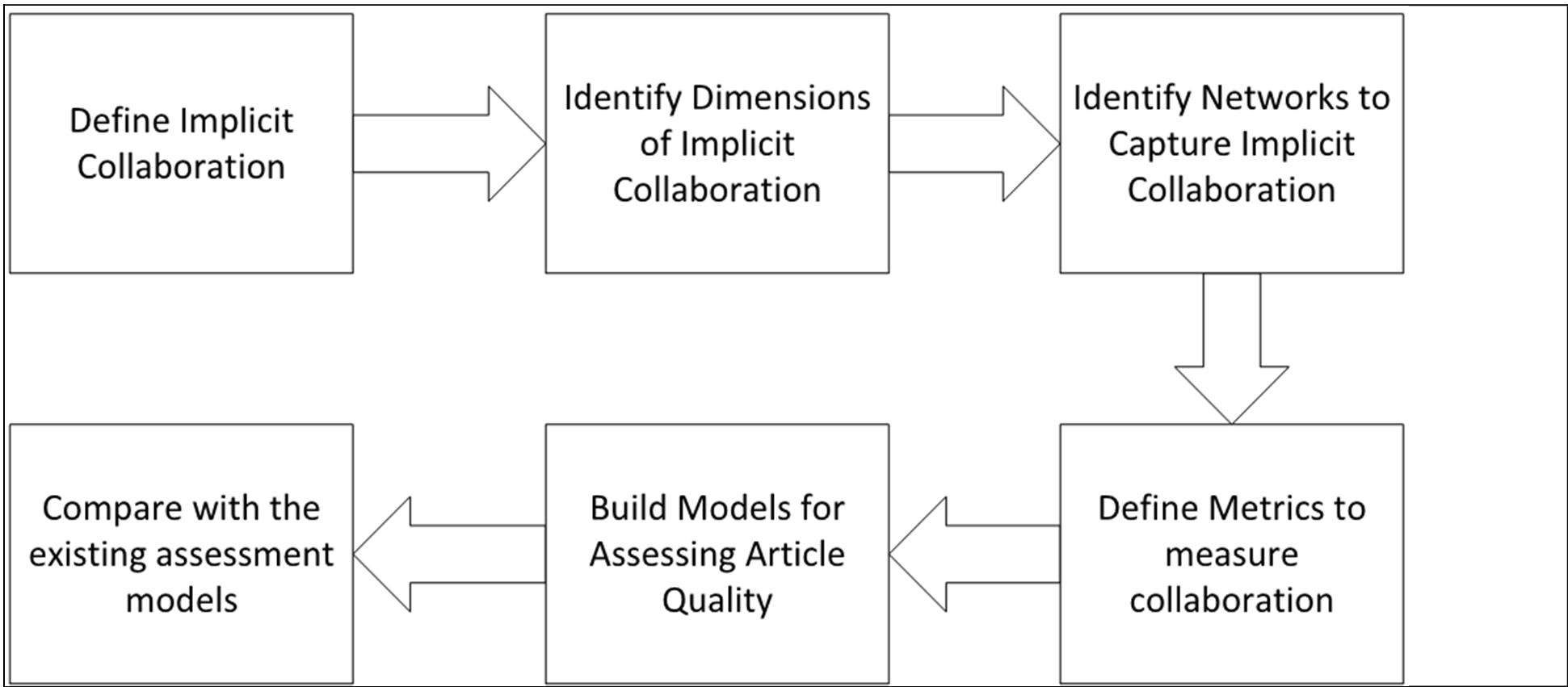 Figure 1: The overarching workflow from defining implicit collaboration to quality prediction.
2. Deep Structural Measures
The paper doesn't just look at who edited most. It uses sophisticated SNA metrics:
- Assortativity Significance Profile (ASP): Do elite editors prefer to edit other elite editors' work?
- Community Analysis: Using the Girvan-Newman algorithm to detect "working groups" within an article's history.
- Bipartite (Two-Mode) Networks: Linking editors to articles to see how much shared history a pair of users has.
Experimental Results: A 90% Success Rate
The study used the entire population of graded English Wikipedia articles—a massive dataset of ~1TB.
Key Performance Gains
- Combined Power: When "Article Characteristics" (word count, etc.) are combined with "Implicit Collaboration" features, accuracy jumps to 90.16%.
- The "Across-Article" Advantage: Interestingly, the number of common articles a pair of editors worked on previously was the single most powerful predictor of success (3.41% accuracy gain on its own).
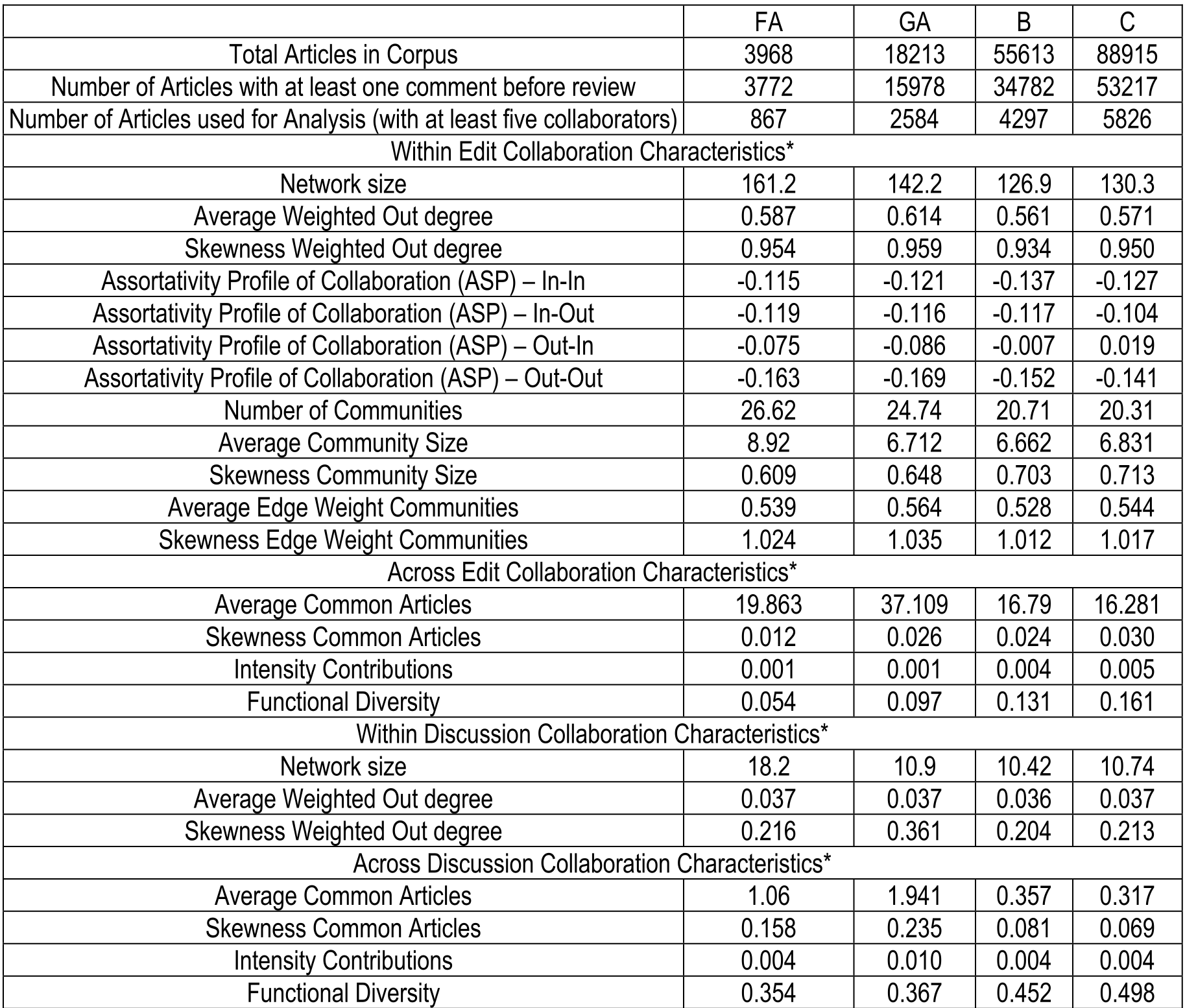 Table 2: Comparative characteristics across quality grades (FA, GA, B, C). Note the higher network sizes for high-quality articles.
Critical Insight: Why it Works
The "Fluidity" perspective focuses on the strategic (general turnover of editors). This paper focuses on the operational (dyadic ties). High-quality content isn't just the result of "many eyes"; it's the result of high-intensity, diverse modifications between specific pairs of experienced editors.
Conclusion & Application
This research proves that the "footprints" of collaboration are better indicators of quality than the content itself.
Future Outlook:
- Beyond Wikipedia: This methodology can be applied to Open Source Software (OSS). Imagine an automated tool that flags "low-quality" code merges based on the lack of implicit collaboration between the coder and the reviewer.
- Limitations: The model currently treats all modifications as "improvements" (after filtering vandalism). It doesn't yet account for "edit wars" where two users might be trapped in a negative feedback loop.
In an era of AI-generated content, understanding the nuanced, human collaboration patterns that produce "Featured" quality information is more vital than ever.