
Meal-Mate Networks: Quantifying Social Capital through the Lens of Academic Dining
A Quantitative Measure for Meal-Mate Social Capital Networks
This paper introduces a quantitative framework to measure social capital within a "meal-mate" social network using student dining records. By defining the concepts of "Invested Social Capital" (TIC) and "Return of Social Capital" (TRC), the authors analyze bidirectional social values and demonstrate that gender and seniority significantly influence social capital distribution.
TL;DR
This study transforms the everyday act of "having a meal" into a measurable metric of social influence. By analyzing student dining data at Shanghai Jiao Tong University (SJTU), the researchers developed a mathematical framework to calculate Invested Social Capital and Return of Capital. They discovered that social power isn't just about how many people you know, but the structural asymmetry of your choices versus your peers'.
Background: Beyond Simple Connections
In the world of graph theory, we often treat "friends" as vertices connected by simple lines. However, human relationships are rarely equal. One person might invest more time, emotion, or "social credit" than the other. This paper bridges the gap between Sociology (Social Capital Theory) and Computer Science (Network Analysis) to answer a fundamental question: Can we put a number on the social value generated by human interaction?
The "Bargaining Power" Insight
The core motivation of the authors is rooted in the Nash Bargaining Game and the Principle of Least Interest.
- The Logic: If you have many potential meal mates (outside options), you have higher bargaining power.
- The Consequence: The person who "cares less" about a specific connection—because they have many other choices—holds more social capital in that specific relationship.
Methodology: The Math of Social Influence
The researchers treated the dining network as a weighted graph . They moved from simple abstractions to complex entropy models:
- Local Weight (): Usually based on the frequency of dining together.
- Global Adjustment (): This factor "penalizes" or "boosts" the value based on the degrees (number of connections) of the two people involved.
Architectural Framework
The authors propose three methods for calculation: Count, Percentage, and Entropy. The Entropy method is the most sophisticated, as it considers the uncertainty and diversity of a person's entire contact list.
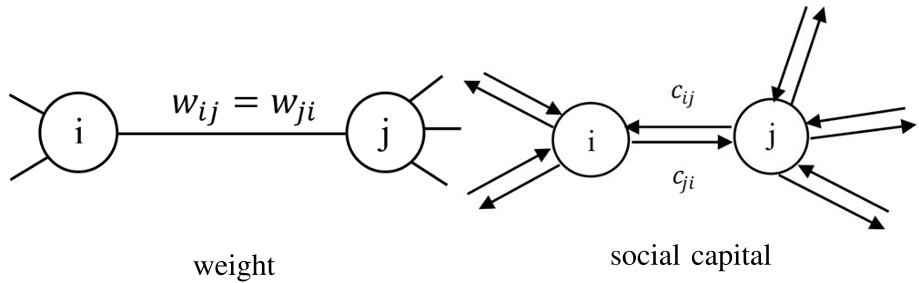 Figure 1: Visualizing how interaction weight translates into directed social capital and .
Core Findings: Inequality and Dynamics
The study applied these formulas to a campus dataset spanning one semester. Two key findings emerge:
1. The Gender Gap in Social Capital
In a network where men significantly outnumber women, the "Bargaining Power" shifts. The study found that females receive more social capital per edge than males. Since women have more "outside options" (relatively) in this specific demographic, their social position is mathematically more powerful.
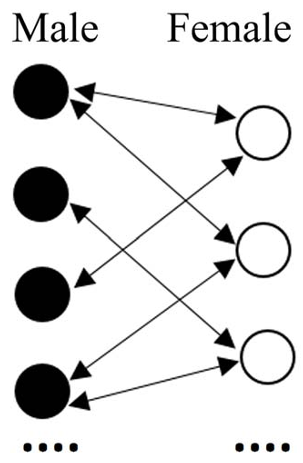 Figure 2: The bipartite representation of social capital flow between genders.
2. Seniority and Accumulation
Social capital isn't static. For undergraduate students, the "Invested Social Capital" (AIC) rises sharply over four years. Interestingly, the gap between Investment and Return widens over time, suggesting that social inequality intensifies as social networks mature.
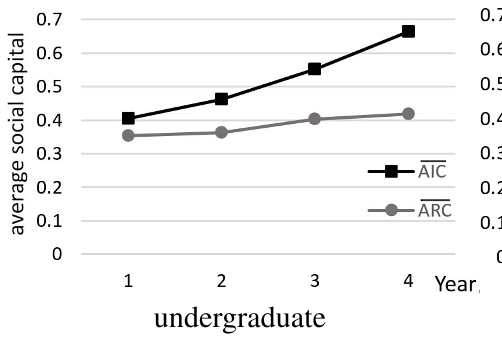 Figure 3: Average social capital growth for undergraduate vs. graduate students.
Critical Analysis & Takeaways
The paper's most significant contribution is the proof that Average Invested Capital (AIC) > Average Return of Capital (ARC) under certain network conditions. This suggests that the "overhead" or the "cost" of maintaining a social network is shared by all participants, but distributed unevenly.
Limitations: The current model assumes social capital is strictly a function of the two nodes at the ends of an edge. In reality, "Structural Holes"—the ability to act as a bridge between two separate groups—provides a social boost that this model might under-calculate. Future work involving "social fluidity" could address this.
Conclusion: By applying financial and information-theoretic concepts to social behavior, this research provides a template for organizations to measure "connectedness" and "influence" objectively, moving social capital from a vague feeling to a hard number.